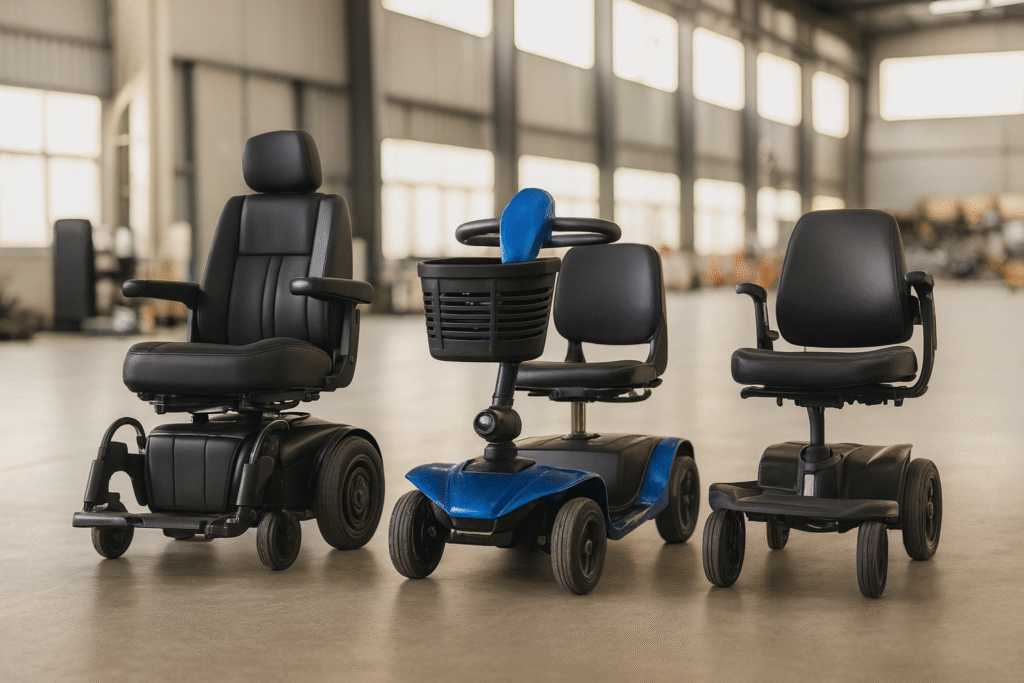
Electric Wheelchair Battery Regulations & Air Travel Compliance: A Complete Guide for Exporters
Quick Answer: Electric wheelchair lithium batteries face strict air transport regulations: IATA limits installed batteries to 300 Wh (160 Wh each for dual-battery systems), requires UN38.3 testing compliance, and mandates terminal protection and advance airline notification. Exporters must design products with removable batteries, proper labeling, and complete documentation to ensure smooth air freight and end-user air travel.
Last updated: August 2026
For electric wheelchair manufacturers and exporters, lithium battery compliance is not just a regulatory checkbox—it is a critical factor that determines whether your products can be shipped by air freight, whether end-users can travel with them, and ultimately, whether distributors will stock them. Non-compliant batteries can result in cargo seizures, airline rejections, customer complaints, and significant financial losses.
This comprehensive guide covers every aspect of electric wheelchair battery regulations: IATA and FAA rules, UN38.3 testing requirements, airline-specific policies, air vs. sea freight cost comparisons, and practical design considerations for manufacturers. Whether you are shipping bulk orders internationally or designing products for travel-friendly end-user use, this guide provides the compliance framework you need.
IATA Dangerous Goods Regulations: The 2026 Framework
Overview of Applicable Rules
Die International Air Transport Association (IATA) publishes the Dangerous Goods Regulations (DGR), updated annually. The 67th Edition (2026) governs current requirements for battery-powered wheelchairs and mobility aids. These regulations align with the ICAO Technical Instructions (2025–2026 edition) and apply to both passenger-carried mobility aids and cargo shipments.
Battery-powered wheelchairs are classified under UN 3481 (Lithium ion batteries contained in equipment) when the battery is installed in the wheelchair. The regulations distinguish between three battery types, each with different requirements:
Lithium-Ion Battery Requirements
For wheelchairs and mobility aids powered by lithium-ion batteries, the 2026 IATA DGR specifies:
| Parameter | Requirement |
|---|---|
| Maximum installed battery capacity | 300 Wh (single battery) |
| Dual-battery systems | 160 Wh per battery (maximum 2 batteries) |
| Spare battery limit | 1 × 300 Wh or 2 × 160 Wh |
| Spare battery location | Carry-on baggage only (never checked) |
| State of charge (batteries >100 Wh) | ≤30% |
| Terminal protection | Mandatory (insulated or enclosed) |
| UN38.3 compliance | Required for all lithium batteries |
| Advance notification | 48–72 hours before flight |
These requirements apply to passenger travel with mobility aids. For cargo shipments (B2B freight), different rules under UN 3480/UN 3481 apply, with additional packaging and labeling requirements.
Non-Spillable (Sealed Lead-Acid) Batteries
Sealed lead-acid (SLA) batteries, while less common in modern electric wheelchairs, are still used in some heavy-duty models. Under IATA Special Provision A67, non-spillable batteries must pass:
- Vibration test: Harmonic motion at 0.8mm amplitude, 10-55 Hz frequency sweep
- Pressure differential test: 88 kPa pressure differential for 6 hours in three positions
If the wheelchair can be loaded, stowed, secured, and unloaded in an upright position, the battery may remain installed. Otherwise, it must be removed and packaged separately with leak-proof, absorbent material.
Key Changes in the 2026 Edition
The 67th Edition (2026) introduced several updates relevant to mobility aid exporters (DGO Online Training):
- Reinforced operator approval requirement: Airlines must approve carriage of battery-powered mobility aids in advance, with a recommended minimum dataset including manufacturer, model, battery type, UN 38.3 compliance confirmation, weight, and dimensions
- Tightened spare battery rules: Each spare lithium battery must be individually insulated and carried in the passenger cabin—checked luggage is strictly prohibited
- Enhanced documentation requirements: Operators may request battery specification sheets, UN38.3 test summaries, and manufacturer compliance declarations
- Training requirements: Aircraft and airport operators must ensure staff are trained on handling battery-powered mobility aids
UN38.3 Testing: The Eight Mandatory Tests
What is UN38.3?
UN38.3 refers to Section 38.3 of the UN Manual of Tests and Criteria, which establishes the global standard for lithium battery transport safety. Every lithium battery used in electric wheelchairs—whether shipped installed in equipment or separately—must pass all eight tests before international transport.
The Eight Tests Explained
| Test | Name | What It Tests | Key Parameters |
|---|---|---|---|
| T.1 | Altitude Simulation | Low-pressure stability | ≤11.6 kPa for 6+ hours |
| T.2 | Thermal Test | Temperature cycling resistance | -40°C to +72°C, 10 cycles |
| T.3 | Vibration | Transport vibration endurance | 7-200 Hz sweep, 3 axes, 3 hours |
| T.4 | Shock | Impact resistance | 50g/11ms or 150g/6ms, 18 shocks |
| T.5 | External Short Circuit | Short-circuit safety | ≤55°C, no disassembly/fire |
| T.6 | Impact/Crush | Physical impact safety | No fire, no disassembly |
| T.7 | Overcharge | Overcharging safety | 2x rated current to 2x max voltage |
| T.8 | Forced Discharge | Deep discharge safety | No disassembly, no fire |
Pass Criteria
A battery passes UN38.3 testing if, after all eight tests:
- No mass loss exceeding 0.1% (for cells) or 0.2% (for batteries)
- No leakage, venting, disassembly, rupture, or fire
- Voltage remains within 10% of pre-test voltage (for rechargeable batteries)
If batteries are shipped separately from equipment (not installed in the wheelchair), they must also pass a 1.2-meter free drop test.
Obtaining UN38.3 Certification
Manufacturers should work with accredited testing laboratories (such as TÜV SÜD, UL, or Intertek) to obtain UN38.3 test reports. The process typically takes 2-4 weeks and costs $2,000-5,000 per battery model. Test reports must be renewed when battery designs change.
For B2B buyers, always request the UN38.3 test summary (not just the certificate) from manufacturers. The test summary includes specific test data that customs and airline officials may request.
FAA Regulations: US-Specific Requirements
Die Federal Aviation Administration (FAA) aligns with IATA regulations but adds US-specific enforcement:
- 49 CFR Parts 100-185: Governs hazardous materials transportation in the United States
- FAA enforcement: Airlines that violate battery regulations face significant fines (up to $75,000 per violation)
- TSA screening: The Transportation Security Administration screens mobility aids at checkpoints, requiring easy battery access for inspection
Practical Impact on US-Bound Shipments
For exporters shipping to the US market:
- All lithium batteries must have valid UN38.3 test reports
- Packaging must meet IATA Packing Instruction 967 (batteries contained in equipment) or 965 (batteries shipped separately)
- Shipments require a Shipper’s Declaration for Dangerous Goods for batteries shipped as cargo (Class 9)
- The lithium battery handling mark must be displayed on packages
Airline-Specific Policies: Variations Exporters Should Know
While IATA sets baseline regulations, individual airlines may impose stricter requirements. Key variations include:
Major Airline Policies
| Airline | Advance Notice | Battery Limitations | Special Requirements |
|---|---|---|---|
| Delta | 48 hours | 300 Wh installed, 160 Wh spare | Battery spec sheet required |
| United | 48 hours | 300 Wh installed, 160 Wh spare | Mobility aid form required |
| American Airlines | 48 hours | 300 Wh installed, 160 Wh spare | Dimensions required at booking |
| Lufthansa | 72 hours | 300 Wh installed, 160 Wh spare | German compliance documentation |
| Emirates | 48 hours | 300 Wh installed | MEDIF form required |
| Qantas | 48 hours | 300 Wh installed | Australian TGA documentation |
(Paiseec)
Recommendations for Exporters
Manufacturers should:
- Include a battery specification sheet with every wheelchair, listing voltage, amp-hour rating, watt-hour rating, UN number, and UN38.3 test reference
- Print battery labels clearly showing Wh rating and UN classification
- Provide airline notification templates that end-users can submit to airlines
- Design for easy battery removal so compliance checks don’t require disassembling the wheelchair
Air Freight vs. Sea Freight: Cost and Compliance Comparison
Cost Analysis
For B2B shipments of electric wheelchairs with lithium batteries:
| Factor | Air Freight | Sea Freight |
|---|---|---|
| Transit time | 5-10 days | 25-45 days |
| Cost per unit (bulk) | $80-200/unit | $15-50/unit |
| Documentation complexity | High (DGD, PI 967/965) | Moderate (MSDS, UN38.3) |
| Battery state-of-charge requirement | ≤30% | No restriction |
| Packaging requirements | UN-spec packaging | Standard export packaging |
| Insurance | Higher premiums | Lower premiums |
| Best for | Urgent samples, small orders | Bulk B2B orders (50+ units) |
When to Choose Air Freight
- Sample evaluation: First orders for quality assessment
- Urgent restocking: When inventory runs low and demand is high
- Trade show samples: When exhibiting at international trade shows like ATSA
- Small custom orders: Special configurations for VIP clients
When to Choose Sea Freight
- Standard B2B bulk orders: Regular inventory replenishment
- OEM/ODM production runs: Custom-branded products in volume
- Cost-sensitive markets: Where competitive pricing is critical
- Non-urgent deliveries: When lead times allow for 30-45 day transit
For most B2B distributors, a hybrid approach works best: sea freight for bulk inventory and air freight for samples and urgent replenishment. Learn more about OEM/ODM services for bulk production planning.
Design Considerations for Compliance
Battery Capacity Design
The 300 Wh IATA limit directly impacts product design. Common battery configurations for air-travel-compliant wheelchairs:
| Configuration | Voltage | Capacity | Watt-Hours | Air Travel Compliant? |
|---|---|---|---|---|
| 24V 10Ah | 24V | 10Ah | 240 Wh | Yes (under 300 Wh) |
| 24V 12Ah | 24V | 12Ah | 288 Wh | Yes (under 300 Wh) |
| 24V 13Ah | 24V | 13Ah | 312 Wh | No (exceeds 300 Wh) |
| 36V 10Ah | 36V | 10Ah | 360 Wh | No (exceeds 300 Wh) |
| 2 × 24V 6Ah | 24V each | 6Ah each | 144 Wh each | Yes (under 160 Wh each) |
Die 24V 12Ah (288 Wh) configuration has emerged as the industry standard for travel-compliant electric wheelchairs, offering adequate range (approximately 20-25 km) while staying comfortably under the 300 Wh limit.
Removable Battery Design
Designing wheelchairs with easily removable batteries provides several advantages:
- Airline compliance: Removed batteries can be carried as carry-on, simplifying gate handling
- Shipping flexibility: Batteries can be shipped separately under different regulations
- User convenience: Spare batteries can be swapped for extended range
- Maintenance: Easier battery replacement without returning the entire wheelchair
Terminal Protection
All battery terminals must be protected against short circuits. Acceptable methods include:
- Battery enclosure: Fully enclosed battery housing with no exposed terminals
- Insulating caps: Rubber or plastic caps over terminal connectors
- Recessed terminals: Terminals recessed within the battery housing
- Integrated circuit breakers: Automatic disconnection when not connected
Labeling Requirements
Each battery must display:
- Watt-hour (Wh) rating: Prominently labeled
- UN number: UN 3480 (standalone) or UN 3481 (contained in equipment)
- Lithium battery handling mark: Square symbol with overlaid lithium battery symbol
- Manufacturer name and contact information
- UN38.3 test reference number
Documentation Checklist for Exporters
For each shipment of electric wheelchairs with lithium batteries, prepare:
For Air Freight
- [ ] UN38.3 test report and summary (per battery model)
- [ ] Shipper’s Declaration for Dangerous Goods
- [ ] Lithium battery handling mark on each package
- [ ] Battery specification sheet (voltage, Ah, Wh, UN number)
- [ ] State-of-charge declaration (≤30% for batteries >100 Wh)
- [ ] Packing Instruction 967 compliance documentation
For Sea Freight
- [ ] UN38.3 test report and summary
- [ ] Material Safety Data Sheet (MSDS)
- [ ] Battery specification sheet
- [ ] Certificate of Origin (for customs)
- [ ] Commercial invoice with battery specifications
- [ ] Packing list with battery quantities and weights
For End-User Documentation
- [ ] Battery specification card (for airline notification)
- [ ] UN38.3 compliance certificate copy
- [ ] User manual with airline travel instructions
- [ ] Airline notification template letter
For manufacturers with comprehensive quality certifications, providing this documentation package should be a standard part of the export process.
Impact on B2B Buyers: What Distributors Need to Know
Product Selection Implications
Distributors should consider battery compliance when selecting products for their portfolio:
- Travel-focused markets: Prioritize wheelchairs with removable batteries under 300 Wh
- Domestic-use markets: Higher-capacity batteries (exceeding 300 Wh) are acceptable if users don’t need air travel
- Rental fleets: Removable batteries simplify logistics and reduce theft risk
- Government procurement: Many government tenders specify air-travel compliance as a requirement
Customer Education Responsibility
Distributors play a critical role in educating end-users about battery regulations:
- Provide airline notification templates with each purchase
- Include battery specification cards in the user documentation package
- Train sales staff on common airline requirements and passenger rights
- Maintain a resource page on their website with current airline policies
Warranty and Liability Considerations
Battery compliance failures can create significant liability exposure:
- Product liability: If a non-compliant battery causes an incident during transport, manufacturers and distributors may face legal action
- Warranty claims: Airlines that reject non-compliant wheelchairs create customer dissatisfaction and return requests
- Insurance implications: Verify that product liability insurance covers battery-related incidents
Future Regulatory Trends
The regulatory landscape continues to evolve. Anticipated changes through 2028 include:
- Stricter state-of-charge enforcement: Airlines may require documented SoC verification, not just declarations
- Enhanced battery tracking: Blockchain-based battery passports may track compliance from manufacture to disposal
- Harmonization efforts: ICAO, IATA, and national authorities are working toward more uniform global standards, reducing regional variation
- Sustainability requirements: EU Battery Regulation will require battery recycling documentation and carbon footprint declarations
Manufacturers who build compliance into their design process now will be better positioned for these upcoming changes. See our wholesale wheelchair guide for more on B2B procurement best practices.
Fazit
Electric wheelchair battery regulations are complex but navigable. The key principles for exporters are clear: design products with removable batteries under 300 Wh, obtain UN38.3 testing for all battery models, prepare comprehensive documentation packages, and educate distributors and end-users on airline requirements.
The investment in compliance—both in product design and documentation—pays dividends through smoother shipping, fewer customer complaints, and stronger distributor relationships. As regulations continue to tighten, manufacturers who prioritize compliance will gain competitive advantage over those who treat it as an afterthought.
Ensure your electric wheelchairs meet global battery compliance standards. Request a quote for our range of air-travel-compliant electric wheelchairs with UN38.3-certified batteries, or explore our OEM/ODM services for custom battery configurations. Our factory tour program includes a battery testing facility review for verified B2B buyers.
— 1000Mobility Editorial Team
Interested in Wholesale Pricing?
Get OEM/ODM details, product specifications, and wholesale pricing within 24 hours.
Or send us a message directly:
 English
  Deutsch
  Français
  Español
  Italiano
  العربية
  Русский