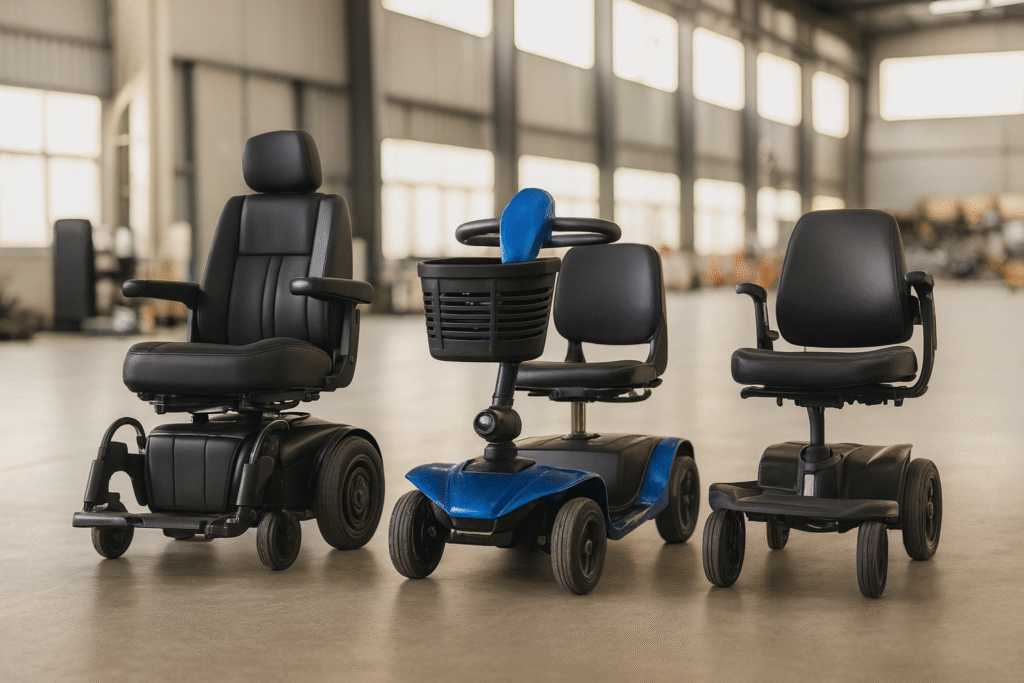
Affrontare il problema dell'abbandono dei dispositivi di ausilio alla mobilità: perché la formazione post-vendita sulle sedie a rotelle elettriche è fondamentale per il successo nel settore B2B
Last updated: July 2026

One of the most overlooked yet financially devastating challenges in the assistive technology industry is product abandonment. When a user stops using their electric wheelchair — not because it is broken, but because they never learned how to use it properly — the consequences cascade through the entire supply chain. The user loses independence. The healthcare provider sees poorer outcomes. The distributor faces warranty claims, returns, and reputational damage. And the manufacturer loses future orders.
Research consistently shows that AT abandonment is not primarily a product quality problem. It is a support and training problem. This article examines the evidence behind AT abandonment, the specific role of post-sale training in preventing it, and how B2B distributors can build training programs that protect their margins and grow their markets.
What Is AT Abandonment and Why Does It Happen?
AT abandonment occurs when a user stops using a device — even one that could significantly improve their quality of life — because it does not fit well into their daily routine. The phenomenon has been studied for decades, and the data is striking:
- Overall AT abandonment rates range from 8% to 75%, depending on device type and study methodology (Tewey, Barnicle, & Perr, 1994; University of Utah Collections).
- A foundational 1993 study by Phillips and Zhao established that approximately 30% of assistive devices are abandoned within one year of delivery — a figure that has remained remarkably consistent across subsequent research.
- A 2016 Italian study by Federici, Meloni, and Borsci surveyed 749 assistive device recipients and found that 17.9% stopped using their device within seven months of delivery. Alarmingly, 40% of those who abandoned devices had never used them even once (Future Care, 2024).
- For mobility devices specifically, abandonment rates are lower than hearing aids but still significant — approximately 14.4% in the Italian study and 19.38% in a Brazilian study by Sugawara et al. (Disability and Rehabilitation: Assistive Technology, 2024).
- In one Italian region alone, abandonment-related waste was estimated at €3.36 million annually on a total assistive device spend of €18.8 million — an 18% loss rate (Future Care).
Root Causes of Abandonment
Research by Federici and Scherer identifies several primary drivers of AT abandonment, and the majority relate to support, not product quality:
| Root Cause | % of Abandonment Cases | Training Intervention |
|---|---|---|
| Mancanza di formazione degli utenti | 30–40% | Structured onboarding program with hands-on practice |
| Discrepanza tra aspettative ed esperienza reale | 20–25% | Pre-delivery expectation setting and trial periods |
| Scarsa integrazione nelle routine quotidiane | 15–20% | Environment-specific training and customization |
| Paura di un malfunzionamento o di trovarsi in imbarazzo | 10–15% | Troubleshooting education and emergency protocols |
| Inadequate professional fitting/assessment | 10–15% | Clinical partnership and proper prescription matching |
The critical insight for B2B distributors: four of the five root causes can be directly addressed through post-sale training programs. Only the product itself is not the primary problem.
The WHO Position: Training as a Standard of Care
The World Health Organization’s Guidelines on Provision of Manual Wheelchairs in Less-Resourced Settings (and subsequent updates for powered wheelchairs) make training a formal recommendation, not a suggestion. The WHO guidelines state:
“Training must be provided for wheelchair users and those who assist them using a wheelchair to enable maximum use, including: skills to use a wheelchair, use of wheelchair components, guiding others with whom they interact, and wheelchair maintenance and repairs.” — WHO Guidelines (NCBI Bookshelf)
The WHO classifies the first three training areas as “Strong recommendation, moderate certainty evidence” — the highest confidence tier short of high-certainty evidence. This means that in clinical and policy contexts, failing to provide training is now considered below the standard of care.
For B2B distributors, this has direct commercial implications:
- Institutional buyers (hospitals, government health programs) increasingly require evidence of training provision in their procurement criteria.
- Insurance providers in markets like the US, Germany, and Japan may withhold reimbursement if training is not documented.
- Liability exposure increases when users are injured due to lack of training that professional standards now mandate.
What Effective Post-Sale Training Looks Like
Effective post-sale training is not a single event — it is a structured program that spans the first weeks and months of device ownership. Based on WHO guidelines and industry best practices, a comprehensive training program should include the following components:
1. Pre-Delivery Assessment and Expectation Setting
Before the wheelchair is even delivered, the distributor or dealer should:
- Conduct a needs assessment to understand the user’s physical capabilities, living environment, and daily routines.
- Set realistic expectations about what the wheelchair can and cannot do. Mismatched expectations are responsible for 20–25% of abandonment cases.
- Identify environmental barriers (narrow doorways, steep ramps, rough terrain) that may require accessories or modifications.
- Schedule the delivery and initial training session, ensuring a caregiver or family member is present.
2. Delivery-Day Training (1–2 Hours)
The initial training session should cover the essentials that WHO classifies as “skills to use a wheelchair”:
- Basic operation: Power on/off, joystick control, speed adjustment, and direction changes in a safe, open area.
- Transfers: Safe techniques for getting in and out of the wheelchair, including proper positioning of the chair and use of transfer boards if needed.
- Braking and safety: How electromagnetic brakes work, what to do if they fail, and emergency stop procedures.
- Component familiarity: How to adjust footrests, armrests, and seating; how to fold/unfold the wheelchair for transport.
- Basic maintenance: Daily checks (battery, tires, brakes), charging routine, and what NOT to do (hosing down, deep discharging).
3. Follow-Up Training (Week 1–4)
Research shows that users often forget up to 50% of delivery-day training within one week without reinforcement. A structured follow-up program should include:
- Day 3–5 phone or video check-in: Verify that the user is charging the battery correctly, using the wheelchair daily, and not experiencing any issues.
- Week 2 in-person or video session: Address challenges that have emerged in real-world use — narrow doorways, outdoor terrain, transferring to different surfaces.
- Week 4 assessment: Evaluate the user’s confidence and proficiency. Identify any remaining barriers and provide targeted training.
4. Ongoing Support and Maintenance Training
WHO classifies maintenance and repair training as a “Conditional recommendation” — valuable where professional services are not readily accessible. For distributors, providing this training:
- Reduces unnecessary service calls (saving $150–$300 per avoided visit).
- Empowers users to handle minor issues themselves, increasing satisfaction and reducing frustration.
- Creates a natural touchpoint for future product recommendations and upgrades.
The Business Case: ROI of Post-Sale Training for B2B Distributors
For distributors, post-sale training is not a cost center — it is a profit center. Here is how the numbers work:
Cost of Abandonment vs. Cost of Training
| Cost Category | Without Training Program | With Training Program |
|---|---|---|
| Product return rate | 15–20% of units | 3–5% of units |
| Average return cost (logistics, restocking, refurbishment) | $200–$500 per unit | $200–$500 per unit (fewer returns) |
| Annual warranty claims | High (users misuse devices) | Low (users maintain properly) |
| Customer acquisition cost | Repeated (lost customers need replacing) | Lower (retained customers refer others) |
| Training cost per unit | $0 | $30–$80 (materials + time) |
The math is straightforward: if a distributor sells 1,000 electric wheelchairs annually at an average price of $1,000, a 15% return rate costs $30,000–$75,000 in return logistics alone. A training program costing $30–$80 per unit ($30,000–$80,000 total) that reduces returns to 5% saves $20,000–$50,000 in returns — while also reducing warranty claims, improving customer satisfaction, and generating referral business.
Additional Revenue from Training Programs
Beyond cost savings, training programs create new revenue streams:
- Service contracts: Customers who receive training are more likely to purchase annual maintenance contracts ($150–$300 per year per unit).
- Accessory upselling: Training sessions naturally reveal user needs for accessories (cushions, bags, weather covers, ramps) that the distributor can supply.
- Institutional contracts: Hospitals and government programs increasingly require training provision in their procurement criteria. Distributors who can demonstrate training capability win contracts that competitors without training programs cannot.
- Reduced CAC: Trained, satisfied users refer other users, reducing customer acquisition cost by an estimated 20–30%.
Building a Training Program: Practical Steps for Distributors
Step 1: Develop Standardized Training Materials
Create a training kit that includes:
- A model-specific quick-start guide (laminated, with photos and minimal text — suitable for users with low literacy or cognitive impairments).
- Video tutorials (3–5 minutes each) covering: first use, daily charging, basic maintenance, troubleshooting common issues, and safe transfers.
- A maintenance checklist poster for wall mounting.
- QR codes on the wheelchair frame linking to digital resources.
Step 2: Train Your Dealer Network
If you work through sub-distributors or dealers, they are your training front line. Provide them with:
- “Train-the-trainer” sessions (2–4 hours) covering both product knowledge and adult learning principles.
- Certification that dealers can use in their marketing and institutional bids.
- Standardized assessment forms to document training completion for each customer.
Step 3: Digitize and Scale
For distributors operating across multiple regions or countries, digital training delivery reduces costs and ensures consistency:
- Mobile-friendly video tutorials accessible via QR code on the device.
- Remote video check-ins using standard video calling apps.
- Digital training logs that sync with your CRM for tracking and compliance.
Step 4: Measure and Improve
Track the following KPIs to demonstrate ROI and continuously improve your training program:
- Return/abandonment rate (target: below 5%)
- Warranty claim rate (target: below 3%)
- Customer satisfaction score (target: 4.5+ out of 5)
- Time-to-first-use (target: same day as delivery)
- Training completion rate (target: 95%+ of deliveries)
At 1000Mobility, we provide every distributor partner with a complete training toolkit — including model-specific video tutorials, multilingual quick-start guides, maintenance checklists, and dealer training protocols. Our goal is to ensure that every electric wheelchair we export reaches its full potential in the hands of the end user, and that our distributors have the tools they need to build lasting customer relationships.
We learned about AT abandonment the hard way. A distributor in Southeast Asia returned 18% of their first order — not because the wheelchairs were defective, but because end users couldn’t figure out how to charge them properly and assumed the batteries were dead. After that experience, we completely overhauled our post-sale support. Now, every shipment includes QR-coded video tutorials in the local language, a laminated charging guide with diagrams, and a 30-minute virtual training session that the distributor can deliver to each customer. The result: return rates dropped to under 4% within six months. We also started tracking which distributors actively deliver training versus those who skip it — the difference in warranty claims is night and day. Our advice: treat training as a product feature, not a courtesy. It sells itself when you show institutional buyers the numbers.
1000Mobility Editorial Team
Product specialists with hands-on experience in mobility equipment manufacturing and B2B export. Learn more →
Interested in Wholesale Pricing?
Get OEM/ODM details, product specifications, and wholesale pricing within 24 hours.
Or send us a message directly:
 English
  Deutsch
  Français
  Español
  Italiano
  العربية
  Русский