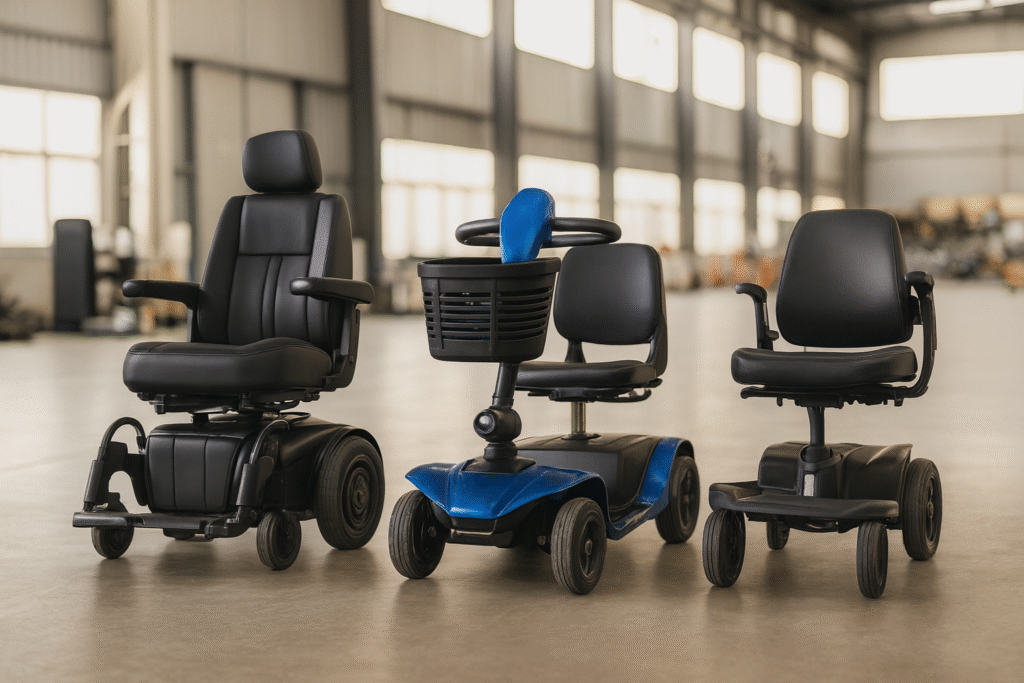
OEM vs ODM Wheelchair: Which Manufacturing Model Is Better for Your Brand in 2026?
Quick Answer
OEM wheelchair manufacturing means the factory produces your exact design from your specifications — you own the IP and control every component. ODM means the factory’s existing design is rebranded with your logo and colors — faster to market, lower upfront cost, but limited customization. Choose OEM when you need proprietary geometry, custom performance specs, or exclusive distribution rights. Choose ODM when speed-to-market, low MOQ, and proven designs matter more than differentiation. Most successful B2B wheelchair distributors start with ODM, then transition to OEM as volume grows past 500 units/year.
Last updated: October 2026
By David Chen, Director of B2B Operations
What Is the Difference Between OEM and ODM Wheelchair Manufacturing?
OEM (Original Equipment Manufacturer) and ODM (Original Design Manufacturer) represent two fundamentally different approaches to wheelchair production. In OEM, you — the brand owner — provide the complete technical specification: frame geometry, material grade, motor selection, controller programming, seat dimensions, and packaging design. The factory executes your design exactly. You own the intellectual property, the tooling (if custom), and the exclusive right to that specific product configuration. Nobody else can sell the identical chair under a different brand name.
ODM flips this relationship. The factory has already designed a wheelchair model — tested, certified, and in production. You select from their existing catalog, apply your brand logo, choose from available color options, and receive a product that is functionally identical to what other distributors may also purchase. The factory owns the design IP. Your customization is limited to surface-level branding: logos, colors, packaging, and sometimes minor component swaps (wheel type, seat fabric).
| Dimension | OEM | ODM |
|---|---|---|
| Design ownership | You own the design IP | Factory owns the design |
| Customization depth | Full: geometry, materials, electronics, firmware | Surface: logo, colors, packaging |
| Tooling cost | $8,000–$50,000+ (custom jigs, molds) | $0–$2,000 (existing tooling) |
| MOQ | 100–500+ units | 20–100 units |
| Lead time (first order) | 8–16 weeks (design + prototype + production) | 3–6 weeks (branding + production) |
| Unit cost (FOB) | Lower at volume (tooling amortized) | Higher at volume (factory’s design margin) |
| Exclusivity | Exclusive — nobody else gets your model | Non-exclusive — competitors may buy same model |
| Best for | Established brands with 500+ units/year demand | New distributors testing market demand |
When Should You Choose OEM Wheelchair Manufacturing?
OEM is the right choice when your business has reached a stage where product differentiation directly drives revenue. Here are the specific scenarios where OEM outperforms ODM:
You need proprietary performance specifications. If your target market demands a wheelchair with specific climbing angle (e.g., 12° for Middle East ramp access), a particular seat width that no ODM catalog offers (e.g., 48 cm bariatric), or a custom controller firmware that limits speed to local regulatory thresholds, OEM is the only path. ODM modifications beyond surface branding typically void the factory’s existing certifications, creating compliance risk.
You want exclusive distribution rights. OEM contracts include exclusivity clauses — geographic, channel, or both. If you invest in building a brand around a wheelchair model, you need assurance that a competitor won’t buy the same chair and undercut your price. ODM cannot provide this because the factory sells the same platform to multiple buyers.
Your annual volume exceeds 500 units. At 500+ units per year, OEM tooling amortization makes the per-unit cost competitive with or lower than ODM. A $20,000 custom mold amortized across 1,000 units adds $20/unit — less than the 8–15% design margin that ODM factories embed in their per-unit pricing. Below 300 units/year, the math favors ODM.
You serve regulated institutional channels. Hospital procurement, government tenders, and military contracts often require products that meet specifications not available in any ODM catalog. OEM lets you engineer to the exact tender requirements — specific ISO 7176 test results, particular material traceability, or custom labeling for the purchasing authority.
Explore our OEM/ODM services to see how 1000Mobility supports both manufacturing models with ISO 13485-certified production.
When Should You Choose ODM Wheelchair Manufacturing?
ODM wins when speed, low upfront investment, and proven reliability matter more than exclusivity. Here is when ODM is the smarter business decision:
You are entering a new market and need to test demand. Before committing $20,000+ to OEM tooling, order 50–100 ODM units, brand them, and test market response. If the product sells, you have validated demand and can transition to OEM at the next production cycle. If it doesn’t sell, you’ve spent $15,000 instead of $50,000+.
Your order volume is under 300 units/year. At low volumes, OEM tooling amortization pushes per-unit cost above ODM pricing. The break-even point depends on model complexity, but for most folding aluminum electric wheelchairs, 300–500 units/year is where OEM starts to win on total cost.
You need product in 4–6 weeks, not 4 months. ODM models are already designed, tested, and certified. The factory’s production line is set up and running. Your first order enters the queue immediately after artwork approval. OEM requires design finalization (2–4 weeks), prototype production (2–3 weeks), testing and revision (2–4 weeks), then mass production (4–6 weeks) — a 10–17 week timeline minimum.
The factory’s existing design already meets your market needs. If a reputable manufacturer offers a folding aluminum electric wheelchair with CE MDR, FDA 510(k), ISO 13485 certification, dual brushless 250W motors, and lithium 24V 15Ah battery — and your target customers don’t need anything different — there is no engineering justification for OEM. The ODM model is proven, certified, and in production.
| Decision Factor | Choose ODM If… | Choose OEM If… |
|---|---|---|
| Annual volume | Under 300 units | Over 500 units |
| Time to market | Under 6 weeks | 10–16 weeks acceptable |
| Upfront budget | Under $5,000 | $15,000+ available |
| Product differentiation | Brand logo + colors sufficient | Custom specs needed |
| Exclusivity | Non-exclusive acceptable | Must have exclusive rights |
| Certificazione | Factory’s existing certs cover your market | Need custom testing for specific market |
What Does the OEM Wheelchair Development Process Look Like?
The OEM development cycle follows seven distinct stages, each with specific deliverables and timelines. Understanding this process helps B2B buyers budget time and capital accurately.
Stage 1: Requirements definition (1–2 weeks). You provide a technical specification document covering frame material, geometry, weight target, weight capacity, motor type and wattage, battery chemistry and capacity, controller brand or equivalent, seat dimensions, folding mechanism, wheel sizes, and packaging requirements. Include target FOB price, annual volume forecast, and target markets with required certifications.
Stage 2: Engineering and DFM review (2–3 weeks). The factory’s engineering team reviews your spec for Design for Manufacturability. They flag impossible tolerances, suggest alternative materials that reduce cost without compromising performance, and identify components that require custom tooling. Output: revised spec, preliminary BOM, and tooling cost estimate.
Stage 3: 3D CAD and prototype (2–4 weeks). The factory produces 3D renderings and a functional prototype using rapid prototyping (3D-printed joints, hand-fabricated frame, off-the-shelf electronics). You test the prototype for fit, function, and feel. This is the stage where design changes are cheapest to implement. Expect 2–3 prototype iterations before final approval.
Stage 4: Tooling and mold production (3–6 weeks). Frame jigs, welding fixtures, and (for carbon fiber) autoclave molds are produced. Steel/aluminum jigs cost $2,000–$8,000. Carbon fiber molds cost $15,000–$50,000. Tooling quality directly affects dimensional consistency across production runs.
Stage 5: Pre-production sample (2–3 weeks). A small batch (5–10 units) is produced using the actual production tooling. These units undergo full ISO 7176 testing — static strength, dynamic fatigue, drop test, and (for electric models) EMC and battery UN38.3. This is the golden sample that defines the production standard.
Stage 6: Mass production (4–8 weeks). Full production run with 100% functional testing, cosmetic inspection, and packaging. Weekly progress photos and videos are shared. QC checkpoints include weld inspection, powder coat thickness, electrical safety, and fold-cycle verification.
Stage 7: Documentation and shipping (1–2 weeks). CE DoC, FDA establishment listing updates, test reports, UN38.3 battery summaries, and commercial documentation are finalized. Container loading with desiccant and pallet/floor-load configuration per buyer preference.
Source: 1000Mobility OEM development cycle data, 2026
What Does the ODM Wheelchair Customization Process Look Like?
ODM customization is dramatically simpler because the core engineering is already done. The process typically takes 3–6 weeks from order to shipment.
Step 1: Model selection and specification review (1–3 days). You review the factory’s ODM catalog, select models, and confirm the available configurations (seat width, motor option, battery capacity, wheel type). The factory provides spec sheets, test reports, and certification copies for your selected models.
Step 2: Branding artwork approval (3–5 days). You provide vector logo files, brand color Pantone codes, packaging artwork, and manual language requirements. The factory produces a digital mockup showing your branding on the selected model. After your approval, silk screens are prepared and packaging is printed.
Step 3: Production and QC (3–5 weeks). Your order enters the production queue. The factory uses existing tooling, existing test reports, and existing certifications. QC follows the same ISO 13485 process as OEM production — the only difference is the frame design already has a validated fatigue test on file.
Step 4: Documentation and shipping (1 week). Because the model already has CE/FDA certification, documentation is a matter of updating the DoC with your brand name and generating commercial invoices. Lead time from order to container loading is typically 4–6 weeks total.
How Do OEM and ODM Costs Compare Over 3 Years?
The total cost comparison between OEM and ODM depends heavily on volume. Here is a 3-year total cost model for a mid-range folding aluminum electric wheelchair:
| Cost Component | OEM (1,000 units/year) | ODM (200 units/year) |
|---|---|---|
| Tooling (one-time) | $15,000–$25,000 | $0 |
| Per-unit FOB | $380–$520 | $450–$650 |
| 3-year unit cost (3,000 units) | $1.14M–$1.56M | $270K–$390K (600 units) |
| Certification documentation | Included | Included |
| Custom testing | $5,000–$15,000 | $0 |
| 3-year total | $1.16M–$1.60M | $270K–$390K |
| Cost per unit (3yr avg) | $387–$533 | $450–$650 |
OEM delivers a lower per-unit cost at volume, but the absolute capital commitment is 4–6x higher because you are buying 5x more units. The right question is not “which is cheaper per unit” but “what volume does my market actually support?”
Can You Start with ODM and Transition to OEM Later?
Yes — this is the most common and recommended path for new B2B wheelchair distributors. The ODM-to-OEM transition follows a predictable pattern:
Phase 1 (Year 1): ODM market entry. Order 50–200 ODM units of a proven model. Brand it, sell it, and collect customer feedback on what features they want that the ODM model doesn’t have. Investment: $25,000–$130,000 in inventory. Risk: Low. Learning: High.
Phase 2 (Year 1–2): ODM with component modifications. As volume grows to 200–500 units, negotiate with the factory for “ODM+” — keeping the base frame but swapping motors, batteries, or seat cushions for upgraded components. This creates a semi-differentiated product without full OEM investment. Tooling: $2,000–$8,000 for custom jigs.
Phase 3 (Year 2–3): Full OEM transition. When volume exceeds 500 units/year and you have clear customer feedback on what geometry, weight, or feature changes would unlock new market segments, commission a full OEM development. The factory uses the ODM model as a starting point, reducing design time from 16 weeks to 10–12 weeks.
This staged approach minimizes risk while building toward the volume where OEM economics become favorable. It also gives you real sales data to justify the OEM investment — critical if you need board approval or bank financing for tooling costs.
What Are the Common Pitfalls in OEM Wheelchair Projects?
OEM projects fail in predictable ways. Here are the five most common pitfalls and how to avoid them:
Pitfall 1: Underestimating tooling cost. Buyers budget for the frame jig ($5,000) but forget the custom seat mold ($3,000–$8,000), packaging foam tooling ($2,000–$5,000), and controller housing mold ($4,000–$10,000). Total tooling often runs 40–60% above the frame-only quote. Solution: Request a complete tooling breakdown before committing.
Pitfall 2: Specifying unobtainable tolerances. Requesting ±0.1mm on a welded aluminum frame is technically possible but adds 30–50% to welding cost and increases scrap rate. Most wheelchair applications need ±0.5mm on critical dimensions and ±1.0mm on non-critical surfaces. Solution: Work with the factory’s DFM team to identify which tolerances actually matter.
Pitfall 3: Changing the spec mid-production. A “small change” to seat width after tooling is produced means new jigs, new welding programs, new test samples, and 2–4 weeks of delay. Solution: Freeze the spec at the golden-sample stage and route all change requests to the next production cycle.
Pitfall 4: Assuming the factory handles all certifications. OEM means you — the brand owner — are often the legal manufacturer of record. CE DoC is signed under your company name. FDA 510(k) may need to be filed under your entity. The factory provides test data and production compliance, but regulatory registration is typically your responsibility. Solution: Engage a regulatory consultant before starting OEM development.
Pitfall 5: Ignoring spare-parts planning. OEM means custom components that may not be interchangeable with ODM catalog parts. You need to plan spare-parts inventory for motors, controllers, batteries, and wear items (wheels, casters, upholstery). Solution: Include a 5–7% spare-parts allocation in the first order.
FAQ
What is OEM in wheelchair manufacturing?
OEM (Original Equipment Manufacturer) in wheelchair production means the factory manufactures wheelchairs to your exact design specifications. You provide the frame geometry, material grade, motor type, battery capacity, controller programming, and packaging design. You own the intellectual property and have exclusive rights to the product configuration. OEM requires higher upfront tooling investment ($8,000–$50,000+) but delivers lower per-unit cost at volumes above 500 units/year.
What is ODM in wheelchair manufacturing?
ODM (Original Design Manufacturer) means the factory has already designed, tested, and certified a wheelchair model. You select from their existing catalog, apply your brand logo and colors, and receive a rebranded product. ODM requires minimal upfront investment ($0–$2,000 for branding artwork), has low MOQ (20–100 units), and fast lead times (3–6 weeks). The trade-off is non-exclusivity — other distributors can buy the same model — and limited customization beyond surface branding.
Is OEM or ODM cheaper for wheelchair sourcing?
ODM is cheaper at low volumes (under 300 units/year) because there is no tooling cost. OEM becomes cheaper per unit at 500+ units/year because tooling amortization ($15,000–$25,000 spread across 1,000+ units = $15–$25/unit) is less than the factory’s ODM design margin (8–15% of per-unit cost). The break-even point depends on model complexity but typically falls between 300–500 units annually.
Can I start with ODM and switch to OEM later?
Yes, this is the recommended path for new distributors. Start with 50–200 ODM units to validate market demand. As volume grows past 200 units, negotiate “ODM+” modifications (component swaps without full redesign). When volume exceeds 500 units/year and you have clear customer feedback, commission a full OEM development using the ODM model as the engineering baseline — this reduces design time from 16 weeks to 10–12 weeks.
How long does OEM wheelchair development take?
OEM wheelchair development takes 10–16 weeks from specification to first mass production shipment. The stages are: requirements definition (1–2 weeks), engineering/DFM review (2–3 weeks), 3D CAD and prototype (2–4 weeks), tooling production (3–6 weeks), pre-production sample and testing (2–3 weeks), mass production (4–8 weeks), and documentation/shipping (1–2 weeks). ODM customization takes 3–6 weeks total because design and tooling stages are eliminated.
What MOQ do I need for OEM wheelchair manufacturing?
Most factories require 100–500 units MOQ for OEM production, depending on model complexity. Steel and aluminum manual wheelchairs typically have 100-unit OEM MOQ. Electric wheelchairs with custom controllers require 200+ units. Carbon fiber OEM projects typically require 50–200 units because autoclave mold amortization is significant. Below these volumes, ODM is the practical choice. Some factories offer “OEM lite” at 50-unit MOQ with shared tooling, but exclusivity may be limited.
Conclusione
The OEM vs ODM decision is not about which model is “better” — it is about which model fits your current business stage. ODM gets you to market fast with minimal risk and investment. OEM gives you ownership, exclusivity, and lower per-unit cost at scale. The most successful wheelchair distributors we work with started with ODM, validated their market, then transitioned to OEM as volume justified the investment. Whether you are ready for OEM or starting with ODM, 1000Mobility’s manufacturing team supports both paths with ISO 13485-certified production. Review our factory-direct capabilities oppure become a distributor to access current ODM models and OEM development schedules.
Interested in Wholesale Pricing?
Get OEM/ODM details, product specifications, and wholesale pricing within 24 hours.
Or send us a message directly:
 English
 Deutsch
 Français
 Español
 Italiano
 العربية
 Русский