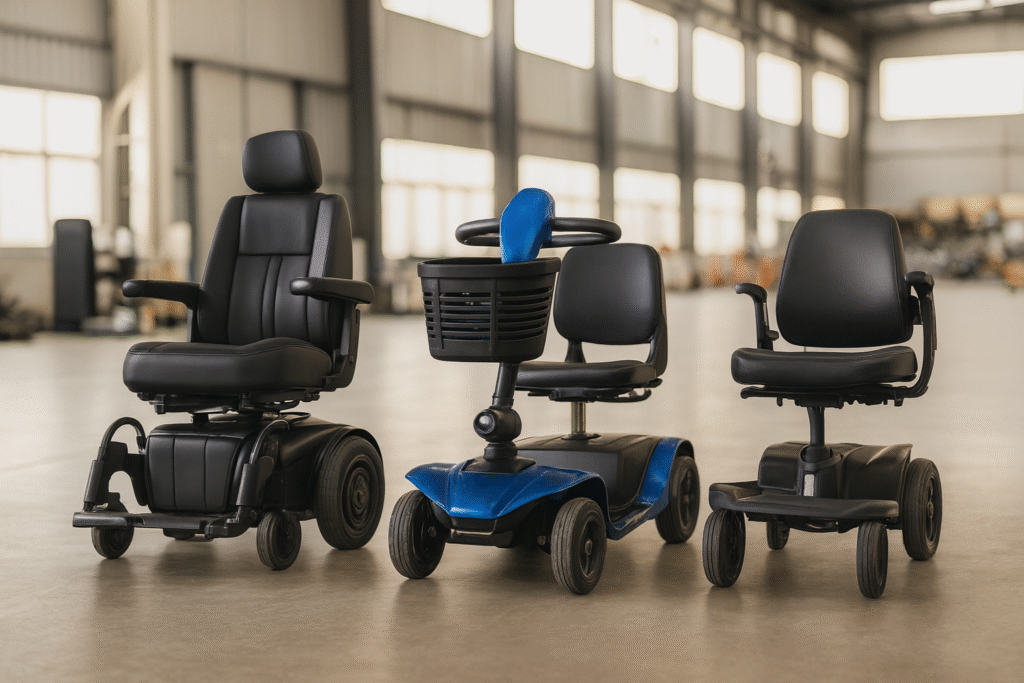
Electric Wheelchair Turning Radius: What Fits in Your Home
Last updated: November 2026
The turning radius is the most critical measurement for indoor wheelchair use — yet it’s rarely listed prominently in product specs. This guide explains what turning radius means, how to measure your home, and which wheelchair categories fit which spaces.
What Is Turning Radius?
Turning radius is the minimum circular space a wheelchair needs to complete a full 360-degree rotation in place. A smaller turning radius means the wheelchair can navigate tighter spaces.
| Wheelchair Type | Raggio di sterzata | Larghezza totale | Can Turn In |
|---|---|---|---|
| Compact travel (mid-wheel) | 20-24″ | 24-26″ | Small bathroom, narrow kitchen |
| Travel (rear-wheel) | 26-30″ | 25-27″ | Standard hallway, bedroom |
| Standard power (mid-wheel) | 24-28″ | 26-28″ | Most rooms |
| Standard power (rear-wheel) | 32-36″ | 27-29″ | Large rooms only |
| Heavy-duty/bariatric | 36-42″ | 28-32″ | Open floor plans |
| Group 3 rehab | 28-34″ | 28-30″ | Varies by configuration |
Mid-wheel drive vs rear-wheel drive: Mid-wheel drive chairs turn in a smaller radius because the drive wheels are at the center of the chair. Rear-wheel drive chairs swing the front casters in a wide arc, requiring more space.
Home Measurement Guide
Before buying a wheelchair, measure these critical spaces:
1. Doorways
| Door Type | Standard Width | Minimum Needed | ADA Compliant |
|---|---|---|---|
| Bathroom door | 24-28″ | 32″ | 32″ |
| Bedroom door | 28-30″ | 32″ | 32″ |
| Front door | 36″ | 32″ | 36″ |
| Narrow hallway door | 24-26″ | ❌ Too narrow | Not compliant |
If your bathroom door is under 30 inches: Consider a travel/mid-wheel drive wheelchair with a width under 26 inches. You may also need to install a widened door frame ($300-$800).
2. Hallway Turns
The most common problem spot is where a hallway meets a door at a 90-degree angle.
| Hallway Width | Door Width | Minimum Turning Radius Needed |
|---|---|---|
| 36″ | 32″ | 28″ |
| 42″ | 32″ | 32″ |
| 48″ | 36″ | 36″ |
| 36″ | 28″ (narrow) | 24″ (very tight) |
3. Bathroom Clearance
The bathroom is usually the tightest space in any home.
| Bathroom Element | Minimum Clearance | Typical Home |
|---|---|---|
| Space beside toilet | 30″ wide × 48″ deep | Often 18-24″ ❌ |
| Space at sink | 30″ wide × 48″ deep | Often 24-30″ |
| 180-degree turn space | 60″ diameter circle | Often 36-48″ ❌ |
| Door clearance | 32″ wide | Often 24-28″ ❌ |
Reality check: Most older homes (pre-1990) do NOT have ADA-compliant bathrooms. If you need a power wheelchair and your bathroom door is under 30 inches, you may need home modifications before the wheelchair is useful.
4. Kitchen Navigation
| Kitchen Layout | Minimum Turning Radius | Wheelchair Compatible? |
|---|---|---|
| Galley (narrow, two walls) | 24″ | Travel/mid-wheel only |
| L-shaped | 28″ | Most standard |
| U-shaped | 28″ | Most standard |
| Island kitchen | 32″ | All types |
| Open plan | 36″ | All types |
How to Measure Your Home’s Tightest Turn
You need: a tape measure and a piece of string.
- Identify the tightest turn in your home — this is usually the bathroom door from a hallway
- Measure the hallway width at the turn point
- Measure the door width
- Calculate the diagonal: if hallway is 36″ and door is 32″, the diagonal opening = √(36² + 32²) = √(1296 + 1024) = √2320 ≈ 48″
- The wheelchair’s turning radius must be less than half the diagonal — so 48″/2 = 24″
- Any wheelchair with a turning radius of 24″ or less can make this turn
Wheelchair Drive Configuration and Turning
| Drive Type | Raggio di sterzata | Why | Best For |
|---|---|---|---|
| Mid-wheel drive | 20-26″ | Pivot point at center; smallest arc | Indoor use, tight spaces |
| Rear-wheel drive | 30-38″ | Front casters swing wide; larger arc | Outdoor use, speed, stability |
| Front-wheel drive | 26-32″ | Pulls front casters through turns | Mixed indoor/outdoor |
| Omni-directional | 0″ (slides sideways) | Mecanum wheels allow lateral movement | Very tight spaces (rare, expensive) |
FAQ
What turning radius do I need for a standard bathroom?
A standard residential bathroom (5×8 feet) with a 28-inch door requires a turning radius of 24 inches or less. Only compact travel/mid-wheel drive wheelchairs can navigate this space. If your bathroom is larger (8×10 feet) with a 32-inch door, a 28-inch turning radius will work.
Can I modify my home instead of buying a smaller wheelchair?
Yes, but it’s often more expensive. Widening a bathroom door costs $500-$2,000 (including framing, drywall, and new door). Installing a pocket door saves swing space ($800-$1,500). Removing a vanity to create turning space costs $200-$500. Compare these costs to the price difference between wheelchair models.
Is mid-wheel drive better than rear-wheel drive for indoor use?
For indoor use, yes. Mid-wheel drive chairs have a 20-26″ turning radius vs 30-38″ for rear-wheel drive. They’re more maneuverable in tight spaces. The trade-off is slightly less stability on slopes and outdoor terrain.
How wide is a standard power wheelchair?
Standard power wheelchairs are 26-28 inches wide. Travel/compact models are 24-26 inches. Heavy-duty models can be 28-32 inches. Always check both the width AND the turning radius — a narrow chair with a large turning radius still can’t navigate tight turns.
Can a power wheelchair fit through a 24-inch door?
No standard power wheelchair fits through a 24-inch door. The narrowest power wheelchairs are 24 inches wide, which means they barely fit through a 24-inch door with zero clearance for hands or controls. The practical minimum door width for any power wheelchair is 28 inches, with 32 inches recommended.
What’s the difference between turning radius and turning diameter?
Turning radius is the distance from the center of the wheelchair to the outermost point during a turn. Turning diameter is the total width of the circular space needed (2× the radius). Manufacturers sometimes list diameter instead of radius, so always check which measurement is being quoted.
Conclusione
Before buying an electric wheelchair, measure your home’s tightest space — especially the bathroom door. A wheelchair that can’t turn in your bathroom is a $3,000 paperweight. For B2B buyers sourcing compact indoor wheelchairs, specify turning radius requirements in your RFQ template. For help matching wheelchair weight and size to your needs, see our weight comparison guide.
Interested in Wholesale Pricing?
Get OEM/ODM details, product specifications, and wholesale pricing within 24 hours.
Or send us a message directly:

 English
 Deutsch
 Français
 Español
 Italiano
 العربية
 Русский