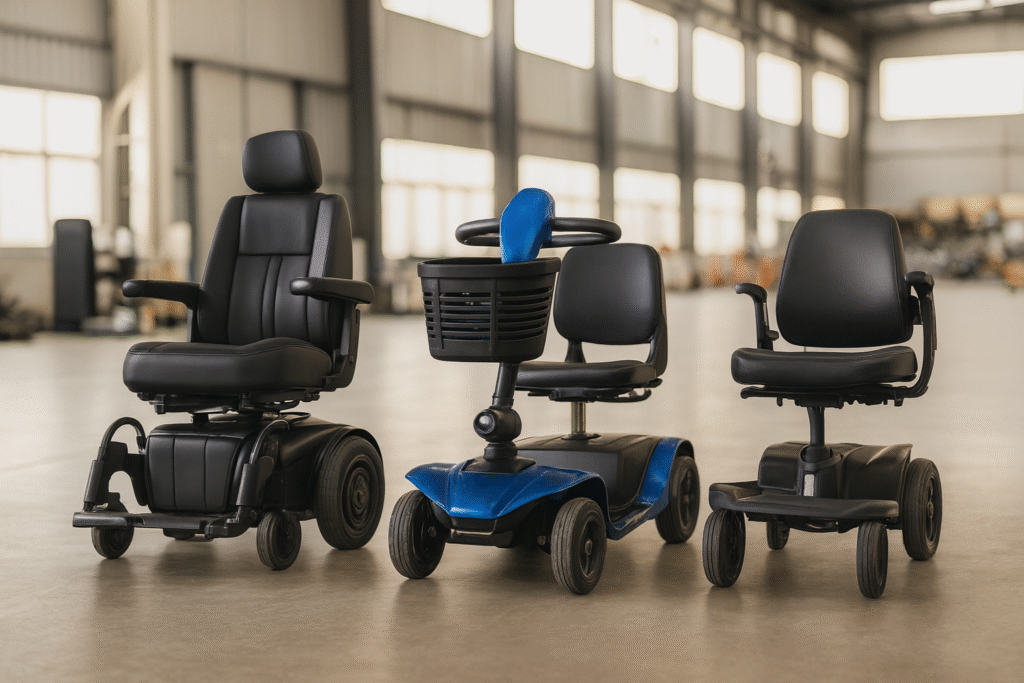
Wheelchair Battery UN38.3 Shipping Guide: Air, Sea & Land Transport Rules for B2B Exporters
Last updated: November 2026
Why UN38.3 Matters for Wheelchair Exporters
If you manufacture, source, or distribute electric wheelchairs and mobility scooters with lithium-ion batteries, UN38.3 is not optional — it is a legal precondition for shipping. The UN Manual of Tests and Criteria, Part III, subsection 38.3 defines eight tests that lithium batteries must pass before they can be legally transported by air, sea, road, or rail.
Without a valid UN38.3 test report, your freight forwarder cannot book the shipment, your carrier will reject the cargo, and customs authorities may seize the goods. For B2B wheelchair exporters, this means:
- Every battery model needs its own UN38.3 test report
- The report must match the exact battery model listed on your commercial invoice
- Air transport has strict Wh (watt-hour) limits that affect which wheelchairs can ship by air
- Sea freight is the standard mode for bulk orders but still requires DG documentation
If you are new to wheelchair sourcing, our wheelchair battery technology guide covers lithium-ion vs lead-acid specifications for B2B buyers.
Battery Classification by UN Number
| UN Number | Battery Type | Common Use | Transport Class | Key Rule |
|---|---|---|---|---|
| UN3480 | Lithium-ion battery (packed alone) | Spare/replacement batteries | Class 9 (DG) | Most restricted; cannot ship by passenger air |
| UN3481 | Lithium-ion battery (packed with equipment) | Battery shipped with wheelchair | Class 9 (DG) | Less restricted than UN3480; air limits apply |
| UN2800 | Wet battery (non-spillable, lead-acid) | Lead-acid wheelchair batteries | Class 8 (Corrosive) | Must pass vibration/pressure differential tests |
| UN3091 | Lithium metal battery (packed with equipment) | Rare in wheelchairs | Class 9 (DG) | Lithium content limits apply |
Important: Most modern electric wheelchairs use lithium-ion batteries (UN3481 when packed with the wheelchair, UN3480 when shipped separately as spares). Lead-acid batteries are still common in budget models and some mobility scooters.
UN38.3 Test Requirements: 8 Tests Explained
The UN38.3 certification requires batteries to pass all eight tests below. Your manufacturer should provide a test report from an accredited laboratory (SGS, TÜV, Intertek, or CNAS-accredited Chinese labs) for each battery model:
| # | Test Name | What It Tests | Pass Criteria |
|---|---|---|---|
| T.1 | Altitude Simulation | Low pressure (11.6 kPa) for 6 hours | No leakage, venting, disassembly, or fire |
| T.2 | Thermal Test | -40°C to +75°C, 10 cycles | No leakage, venting, disassembly, or fire |
| T.3 | Vibration Test | 7–200 Hz sinusoidal, 3 axes | No leakage, venting, disassembly; voltage within 10% |
| T.4 | Shock Test | 150g/50g half-sine, 3 axes | No leakage, venting, disassembly; voltage within 10% |
| T.5 | External Short Circuit | 55°C, <5mΩ short circuit | No fire, no explosion; temperature ≤170°C |
| T.6 | Impact/Crush Test | 13kN crushing force | No fire, no explosion |
| T.7 | Overcharge Test | 2x rated current for 24h | No fire, no disassembly |
| T.8 | Forced Discharge | Discharge to 0V | No fire, no disassembly |
What to request from your supplier:
- UN38.3 test report (matching exact battery model number)
- MSDS (Material Safety Data Sheet) in English
- DG packing declaration
- Battery specification sheet (Wh rating, voltage, capacity)
For suppliers who may not have these documents ready, our ISO 13485 factory audit checklist includes battery compliance verification as a mandatory checkpoint.
Air Freight Rules for Wheelchair Batteries (IATA DGR 2026)
Air freight is the fastest but most restrictive transport mode for lithium batteries. The IATA Dangerous Goods Regulations (67th Edition, 2026) set the following limits:
| Battery Configuration | Wh Limit | Passenger Aircraft | Cargo Aircraft | Documentation Required |
|---|---|---|---|---|
| Installed in wheelchair (UN3481) | ≤300 Wh | Permitted (with approval) | Permitted | UN38.3 report, DG declaration |
| Installed in wheelchair (UN3481) | 300–500 Wh | Prohibited | Permitted (Cargo Aircraft Only) | UN38.3 report, DG declaration, CAO label |
| Spare battery (removed, UN3480) | ≤300 Wh total | Permitted (cargo hold only) | Permitted | UN38.3 report, DG packing |
| Spare battery (removed, UN3480) | >300 Wh | Prohibited | Cargo Aircraft Only | UN38.3 report, DG declaration, CAO |
| Battery >500 Wh | Any | Prohibited | Cargo Aircraft Only (case-by-case) | Special permit may be required |
Practical implications for wheelchair exporters:
- Most portable electric wheelchairs use 20–40 Ah batteries at 24V (480–960 Wh), which exceed the 300 Wh air freight limit for spare batteries
- For batteries installed in the wheelchair, the 300 Wh limit applies to the total capacity — a 24V 20Ah battery (480 Wh) would require Cargo Aircraft Only (CAO) shipping
- Small folding wheelchairs with 24V 6Ah batteries (144 Wh) can ship by passenger aircraft
- Always confirm with your airline or freight forwarder before booking
Sea Freight Rules for Wheelchair Batteries (IMDG Code)
Sea freight is the standard transport mode for bulk B2B wheelchair shipments. The IMDG Code (Amendment 41-22) regulates lithium battery shipments as follows:
| Requirement | UN3481 (with equipment) | UN3480 (packed alone) | UN2800 (lead-acid) |
|---|---|---|---|
| DG Classification | Class 9 | Class 9 | Class 8 |
| Packing Group | II | II | II |
| DG Packing Required | Yes | Yes | Yes |
| DG Declaration | Yes | Yes | Yes |
| Container Placarding | Class 9 label | Class 9 label | Class 8 label |
| Segregation from other DG | Per IMDG segregation table | Per IMDG segregation table | Away from Class 5.1 |
| Max per container | No specific limit | No specific limit | No specific limit |
| Stowage category | Category A (on deck or under deck) | Category A | Category B (preferably on deck) |
Container loading guidelines for wheelchair shipments:
- A 20-foot container typically holds 80–120 electric wheelchairs with batteries installed
- A 40HC container holds 180–250 units depending on packaging
- Batteries must be securely attached to the wheelchair (or individually packed in DG-approved boxes)
- Terminal protection (insulating caps or tape) is mandatory for all battery terminals
- Package markings must include: UN number, proper shipping name, Class 9/8 label, packing group
Air vs Sea vs Land: Transport Mode Comparison
| Factor | Air Freight | Sea Freight | Land (Truck/Rail) |
|---|---|---|---|
| Speed | 3–7 days | 25–40 days (China to US/EU) | 15–25 days (China to EU via rail) |
| Cost per unit (wheelchair) | $40–80 | $8–15 | $12–20 |
| Battery Wh limit | ≤300 Wh (passenger) / ≤500 Wh (CAO) | No Wh limit | Varies by country regulations |
| DG documentation | Full IATA DGR compliance | Full IMDG Code compliance | ADR (Europe) / national rules |
| Best for | Samples, urgent restocks, small orders | Bulk orders (200+ units) | China-Europe land bridge |
| Temperature control | Climate-controlled cargo hold | Container insulation recommended | Climate varies by route |
| Insurance | Higher premiums for DG | Standard marine cargo insurance | Transit insurance required |
Required Documentation Checklist for Battery-Equipped Wheelchair Exports
Before your freight forwarder can book a shipment, prepare this complete documentation package:
| # | Document | Who Provides | When Needed |
|---|---|---|---|
| 1 | UN38.3 Test Report | Battery manufacturer / accredited lab | Before booking any transport |
| 2 | MSDS (Material Safety Data Sheet) | Battery manufacturer | Before booking any transport |
| 3 | Battery Specification Sheet | Wheelchair manufacturer | Quote stage |
| 4 | DG Packing Declaration | Packing warehouse / supplier | Before loading |
| 5 | Commercial Invoice | Exporter (you) | Customs clearance |
| 6 | Packing List | Exporter | Customs clearance |
| 7 | Certificate of Origin | Exporter / CCPIT | Preferential duty claims |
| 8 | DG Declaration (IATA/IMDG) | Freight forwarder | Carrier booking |
| 9 | CE/FDA Certificate | Wheelchair manufacturer | Market compliance |
| 10 | Battery Label Test Report | Label printer / manufacturer | If using PI 965-970 |
Critical: The battery model number on the UN38.3 test report, MSDS, specification sheet, commercial invoice, and physical battery label must all match exactly. Mismatched model numbers are the #1 cause of customs holds for battery-equipped wheelchair shipments.
For comprehensive export documentation beyond batteries, including CE/FDA/ISO requirements, see our factory audit checklist covering 47 compliance checkpoints.
Common Battery Shipping Mistakes That Delay Wheelchair Exports
Mistake 1: Not requesting UN38.3 reports before placing the order
Many buyers discover battery compliance issues only when the freight forwarder asks for documentation — by then, the goods are packed and ready to ship. Always request UN38.3 test reports during the supplier evaluation stage, not after production is complete.
Mistake 2: Shipping spare batteries separately without DG packing
Spare batteries (UN3480) face stricter rules than batteries installed in equipment (UN3481). If you ship replacement batteries in the same container as wheelchairs, they must be individually packed in UN-specification packaging with DG labels.
Mistake 3: Incorrect Wh calculation on shipping documents
The watt-hour rating determines which transport rules apply. Calculate Wh as: Voltage (V) × Capacity (Ah) = Wh. A 24V 20Ah battery is 480 Wh, not 20 Ah. Incorrect calculations can lead to rejected shipments or regulatory fines.
Mistake 4: Assuming lead-acid batteries don’t need DG documentation
Non-spillable lead-acid batteries (UN2800) still require DG documentation and may need to be removed from the wheelchair if the device cannot be kept upright during transport. Always confirm with your carrier.
Mistake 5: Not insuring battery cargo adequately
Standard marine cargo insurance may exclude or limit coverage for dangerous goods. Confirm that your policy explicitly covers lithium battery shipments at full declared value.
FAQ
Conclusion
Battery compliance is the single most common cause of shipping delays for electric wheelchair exports. By requesting UN38.3 test reports at the supplier evaluation stage, calculating Wh ratings accurately, and preparing complete DG documentation before booking freight, you can avoid customs holds, carrier rejections, and costly storage fees.
For most B2B wheelchair orders over 200 units, sea freight under IMDG Code is the standard choice — cost-effective, no Wh limits, and well-understood by experienced freight forwarders. Air freight remains viable for samples and urgent restocks of small-battery wheelchairs.
Need UN38.3-compliant electric wheelchairs with full export documentation? Contact our B2B team for electric wheelchairs, mobility scooters, and rollator walkers with CE/FDA certification, ISO 13485 quality management, and complete battery compliance packages.
Interested in Wholesale Pricing?
Get OEM/ODM details, product specifications, and wholesale pricing within 24 hours.
Or send us a message directly:
 English
 Deutsch
 Français
 Español
 Italiano
 العربية
 Русский