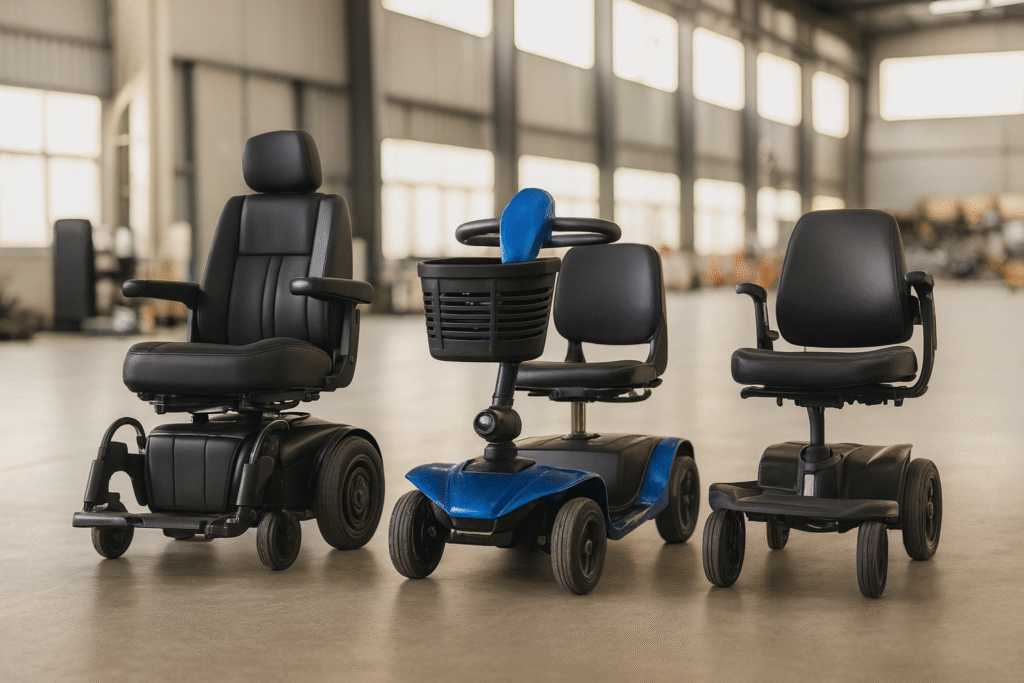
B2B Buying Guides for Mobility Equipment
Quick Answer: B2B buying guides for mobility equipment help distributors, importers, and medical supply companies evaluate electric wheelchairs, mobility scooters, and rollators before purchasing. Key factors include product specifications, material comparisons, certification requirements, MOQ policies, and shipping logistics for importing from China.
Last updated: July 2026
1000Mobility provides comprehensive buying guides designed for B2B buyers — distributors, importers, medical supply companies, and healthcare procurement specialists. Our guides cover product specifications, material comparisons, certification requirements, and supplier evaluation criteria for electric wheelchairs, mobility scooters, and rollator walkers.
Which Buying Guides Are Available?
Electric Wheelchair Buying Guide for B2B Buyers →
A comprehensive 1,700+ word guide covering: wheelchair types (folding, rigid, portable, bariatric), frame materials (carbon fiber vs. aluminum vs. steel), weight capacities (100-200kg range), battery specifications (24V lithium-ion, 10-60Ah), motor power (200-500W), key certifications (CE, FDA, ISO 13485), and supplier evaluation checklist. Includes comparison tables for frame materials, battery life, and price ranges.
Mobility Scooter Buying Guide for B2B Buyers →
A detailed 1,900+ word guide covering: scooter classifications (Class 2 and Class 3), wheel configurations (3-wheel vs. 4-wheel vs. folding), weight capacities (100-200kg), battery range (15-45km), speed specifications (6-15 km/h), terrain capabilities, key certifications (CE, FDA, ISO), and total cost of ownership analysis. Includes comparison tables and supplier qualification framework.
Why Do These Buying Guides Matter for B2B Buyers?
Selecting the right mobility equipment supplier impacts your business across multiple dimensions:
- Product Quality — Material choice (carbon fiber, aviation aluminum, steel) directly affects durability, weight, and end-user satisfaction
- Regulatory Compliance — CE, FDA, and ISO certifications determine which markets you can sell into
- Profit Margins — Understanding MOQ structures, pricing tiers, and customization options helps optimize your procurement costs
- After-Sales Support — Spare parts availability, warranty terms, and technical documentation affect your long-term operational costs
- Market Differentiation — Carbon fiber technology and smart features create competitive advantages in your local market
Mobility Equipment Category Comparison
| Category | Target Users | Key Specs | MOQ | Lead Time |
|---|---|---|---|---|
| Electric Wheelchairs | Users with severe mobility limitations | 250-500W motor, 20-60Ah battery, 100-150kg capacity | 1 unit (sample) | 30-45 days |
| Mobility Scooters | Elderly and disabled users | 3/4-wheel, 100-200kg capacity, 20-50km range | 1 unit (sample) | 30-45 days |
| Rollators | Users needing walking support | Carbon fiber/aluminum, 6-8″ wheels, 100-150kg | 1 unit (sample) | 30-45 days |
| Manual Wheelchairs | Transit and self-propel users | Aluminum frame, 11-15kg, 6-12″ wheels | 1 unit (sample) | 30-45 days |
Additional Resources
- OEM/ODM Manufacturing Solutions — Custom branding and design services
- Quality Control & Certifications — Our testing standards and compliance
- Factory Tour — See our 50,000 sqm manufacturing facility
- Become a Distributor — Partnership opportunities
- Why Choose 1000Mobility — Our competitive advantages
- Contact Us — Request a quote or product catalog
 English
  Deutsch
  Français
  Español
  Italiano
  العربية
  Русский