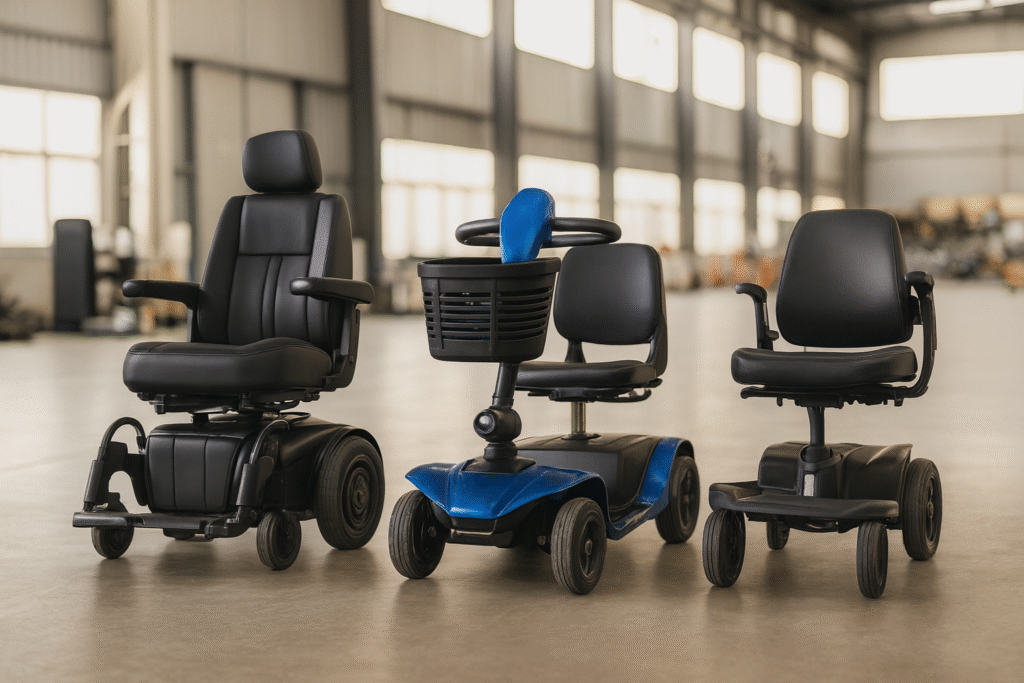
Electric Wheelchair Safety Features: Anti-Tip, Auto-Brake, and More
Last updated: November 2026
Electric wheelchairs have evolved from simple motorized chairs to sophisticated machines with multiple safety systems. This guide explains each safety feature, how it works, and which ones are essential vs optional.
Safety Feature Comparison
| Feature | Essential? | Standard on Most Chairs? | Aftermarket Cost | Prevents |
|---|---|---|---|---|
| Anti-tip wheels | ✅ Yes | ✅ Yes | $15-$30/pair | Backward tipping |
| Electromagnetic brake | ✅ Yes | ✅ Yes | Built-in | Uncontrolled rolling |
| Auto-brake on release | ✅ Yes | ✅ Yes | Built-in | Drifting when user stops |
| Seat belt | ✅ Yes | ✅ Yes | $15-$30 | Falls during sudden stops |
| Speed limiter | ✅ Yes | ✅ Yes | Built-in | Loss of control at speed |
| Stability control system | ⚠️ Recommended | Mid-high tier only | Built-in | Tipping during sharp turns |
| Incline rollback brake | ⚠️ Recommended | Some models | $100-$200 | Rolling backward on hills |
| Tip sensor/shutdown | Optional | High-end only | Built-in | Operation after tipping |
| Collision avoidance | Optional | Very few models | $500-$1,000 | Front collisions |
| GPS tracking | Optional | Smart models | $50-$100 | Theft, getting lost |
1. Anti-Tip Wheels
Small wheels mounted on arms extending behind the main rear wheels. When the chair tilts backward more than 15 degrees, these wheels catch the ground and prevent a full backward flip.
How they work:
- Spring-loaded arms with 2-3 inch rubber wheels
- Normally hover 1-2 inches above the ground
- Contact ground when chair tilts back beyond 15°
- Support the chair’s weight, preventing tipping
Critical rules:
- Never remove them to fit the wheelchair in a car — remove the seat instead
- Check monthly that the wheels spin freely and the springs aren’t bent
- Replace immediately if the rubber is cracked or worn smooth
- If your wheelchair didn’t come with anti-tips, purchase and install them ($15-$30)
2. Electromagnetic Brakes
Unlike mechanical disc brakes on cars, electric wheelchairs use electromagnetic brakes built into the motor. When power is cut to the motor (joystick released or power off), a spring pushes a brake pad against the motor shaft, stopping the wheels within 1-2 feet.
How they work:
- Normally engaged (brake on) — power must be applied to disengage
- When joystick is centered (neutral), brake engages
- When power is off, brake stays engaged (fail-safe)
- Manual release lever allows pushing the chair when battery is dead
Testing your brakes:
- Turn on the wheelchair on a flat surface
- Drive forward at medium speed
- Release the joystick completely
- The chair should stop within 2-3 feet
- If it rolls more than 3 feet, brakes need servicing
Manual release: Most motors have a freewheel lever. When pulled, it disengages the electromagnetic brake so the chair can be pushed manually. Always re-engage before using the motor — driving with the brake disengaged is extremely dangerous.
3. Auto-Brake on Joystick Release
When the user releases the joystick (returns it to center), the wheelchair automatically decelerates and stops within 2-3 seconds. This is a software feature, not a separate brake.
Deceleration profiles:
| Setting | Deceleration Time | Use Case |
|---|---|---|
| Gentle | 4-5 seconds | Indoor, delicate items |
| Standard | 2-3 seconds | General use |
| Aggressive | 1-2 seconds | Outdoor, safety-critical |
Important: Aggressive deceleration can cause the user to lurch forward. Always use the seat belt. The standard setting is recommended for most users.
4. Seat Belt
A simple lap belt that prevents the user from sliding forward during sudden stops or tipping out on inclines. Despite being the cheapest safety feature, it’s the most underutilized.
Types:
| Belt Type | Buckle | Cost | Best For |
|---|---|---|---|
| Standard lap | Push-button | $15 | Most users |
| Velcro lap | Hook-and-loop | $20 | Limited hand dexterity |
| 4-point harness | Buckle | $40 | Severe balance impairment |
| Chest strap | Buckle | $25 | Forward leaning posture |
Always wear the seat belt when:
- The wheelchair is moving
- On any slope greater than 5 degrees
- During transfers (prevents sliding)
- When the wheelchair is tilted or reclined
5. Speed Limiter
Most power wheelchairs have a maximum speed of 4-6 mph. The speed limiter allows the user or caregiver to cap the maximum speed for safety.
Recommended speed settings:
| Environment | Max Speed | Why |
|---|---|---|
| Indoor (home) | 2 mph | Avoids collisions with walls/furniture |
| Indoor (facility) | 3 mph | Allows navigation of hallways |
| Outdoor (sidewalk) | 4 mph | Safe for pedestrian areas |
| Outdoor (open area) | 6 mph | Full speed, flat and clear |
Advanced Safety Features
Stability Control System (SCS)
Monitors the wheelchair’s center of gravity and automatically reduces speed during sharp turns to prevent tipping. Found on mid-to-high tier models.
Incline Rollback Brake
Prevents the wheelchair from rolling backward when stopped on an incline. When the joystick is released on a slope, the brake holds for 2-3 seconds before the electromagnetic brake fully engages, preventing rollback.
Tip Sensor
An accelerometer detects if the wheelchair has tipped more than 45 degrees. The system cuts motor power immediately to prevent the wheels from spinning dangerously while tipped.
Collision Avoidance
Ultrasonic or infrared sensors on the front of the wheelchair detect obstacles within 2-3 feet. The wheelchair automatically slows or stops before impact. Available on a few premium models.
GPS Tracking
Built-in GPS allows caregivers to track the wheelchair’s location via smartphone app. Useful for users with dementia or those who travel independently.
FAQ
Are anti-tip wheels required by law?
In the United States, anti-tip wheels are not federally mandated on all power wheelchairs, but they ARE required on Medicare-covered (Group 2+) power wheelchairs. The RESNA WC-4 standard recommends them on all power wheelchairs. Any reputable manufacturer includes them standard.
Can I drive my wheelchair without the seat belt?
Technically yes, but it’s strongly advised against. The seat belt prevents you from being thrown forward during sudden stops, which happen automatically when you release the joystick. On slopes, the belt prevents sliding out of the seat. Treat it like a car seat belt — always on when moving.
What happens if the electromagnetic brake fails?
Electromagnetic brakes are fail-safe — they’re spring-engaged and require power to release. If the brake mechanism itself fails (rare), the wheelchair will roll freely. This is why anti-tip wheels and seat belts are critical backup safety systems. If your brakes feel weak (chair rolls more than 3 feet when joystick is released), stop using the wheelchair and have it serviced immediately.
How fast can a power wheelchair go?
Most power wheelchairs have a maximum speed of 4-6 mph. Some sport models reach 8-10 mph but are not recommended for users with balance issues. The speed should be limited to 2-3 mph indoors and 4 mph on sidewalks. For outdoor trail use, 6 mph is the maximum safe speed.
Do I need collision avoidance?
Collision avoidance is helpful for users with visual impairments, cognitive decline, or those who use their wheelchair in busy environments (hospitals, shopping centers). For most users who drive in familiar environments, it’s an optional luxury. The cost ($500-$1,000) may not be justified.
Can I add safety features to an older wheelchair?
Anti-tip wheels, seat belts, and speed limiters can be added to most older power wheelchairs. Electromagnetic brakes are built into the motor and can’t be retrofitted — if they fail, the motor must be replaced. Stability control and collision avoidance require electronic integration and generally can’t be added aftermarket. See our assembly guide for installation details.
Conclusion
Safety features on electric wheelchairs work as a system — anti-tip wheels prevent backward falls, electromagnetic brakes prevent rolling, and seat belts prevent user ejection. Never disable any safety feature. For safety-focused rollator use, see our rollator safety guide. For B2B sourcing with safety specifications, use our RFQ template.
Interested in Wholesale Pricing?
Get OEM/ODM details, product specifications, and wholesale pricing within 24 hours.
Or send us a message directly:
 English
 Deutsch
 Français
 Español
 Italiano
 العربية
 Русский