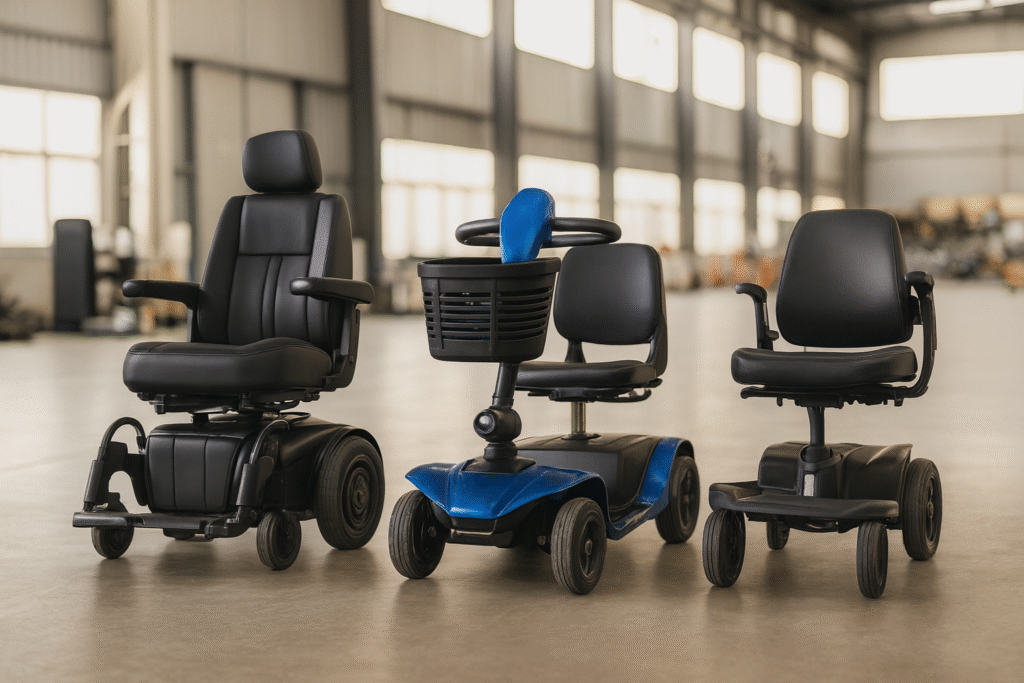
Quick Answer: Choose a mobility scooter if your parent can sit upright unsupported, use both hands to steer a tiller, and primarily needs help covering outdoor distances. Choose an Elektrorollstuhl if they need indoor maneuverability, have limited hand strength or tremors, require a joystick control, or will sit in the device for most of the day. The deciding factors are hand strength, home layout, and where they’ll use it most.
Last updated: October 2026
The One Question That Decides Everything
Before comparing specs, ask yourself this: Where will your parent use it most — inside the home or outdoors?
This single question eliminates more confusion than any spec sheet. As Selected Comfort puts it: “When someone calls and can’t decide, the first thing I ask is: ‘Where will you use it most: inside the home, outdoors, or both?'”
If the answer is “mostly indoors” — narrow hallways, tight bathroom turns, getting from bed to kitchen — an electric wheelchair is almost always the right choice. If the answer is “mostly outdoors” — shopping, parks, community trips — a mobility scooter may be better, provided your parent can safely operate it.
The Core Difference: Joystick vs Tiller
Everything else follows from how the device is steered:
| Feature | Elektrorollstuhl | Mobilitätsroller |
|---|---|---|
| Steering | Joystick on armrest (one hand, minimal force) | Tiller/handlebars (two hands, grip strength + arm mobility) |
| Turning radius | 25–32 inches (turns within its own length) | 45+ inches (needs wide arcs) |
| Indoor use | Excellent — fits through 30″ doorways | Limited — struggles in hallways and bathrooms |
| Outdoor range | 8–20 miles (folding models) | 10–40+ miles (larger batteries) |
| Seating | Adjustable, supportive, clinical-grade options | Basic bench/captain’s seat |
| Transfer on/off | Sit down like a chair | Step onto deck or swing legs past |
| Typical weight | 45–75 lbs (folding) | 40–120 lbs |
| Airline travel | Usually approved (battery under 300 Wh) | Rarely accepted by airlines |
| Price range | $800–$5,000+ | $500–$4,000 |
A power wheelchair’s joystick requires only minimal finger movement — ideal for arthritis, tremors, or stroke recovery. A scooter’s tiller demands bilateral grip strength, shoulder mobility, and the core stability to sit upright without back support.
When to Choose a Mobility Scooter
A mobility scooter is the better choice when your parent:
- Can walk short distances but tires over longer routes
- Has good sitting balance — can stay upright without back support
- Has adequate hand and arm strength to grip and steer a tiller with both hands
- Primarily needs outdoor mobility — shopping, parks, community events
- Can transfer safely — step onto the deck and sit down independently
- Understands speed, braking, and obstacle avoidance
- Has storage space at home for charging
Scooters excel at covering distance outdoors. Four-wheel models provide stability on grass, gravel, and gentle slopes. Many disassemble into pieces that fit in a car trunk. Under CMS policy (LCD L33789), Medicare covers a scooter only if the user can get on and off safely, steer the tiller, and stay upright while riding — a useful self-test even if you’re not using Medicare.
When to Choose an Electric Wheelchair
An electric wheelchair is the better choice when your parent:
- Cannot walk safely or consistently — needs powered mobility for daily activities
- Has limited hand strength, tremors, or weakness — joystick needs only one finger
- Needs to navigate indoors — narrow hallways, doorways, bathrooms, kitchens
- Will sit in the device for significant periods each day
- Requires postural support — adjustable backrest, armrests, footrests
- Cannot use tiller controls safely due to arthritis, stroke effects, or neuropathy
- Travels by car frequently — folding models fit in trunks without disassembly
- Flies occasionally — most folding models have airline-approved batteries (under 300 Wh)
Electric wheelchairs turn within their own length, making them the only viable option for homes with 30-inch doorways and tight bathroom layouts. The joystick can be positioned for left or right hand operation, and many models support alternative controls (chin, head, sip-and-puff) for users with severe limitations.
The Decision Matrix: 5 Questions to Ask
1. Can your parent operate a tiller with both hands?
If yes → scooter is viable. If no (tremors, arthritis, weakness, unilateral impairment) → electric wheelchair with joystick.
2. What are your doorway widths?
Measure the narrowest doorway and the tightest daily turn (usually bed-to-bathroom). If it’s 30–32 inches, a power wheelchair turns within that space. A compact folding scooter typically needs 45 inches or more to turn.
3. Where will they spend most of their time?
| Primary Location | Recommended Device | Why |
|---|---|---|
| Inside the home | Electric wheelchair | Tight turning radius, joystick control, supportive seating |
| Outdoors — errands, parks | Mobility scooter | Longer range, higher speed, better on uneven terrain |
| Both indoor and outdoor | Electric wheelchair (folding) | Versatile enough for both environments |
| Car trips and travel | Electric wheelchair (folding, under 300 Wh) | Airline-approved, fits in car trunk |
4. How long will they sit in it each day?
- Less than 2 hours (short outings, errands) → Either device works
- 2–4 hours (community activities) → Scooter seat is adequate for trips
- Most of the day (daily living, indoor navigation) → Electric wheelchair with supportive seating
5. Can they transfer independently?
Scooter transfers require stepping onto a deck and sitting down — this needs leg strength and balance. Wheelchair transfers are more like sitting in a chair, which is easier for people with limited leg mobility. If transfers are difficult, an electric wheelchair with a lower seat height is usually safer.
Common Mistake: Buying a Scooter for Indoor Use
The most common mistake families make is buying a scooter for someone who mostly needs to get around inside the home. The scooter arrives, everyone is pleased — and then it can’t get around the corner into the hallway. Or it takes a three-point turn just to get past the dining table.
Rule of thumb: If your doorways or tight daily turns give you about 30–32 inches of usable clearance, buy a compact electric wheelchair, not a mobility scooter. Measure before you buy, not after.
What About Cost?
| Cost Factor | Mobilitätsroller | Elektrorollstuhl |
|---|---|---|
| Entry price | $500–$1,000 | $800–$1,500 |
| Mid-range | $1,000–$2,500 | $1,500–$3,000 |
| Premium | $2,500–$4,000+ | $3,000–$5,000+ |
| Medicare coverage | Yes, if LCD L33789 criteria met | Yes, broader criteria than scooters |
| Battery replacement | $100–300 (SLA) | $200–400 (Li-ion) |
| Maintenance | Lower — simpler mechanics | Higher — electronic systems |
Don’t let price be the primary driver. A cheaper scooter that can’t navigate your parent’s home is a waste of money. A slightly more expensive electric wheelchair that restores indoor independence is worth every dollar.
Think a Few Years Ahead
Hand strength rarely comes back with age. Someone who handles a tiller easily today may not in two or three years. A tiller needs two steady hands; a joystick needs one. If your parent’s condition may progress — Parkinson’s, MS, post-stroke — choosing a joystick-controlled electric wheelchair from the start avoids the need to switch devices later.
For a deeper look at how to match devices to specific conditions, our assistive technology assessment guide covers the clinical evaluation process.
Frequently Asked Questions
Is a mobility scooter or electric wheelchair better for seniors?
It depends on their hands and where they ride. A senior with steady hands who’s mostly outdoors usually does well on a four-wheel scooter. With tremors, a weak grip, or a small home, an electric wheelchair is usually the better fit. The joystick requires only minimal finger movement, while a tiller demands bilateral grip strength and arm control.
Can a mobility scooter be used indoors?
Some smaller 3-wheel scooters can navigate wider indoor spaces, but their turning radius (typically 45+ inches) makes them impractical for narrow hallways, standard 30-inch doorways, and bathrooms. An electric wheelchair, with a turning radius of 25–32 inches, is almost always the better choice for indoor use.
Will Medicare or Medicaid cover a mobility scooter or electric wheelchair?
Medicare covers both scooters and power wheelchairs under its Durable Medical Equipment benefit, but with different criteria. Under LCD L33789, a scooter requires the user to safely get on and off, steer the tiller, and maintain upright posture. A power wheelchair has broader eligibility criteria, including users who cannot operate a tiller. Coverage typically requires a face-to-face exam and a prescription from a physician. See our Medicaid mobility scooter guide for details.
Can you take a mobility scooter or electric wheelchair on an airplane?
Most folding electric wheelchairs with lithium-ion batteries under 300 Wh are airline-approved under FAA PackSafe rules. Mobility scooters are rarely accepted by airlines because their batteries often exceed the 300 Wh limit and they don’t fold compactly enough for cargo. If air travel is important, an electric wheelchair is the clear choice. See our airline battery rules guide for complete details.
Which is safer for an elderly parent — a scooter or a wheelchair?
Both are safe when used correctly and matched to the right user. Electric wheelchairs generally have a lower center of gravity, anti-tip mechanisms, and smoother acceleration/braking. Mobility scooters are faster but can tip on sharp turns if the user leans too far. Safety depends on matching the device to the user’s physical abilities, not on the device category alone. A proper assessment by a physical or occupational therapist is always recommended.
How do I know if my parent can safely operate a tiller?
Test three things at home: (1) Can they grip and turn a broom handle with both hands for 30 seconds without fatigue? (2) Can they sit on a kitchen chair without back support for 5 minutes? (3) Can they look over their shoulder to check for obstacles behind them? If any of these are difficult, a joystick-controlled electric wheelchair is the safer choice.
Fazit
The right choice isn’t about which device is “better” — it’s about which one fits your parent’s hands, home, and daily life. Measure the doorways. Test the hand strength. Think about where they’ll spend most of their time. And plan for a few years ahead, not just today.
If you are a distributor or retailer helping families make this decision, 1000Mobility manufactures both folding electric wheelchairs (joystick, airline-approved) and mobility scooters (4-wheel, folding) designed for the elderly market. Our electric wheelchair buying guide und mobility scooter buying guide provide detailed specs and comparison tools to help match the right device to each customer.
Interested in Wholesale Pricing?
Get OEM/ODM details, product specifications, and wholesale pricing within 24 hours.
Or send us a message directly:
 English
 Deutsch
 Français
 Español
 Italiano
 العربية
 Русский