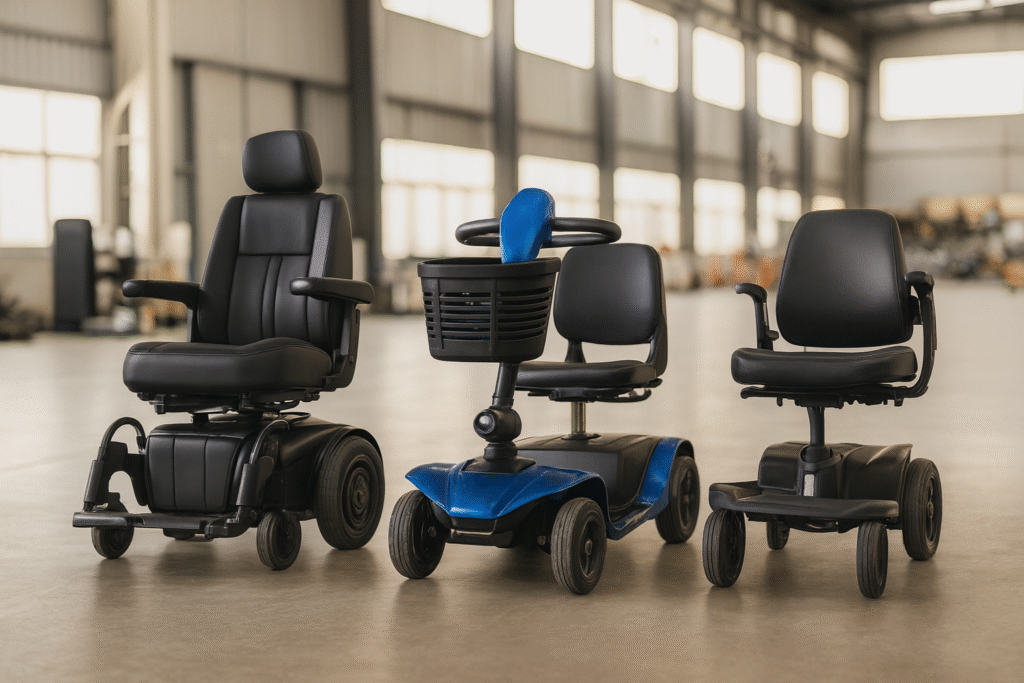
Wheelchair Factory Audit Checklist: ISO 13485 On-Site Verification Guide 2026
Quick Answer
A wheelchair factory audit under ISO 13485 requires verifying 6 core areas: quality management system documentation, design controls, production process validation, incoming material inspection, in-process QC, and finished-product testing. On-site, check for a valid ISO 13485:2016 certificate with correct scope covering wheelchairs, recent surveillance audit reports, calibrated testing equipment (ISO 7176 test rigs, durometers, torque gauges), nonconformance logs with corrective actions, and batch traceability from raw material to serial number. A factory that cannot produce NC reports or show running test equipment is relying on paper compliance, not process control.
Last updated: October 2026
By David Chen, Director of B2B Operations
Why Is On-Site Factory Audit Critical Before Placing a Wheelchair Order?
Certifications on paper tell you what a factory claims. An on-site audit tells you what a factory actually does. The gap between the two is where quality problems, compliance failures, and supply-chain disruptions live.
The FDA’s Quality Management System Regulation (QMSR), effective February 2, 2026, fully incorporates ISO 13485:2016 requirements. The EU Medical Device Regulation (MDR 2017/745) demands living technical files with active Notified Body oversight. A certificate issued in 2023 can no longer be assumed valid for 2026 placements. Buyers who skip the audit and accept a PDF at face value often discover, months later, that the scope didn’t cover their product class, the surveillance audit flagged unresolved issues, or the testing equipment was outsourced and unavailable for production verification.
A structured 4–6 hour factory audit covers the six areas below. Each area has specific evidence you must see — not hear about, but physically see and photograph.
Checklist Area 1: Quality Management System Documentation
The QMS is the backbone of ISO 13485. Without documented processes, a factory cannot demonstrate systematic quality control. Here is exactly what to request and verify:
| Item | What to Ask For | Pass Criteria | Red Flag |
|---|---|---|---|
| ISO 13485 certificate | Original certificate (not scan), with certificate number, scope, accreditation body | Scope explicitly covers “design and manufacture of wheelchairs” or “mobility aids”; active status in IAF CertSearch | Scope covers “medical consumables” only; certificate expired or suspended |
| Quality manual | Controlled copy with revision history | Covers design, production, QC, post-market surveillance | No revision history; copied from another company |
| SOP index | List of all standard operating procedures | At least 25–40 SOPs covering incoming, production, QC, calibration, training, CAPA | Fewer than 15 SOPs; no CAPA procedure |
| Management review records | Most recent management review meeting minutes | Conducted within last 12 months; includes quality metrics, complaints, audit results | No management review in 12+ months |
| Training records | Training matrix for production and QC staff | Operators trained on specific workstations; training current within 12 months | Training records backdated or blank |
How to verify: Ask the quality manager to show you the actual documents — not describe them. A factory with a real QMS can pull any SOP within 5 minutes. A factory with a paper-only QMS will say “the document controller is not here today.”
Checklist Area 2: Design Controls
If the factory does OEM or ODM development, design controls are where most compliance gaps appear. ISO 13485 requires documented design inputs, outputs, verification, validation, and design change history.
| Item | What to Ask For | Pass Criteria | Red Flag |
|---|---|---|---|
| Design input documents | For a current product: spec sheet, regulatory requirements, user needs | Inputs trace to specific user needs and regulatory standards (ISO 7176, EN 12184) | No design input records; “the designer left” |
| Design output documents | Drawings, BOM, test specifications, labeling artwork | Outputs correspond to inputs; revision-controlled | Drawings without revision numbers |
| Verification records | Test reports linking each design output to input requirements | Each test references the specific input it verifies | Test reports with no traceability to design inputs |
| Design validation | Clinical/user evaluation, field testing data | Validation conducted on production-equivalent samples | “Validated by customer complaints” (not acceptable) |
| Design change log | History of changes after initial release, with impact assessment | Changes trace to specific change requests; re-verification noted | No change history; changes made verbally |
| Risk management file | ISO 14971 risk analysis for at least one current product | Identifies hazards, estimates risk, implements controls, residual risk documented | No risk management file; “we do risk analysis but didn’t write it down” |
Checklist Area 3: Production Process Validation
Process validation proves that the factory’s production processes consistently produce conforming product. For wheelchair manufacturing, the critical validated processes are welding, powder coating, electrical assembly (for electric models), and final functional testing.
| Process | What to Verify On-Site | Pass Criteria | Red Flag |
|---|---|---|---|
| Welding (TIG/MIG) | Welding procedure specification (WPS), welder qualification certificates | WPS specifies current, voltage, gas flow, travel speed; welders qualified to ISO 9606 | No WPS; “our welders are experienced” |
| Powder coating | Coating thickness gauge, pre-treatment process records | 60–120 μm thickness; 12-stage pre-treatment tank record visible | No thickness gauge; coating thickness not measured |
| Electrical assembly | Torque-controlled tools for controller mounting, soldering inspection | Torque wrenches calibrated; solder joints visually inspected; hipot test performed | Hand-tightened connections; no hipot test |
| Final functional test | Test checklist per unit, with pass/fail criteria and operator sign-off | 100% units tested; test record includes serial number, date, result | “We test randomly”; no per-unit test records |
| Calibration | Calibration certificates for all measurement equipment | Calipers, torque wrenches, durometers, thickness gauges calibrated within 12 months | Equipment not labeled with calibration status |
Physical evidence to look for on the production floor:
- Double-drum fatigue tester (ISO 7176-8) — running or recently used
- Static/dynamic stability platform — visible test platform with clamps
- Drop test frame — structure for ISO 7176-9
- Hardness tester for frame material verification — calibrated
- Hipot tester for electrical safety (IEC 60601-1) — with test records
A factory that outsources all testing and cannot produce recent in-house test data is relying on luck, not control. Ask to see the last 3 months of test records. A well-run plant produces test data daily.
Checklist Area 4: Incoming Material Inspection
Incoming inspection is the first line of defense against defective raw materials. Without it, quality problems propagate through the entire production process.
| Material | Inspection Method | Sampling Plan | Documentation |
|---|---|---|---|
| Aluminum tubing (6061-T6) | Dimensions (caliper), tensile test report from mill, surface check | AQL 1.5 per batch | Incoming inspection record with mill certificate reference |
| Steel tubing | Dimensions, surface finish, mill certificate | AQL 2.5 per batch | Incoming inspection record |
| Carbon fiber prepreg | Resin content test, fiber areal weight, cure cycle verification | 100% first article per roll | Prepreg certificate of conformance; autoclave cure record |
| Motors (brushless DC) | Resistance test, no-load current, noise level | AQL 1.0 per batch | Motor test report from supplier + incoming verification |
| Battery packs (Li-ion) | Voltage check, capacity test (sample), UN38.3 summary verification | AQL 0.65 (critical) | UN38.3 test summary for exact cell model; BMS specification |
| Controllers | Functional test (joystick response, brake engagement) | 100% incoming | Controller programming verification record |
Key question to ask: “Show me the last rejection of incoming material and what happened.” A factory that never rejects incoming material either has perfect suppliers (unlikely) or isn’t inspecting. A factory with documented rejections and corrective actions is actively managing quality.
Checklist Area 5: In-Process Quality Control
In-process QC catches defects during production, before they reach final assembly. The depth of in-process QC separates factories that produce consistent quality from those that rely on final inspection alone.
| Checkpoint | What to Verify | Frequency | Documentation |
|---|---|---|---|
| Post-welding inspection | Visual + dimension check of frame welds; ultrasonic test for critical joints | Every frame (100%) | Welding inspection record with operator ID |
| Post-powder-coat | Coating thickness, adhesion (cross-hatch test on sample), color match | Every batch (AQL 1.5) | Coating inspection record |
| Electrical safety | Hipot test (500VDC dielectric), insulation resistance, ground continuity | 100% of electric models | Electrical safety test record per serial number |
| Fold mechanism | Fold/unfold cycle test (minimum 50 cycles on golden sample), hinge gap measurement | First article per batch | Functional test record |
| Brake test | Engage/disengage test on flat surface; braking distance measurement | 100% of units | Brake test record |
| Weight verification | Scale reading vs. BOM target weight | Every unit (100%) | Weight record with tolerance |
Checklist Area 6: Finished Product Testing and Traceability
Finished product testing is the final gate before a wheelchair ships. It must be 100% — not random sampling — because each unit goes to a different end user who cannot tolerate defects.
| Test | Standard Reference | Pass Criteria | Equipment Needed |
|---|---|---|---|
| Static strength | ISO 7176-8 | Withstands 3× rated capacity for 1 minute without permanent deformation | Static load rig |
| Dynamic fatigue | ISO 7176-8 (double-drum) | 200,000 cycles without frame failure | Double-drum tester |
| Drop test | ISO 7176-9 | No functional damage after 50mm drop on each wheel | Drop test frame |
| Brake effectiveness | ISO 7176-3 | Braking force ≥ specified minimum; rollback ≤ specified distance | Incline plane or force gauge |
| Electrical safety | IEC 60601-1 | Hipot pass; insulation resistance ≥ 2MΩ; ground resistance ≤ 0.1Ω | Hipot tester, megohmmeter |
| Battery safety | UN38.3 | Test summary available for exact cell model; overcharge/short-circuit protection verified | Battery test data from certified lab |
Traceability verification: Ask the factory to pick a random finished unit from the warehouse. Within 10 minutes, they should be able to trace: frame material batch number → welding operator → powder coat batch → motor serial number → battery pack lot → controller firmware version → final test result → packaging date. This traceability chain is mandatory under ISO 13485 and is the difference between a recall affecting 1 unit vs. 10,000 units.
What Red Flags Should Terminate an Audit Immediately?
Some findings indicate systemic failure that cannot be fixed with a corrective action plan. If you encounter any of these during an audit, walk away:
- Certificate scope mismatch: ISO 13485 scope covers “medical consumables” or “general medical devices” but not wheelchairs specifically
- No testing equipment on site: All ISO 7176 tests are “outsourced” and no recent in-house data exists
- No nonconformance records: A factory that claims zero NCs in 12 months is either not inspecting or not documenting — both are disqualifying
- Backdated documents: Training records, calibration certificates, or test reports with the same date across multiple months
- Multiple legal entities: The ISO 13485 certificate belongs to Company A, the production license to Company B, and the export invoice to Company C — this structure prevents accountability
- Refused access: The factory refuses to show the production floor, testing area, or QC records — “confidentiality” is used as a shield against audit
Can a Video Audit Substitute for On-Site Inspection?
A structured video audit — where the factory walks you through each area via live video call — can cover 60–70% of what an on-site visit achieves. It is a practical first step when travel is not feasible, but it has limitations:
| Audit Element | On-Site Effectiveness | Video Audit Effectiveness | Gap |
|---|---|---|---|
| Document review | 100% | 80% (can photograph documents) | Document authenticity harder to verify remotely |
| Equipment presence | 100% | 70% (can see equipment, but calibration status hard to read) | Cannot physically verify equipment is functional |
| Production floor observation | 100% | 60% (limited camera angles, staged walkthrough risk) | Cannot see behind closed doors or talk to operators |
| Operator interviews | 100% | 30% (factory may stage who you talk to) | Critical gap — operators reveal what managers won’t |
| Traceability test | 100% | 50% (can ask to trace a unit, but limited by camera) | Harder to verify physical records vs. digital lookups |
Recommendation: Use video audit for initial screening. If the video audit reveals any concerns, or before placing an order exceeding $50,000, conduct or commission an on-site audit. Many third-party inspection firms (SGS, TÜV, Bureau Veritas) offer wheelchair-specific factory audits for $1,500–$3,500.
FAQ
What is a wheelchair factory audit?
A wheelchair factory audit is a systematic on-site or video-based verification of a manufacturer’s quality management system, production processes, and testing capabilities. Under ISO 13485:2016, the audit covers 6 areas: QMS documentation, design controls, production process validation, incoming material inspection, in-process QC, and finished-product testing. The goal is to confirm that the factory’s certifications match its actual practices, and that quality is controlled at every production stage — not just at final inspection.
How do I verify ISO 13485 certification for a wheelchair factory?
Take the certificate number and company name to the IAF CertSearch database. Search by certificate number — the system returns current status (active, suspended, withdrawn, or expired) and confirms the accreditation body holds valid accreditation. Check the scope statement: it must explicitly cover “design and manufacture of wheelchairs” or “mobility aids/rehabilitation equipment.” A scope covering only “medical consumables” does not cover wheelchairs. Also request the most recent surveillance audit summary — ISO 13485 requires annual surveillance.
What testing equipment should a wheelchair factory have?
A serious wheelchair manufacturer should own or have permanent access to: a double-drum durability tester (ISO 7176-8), static and dynamic stability platforms, a drop test frame (ISO 7176-9), hardness testers for frame materials, a hipot tester for electrical safety (IEC 60601-1), coating thickness gauges, torque-controlled assembly tools, and calibrated measuring instruments. Factories that outsource all testing and cannot produce recent in-house data are relying on luck rather than process control.
How long does a wheelchair factory audit take?
A comprehensive factory audit takes 4–6 hours on-site, covering all 6 ISO 13485 areas. Plan for 2 hours on the production floor (welding, coating, assembly, testing), 1 hour in the QC/document area, 1 hour interviewing the quality manager, and 1 hour for the traceability test (picking a random unit and tracing it backward through production). Video audits take 2–3 hours but cover 60–70% of on-site effectiveness.
Can I audit a wheelchair factory by video call?
Yes, a structured video audit can cover 60–70% of an on-site visit. It is effective for document review, equipment presence verification, and high-level process observation. It is weaker for operator interviews, physical equipment verification, and unannounced area access. Use video audit for initial supplier screening; commission an on-site audit (directly or through SGS/TÜV/Bureau Veritas for $1,500–$3,500) before orders exceeding $50,000.
What are red flags in a wheelchair factory audit?
Immediate walk-away red flags include: ISO 13485 scope not covering wheelchairs; no testing equipment on site (all outsourced); zero nonconformance records in 12 months (means not inspecting); backdated documents; multiple legal entities on certificate/license/invoice; refused access to production floor or QC records. Any of these indicates systemic compliance failure that cannot be fixed with a corrective action plan.
Fazit
A factory audit is not an expression of distrust — it is basic supply-chain risk management. The six checklist areas above cover everything a B2B buyer needs to verify before committing to a wheelchair sourcing relationship. The factory that welcomes your audit, shows you running test equipment, produces recent NC reports, and traces a unit from warehouse to raw material in 10 minutes is a factory you can trust with your brand. Explore our quality certifications und OEM/ODM services to see 1000Mobility’s ISO 13485 production standards, or contact us to schedule a video or on-site factory audit.
Interested in Wholesale Pricing?
Get OEM/ODM details, product specifications, and wholesale pricing within 24 hours.
Or send us a message directly:

 English
 Deutsch
 Français
 Español
 Italiano
 العربية
 Русский