Mobility Aid Manufacturer in China: Complete B2B Sourcing Guide for Distributors
Everything distributors need to know about sourcing mobility aids from a leading China manufacturer. Explore six product categories, OEM/ODM processes, quality control, certifications, shipping logistics, and get answers to the most common B2B sourcing questions.
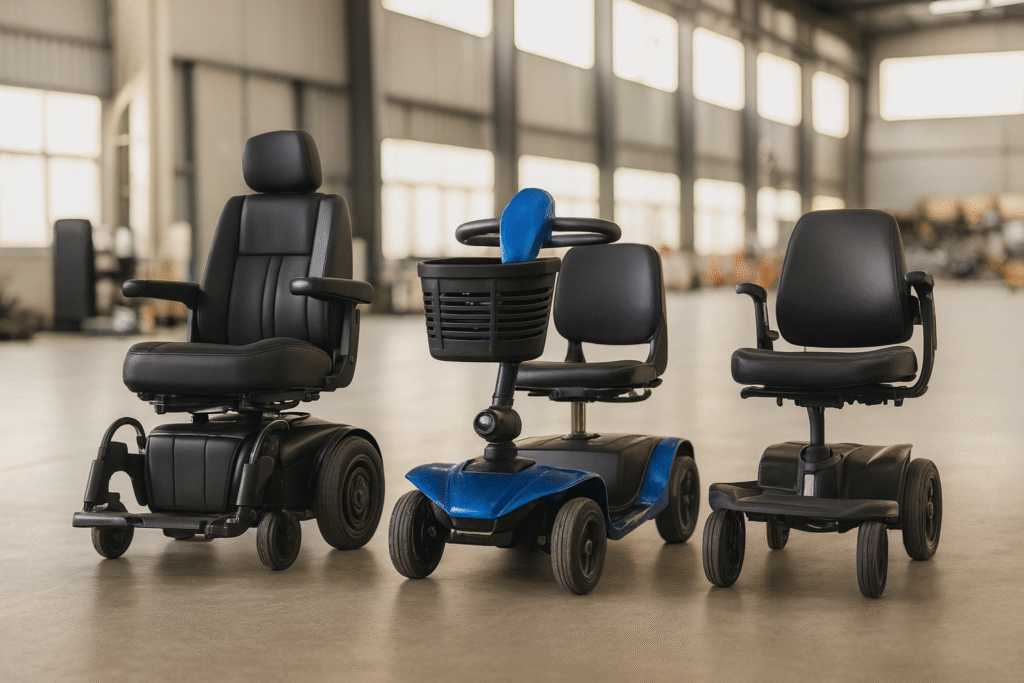
China has become the world’s largest manufacturer and exporter of mobility aid equipment, supplying distributors, medical supply companies, and healthcare institutions across more than 150 countries. 1000Mobility, headquartered in Zhangjiagang, Jiangsu Province—one of China’s premier medical equipment manufacturing hubs—stands at the forefront of this industry with a comprehensive product portfolio spanning six major categories: electric wheelchairs, mobility scooters, portable scooters, manual wheelchairs, rollator walkers, and vehicle lifts.
This complete B2B sourcing guide is designed for distributors, procurement managers, and medical equipment importers who are evaluating Chinese mobility aid manufacturers. Whether you are sourcing mobility equipment wholesale for the first time or looking to diversify your existing supply chain, this guide covers every critical aspect: the Chinese mobility aid manufacturing landscape, product category overviews, manufacturer selection criteria, OEM/ODM processes, quality control and certifications, shipping and logistics, and answers to the most frequently asked questions from B2B buyers worldwide.
With over 30 countries served, multiple international certifications (FDA, CE, ISO 13485, ISO 9001, RoHS), and full OEM/ODM capabilities, 1000Mobility represents the new generation of Chinese medical equipment suppliers—combining manufacturing excellence with the flexibility and service orientation that global B2B partners demand.
China Mobility Aid Manufacturing Landscape
China’s mobility aid manufacturing industry has evolved dramatically over the past two decades. What began as a low-cost production base for basic wheelchairs has transformed into a sophisticated, innovation-driven ecosystem that produces everything from carbon fiber electric wheelchairs to smart mobility scooters with IoT connectivity. Understanding this landscape is essential for B2B buyers seeking reliable manufacturing partners.
Export Data & Industry Growth
China’s medical rehabilitation equipment exports, which include mobility aids, were valued at approximately USD 8.5 billion in 2024, representing year-over-year growth of 12%. Mobility aids—specifically wheelchairs, scooters, and rollators—account for roughly 35% of this export value. The United States, Germany, the United Kingdom, Japan, and Australia are the top five export destinations, collectively accounting for over 50% of Chinese mobility aid exports.
The growth trajectory is driven by several factors: aging populations in developed countries, expanding healthcare access in emerging markets, technological advancements in lightweight materials (carbon fiber, advanced aluminum alloys), and the increasing sophistication of Chinese manufacturers in meeting international regulatory standards. Chinese manufacturers now routinely obtain FDA, CE, and ISO certifications, narrowing the quality gap with traditional Western and Japanese manufacturers while maintaining significant cost advantages.
Industry Clusters & Geographic Concentration
China’s mobility aid manufacturing is concentrated in several key industrial clusters, each with distinct specializations:
| Region | Specialization | Key Advantages |
|---|---|---|
| Jiangsu Province (Zhangjiagang, Suzhou) | Full-range mobility aids, electric wheelchairs, rollators | Complete supply chain, port access, skilled labor, medical device cluster |
| Guangdong Province (Foshan, Shenzhen) | Electric wheelchairs, smart mobility devices | Electronics integration, battery supply chain, export infrastructure |
| Zhejiang Province (Jinhua, Yongkang) | Manual wheelchairs, rollators, walking aids | Cost-efficient production, metalworking expertise, high volume |
| Shandong Province (Qingdao) | Mobility scooters, medical beds | Port access, steel/aluminum supply, large-format manufacturing |
1000Mobility’s location in Zhangjiagang is strategically significant. Zhangjiagang is a major port city on the Yangtze River, providing direct access to Shanghai’s international shipping infrastructure. The city is part of the broader Suzhou medical device manufacturing cluster, which includes suppliers of carbon fiber materials, lithium batteries, electric motors, and precision metal components—all critical inputs for mobility aid manufacturing. This geographic advantage translates to shorter supply chains, faster prototyping, and more competitive pricing for B2B buyers.
The Evolution of Chinese Mobility Aid Manufacturing
The Chinese mobility aid industry has progressed through three distinct phases:
- Phase 1 (2000-2010): Cost Leadership. Chinese manufacturers competed primarily on price, producing basic manual wheelchairs and rollators for OEM customers. Quality was variable, and brand recognition was minimal.
- Phase 2 (2010-2020): Quality & Certification. Leading manufacturers invested in ISO 9001, ISO 13485, CE, and FDA certifications. Product quality improved significantly, and Chinese-made mobility aids gained acceptance in regulated Western markets.
- Phase 3 (2020-Present): Innovation & Brand Building. Manufacturers like 1000Mobility are now developing proprietary products with advanced materials (carbon fiber), smart features (IoT connectivity), and distinctive designs. The focus has shifted from cost leadership to value creation and brand differentiation.
For B2B buyers, this evolution means that sourcing from China is no longer just about cost savings. Today’s leading Chinese manufacturers offer product innovation, design capabilities, certification support, and after-sales service that rival traditional Western manufacturers—at competitive prices. 1000Mobility exemplifies this new standard.
Product Categories Overview
1000Mobility manufactures six major product categories, comprising 19 individual products. Each category serves distinct end-user needs and market segments, allowing distributors to build comprehensive mobility aid portfolios from a single supplier.
| Category | Products | Key Materials | Target Markets | Certifications |
|---|---|---|---|---|
| Electric Wheelchairs | 7 models (LUMA Carbon, ALYA Core, ALYA Air, ALYA Flex, Striker GT, MAGNA Carbon, ALYA Air Ultra) | Carbon fiber, aluminum alloy | Premium mobility, elderly care, rehab | FDA, CE, ISO 13485 |
| 4-Wheel Mobility Scooters | 3 models (Cooper, Milo, TOBY) | Steel, aluminum | Outdoor mobility, retail pharmacy | CE, ISO 9001 |
| Portable Mobility Scooters | 4 models (Riley, Zippy, Maxwell, Aero Carbon) | Aluminum alloy, carbon fiber | Travel, indoor/outdoor, all-terrain | CE, ISO 9001, RoHS |
| Manual Wheelchairs | 2 models (MIRA Self-Propelled, MIRA Transit) | Aluminum (double-braced) | Hospital, home care, transit | CE, ISO 13485 |
| Rollator Walkers | 2 models (NOVA Carbon, PIXIE) | Carbon fiber, aluminum alloy | Elderly care, retail medical supply | FDA, CE, ISO 13485 |
| Vehicle Lifts | 1 model (LIFTGO W1) | Steel, aluminum, lithium battery | Automotive accessibility, vehicle modification | CE, RoHS, ISO 9001 |
Product Category Highlights
Electric Wheelchairs (7 Products)
Our flagship category, featuring both carbon fiber models (LUMA Carbon, MAGNA Carbon with T-700 carbon fiber at just 15.8 kg) and aluminum models (ALYA series). All are foldable with speeds up to 6 km/h. The MAGNA Carbon offers a 30 km range on a single charge. The ALYA Air Ultra features a 17.8-inch wide seat for larger users, and the Striker GT includes a seat-lifting function. This category offers the widest range of price points and feature sets for distributors.
4-Wheel Mobility Scooters (3 Products)
Designed for outdoor stability and comfort. The TOBY is ultra-lightweight at just 20 kg, while the Cooper (40 kg) offers robust performance with a 300W motor. The Milo features a one-key detachable battery for convenient charging. All models are foldable for transport and storage.
Portable Mobility Scooters (4 Products)
Compact, travel-friendly scooters for users who need mobility assistance on the go. The Aero Carbon stands out at just 14 kg with carbon fiber construction. The Maxwell is an all-terrain heavy-duty option with a 450W motor. Riley and Zippy are compact folding scooters ideal for indoor and light outdoor use.
Manual Wheelchairs (2 Products)
The MIRA Self-Propelled features quick-release rear wheels, flip-up armrests, swing-away legrests, and airless PU tires for low maintenance. The MIRA Transit is a lightweight transport chair at 11.8 kg with caregiver hand brakes and parking lock—ideal for institutional and care facility use.
Rollator Walkers (2 Products)
The NOVA Carbon is our FDA-certified premium rollator with a carbon fiber frame, ideal for the U.S. market. The PIXIE offers exceptional value at 8 kg with a 136 kg load capacity. Both are foldable and designed for elderly users seeking stable, lightweight walking support.
Vehicle Lifts (1 Product)
The LIFTGO W1 is a portable electric vehicle lift powered by a 24V 5Ah lithium battery. At just 10 kg, it can lift up to 50 kg to a height of 76 cm—sufficient for loading most portable wheelchairs and scooters into vehicle cargo areas. This product fills a growing market gap between expensive permanent lifts and impractical manual loading.
How to Choose a Mobility Aid Manufacturer in China
Selecting the right mobility aid manufacturer in China is one of the most consequential decisions a B2B distributor will make. The manufacturer you choose will determine product quality, certification compliance, customization capabilities, lead times, and ultimately your brand’s reputation in the market. This section provides a detailed, actionable framework for evaluating and selecting a Chinese mobility aid manufacturer, drawing on 1000Mobility’s experience serving distributors in over 30 countries.
1. Certification & Regulatory Compliance
The single most important criterion is certification. A manufacturer without the appropriate certifications cannot legally supply products to regulated markets, and distributing non-compliant products exposes your business to legal liability, customs seizure, and reputational damage. At minimum, verify that the manufacturer holds:
- ISO 9001: The foundational quality management system certification. Every legitimate manufacturer should hold this.
- ISO 13485: Medical device-specific quality management. Essential for manufacturers of wheelchairs, rollators, and other products classified as medical devices.
- CE Marking: Required for European market access. Verify that CE certificates are valid and product-specific, not generic factory certifications.
- FDA Registration: For U.S. market access, the manufacturer must be registered with the FDA and specific products must be listed. Request the FDA registration number and verify it on the FDA database.
- RoHS: Required for electronic products (electric wheelchairs, scooters, vehicle lifts) sold in the EU and increasingly required globally.
Red flag: A manufacturer that cannot produce current, valid certificates or that offers to “obtain certifications after the order” is not a reliable partner. 1000Mobility maintains all certifications current and provides documentation upon request to verified B2B buyers.
2. Manufacturing Capabilities & Capacity
Assess whether the manufacturer has the production capacity to meet your current and projected order volumes. Key questions include: What is the monthly production capacity? How many production lines are dedicated to each product category? What is the typical lead time for standard vs. OEM/ODM orders? Does the manufacturer have in-house capabilities for critical processes (welding, painting, assembly, testing) or do they outsource?
1000Mobility operates integrated production facilities in Zhangjiagang with in-house capabilities for frame welding, surface treatment, electronic assembly, and quality testing. This vertical integration ensures consistent quality control and shorter lead times compared to manufacturers who outsource critical processes.
3. Product Range & Specialization
A manufacturer with a broad product range offers strategic advantages: you can consolidate multiple product categories with a single supplier, reducing logistics complexity and enabling volume-based pricing. However, breadth should not come at the expense of depth—each product category should demonstrate genuine expertise, not just a token offering.
1000Mobility’s six-category portfolio (19 products) allows distributors to source their entire mobility aid range from one partner. Each category includes multiple models at different price points, enabling tiered product strategies. Our specialization in carbon fiber technology (applied across electric wheelchairs, portable scooters, and rollators) demonstrates genuine material expertise rather than superficial product breadth.
4. OEM/ODM Capabilities
For distributors building private-label brands, OEM/ODM capabilities are essential. Evaluate: Does the manufacturer have an in-house design/engineering team? Can they produce custom prototypes? What is the prototyping timeline? Do they support custom packaging, user manuals, and branding? Can they assist with obtaining certifications for custom designs?
5. Quality Control Systems
Request details of the manufacturer’s quality control processes: incoming material inspection, in-process quality control, final inspection protocols, and defect rate tracking. Ask for sample quality inspection reports from previous orders. A manufacturer with robust QC systems will be transparent about their processes and willing to share documentation.
6. Communication & Responsiveness
In B2B sourcing, communication quality is often the difference between a smooth partnership and a frustrating experience. Evaluate response times, English proficiency, technical knowledge of the sales team, and willingness to provide detailed information. A manufacturer that responds within 24 hours with substantive, accurate information is demonstrating the service orientation that matters for long-term partnership.
7. After-Sales Support
After-sales support is frequently overlooked during supplier evaluation but becomes critical once orders are in the market. Verify: warranty terms, spare parts availability, technical support channels, and the process for handling defective products. A manufacturer that stands behind their products with comprehensive after-sales support protects your brand reputation and reduces customer service costs.
8. Factory Location & Logistics
The manufacturer’s location affects shipping costs, lead times, and your ability to visit the facility. Proximity to a major port (Shanghai, Shenzhen, Ningbo) reduces inland transportation costs and simplifies export logistics. Zhangjiagang’s location on the Yangtze River provides 1000Mobility with direct access to Shanghai’s port infrastructure, one of the world’s busiest container ports.
Summary Checklist: When evaluating a Chinese mobility aid manufacturer, prioritize: (1) valid certifications, (2) in-house manufacturing capabilities, (3) genuine product expertise, (4) proven OEM/ODM track record, (5) documented quality control, (6) responsive communication, (7) comprehensive after-sales support, and (8) strategic factory location. 1000Mobility meets all eight criteria—contact us to begin the evaluation process.
OEM/ODM Process: From Design to Delivery
1000Mobility’s OEM/ODM process is designed to take distributors from initial concept to delivered product with maximum efficiency and transparency. Whether you are branding an existing product (OEM) or developing a completely new design (ODM), our structured process ensures predictable timelines and consistent quality.
Requirements Analysis & Quotation
The process begins with a detailed discussion of your requirements: product specifications, target price point, order quantity, customization level, certification needs, and timeline. Our sales and engineering teams jointly review the requirements and provide a detailed quotation within 24-48 hours, including unit pricing, tooling costs (if applicable), lead time, and certification roadmap.
Design & Prototyping
For OEM projects, we prepare samples of the existing product with your requested customizations (colors, logos, packaging). For ODM projects, our engineering team creates CAD designs and technical specifications for your review. Prototypes are fabricated using the actual production materials and processes, ensuring that what you evaluate is representative of the final product. Prototype lead time: 1-2 weeks (OEM), 3-4 weeks (ODM).
Sample Evaluation & Approval
You receive physical samples for evaluation. We encourage thorough testing: functional performance, material quality, aesthetic finish, packaging integrity, and user experience. Feedback is incorporated, and revised samples are produced if needed. Once you approve the final sample, it becomes the golden standard for mass production.
Tooling & Pre-Production
For custom designs requiring new tooling (molds, jigs, fixtures), this phase involves tooling fabrication and pre-production sample (PPS) approval. The PPS is produced using the actual mass production line and tooling, serving as the final verification before full-scale manufacturing begins. Tooling lead time: 2-3 weeks.
Mass Production
Full-scale manufacturing begins upon deposit confirmation. Production follows our ISO 9001/ISO 13485 quality management protocols, with in-process quality control at every stage. We provide weekly production status updates including photos and videos of the production line, ensuring full transparency throughout the manufacturing process. Production lead time: 25-35 days for standard products.
Quality Inspection & Packaging
Every order undergoes a comprehensive final quality inspection before packaging. This includes visual inspection, functional testing, dimensional verification, and packaging drop tests. Third-party inspection (SGS, TUV, Intertek) can be arranged at the buyer’s request and expense. Detailed inspection reports with photos are provided for every shipment.
Container Loading & Shipping
Approved products are loaded into containers at our facility or transported to the port for LCL (less than container load) shipments. We handle all export documentation, including commercial invoice, packing list, certificate of origin, and certification documents. FOB (Zhangjiagang/Shanghai) and CIF terms are available. Sea freight transit: 15-35 days depending on destination.
Delivery & After-Sales
Upon arrival at your destination port, your freight forwarder handles customs clearance and final delivery. We provide remote technical support for any post-delivery questions and maintain spare parts inventory for warranty support. Our after-sales team is available throughout the product lifecycle to ensure your ongoing satisfaction.
Quality Control & Certifications
Quality is the foundation of 1000Mobility’s reputation as a trusted mobility aid manufacturer. Our quality management system is certified to both ISO 9001 (general quality management) and ISO 13485 (medical device quality management), ensuring that every product meets the rigorous standards required for global medical equipment distribution.
Multi-Stage Quality Control Process
| Stage | Inspection Activities | Documentation |
|---|---|---|
| Incoming Material Inspection | Verify material specifications, certificates of conformity, dimensional checks, visual inspection | Material inspection report, supplier COC |
| In-Process Quality Control | Weld integrity checks, dimensional verification during assembly, electrical safety testing, functional testing at each assembly station | Production QC log, station inspection records |
| Final Product Inspection | 100% functional testing, load testing, fold/unfold cycle testing, brake performance, battery charge/discharge verification, visual quality inspection | Final inspection report (per unit and batch) |
| Pre-Shipment Inspection | Batch sampling inspection (AQL 2.5), packaging integrity, labeling accuracy, documentation verification | Pre-shipment inspection report with photos |
Product Testing Standards
Our products are tested against internationally recognized standards to ensure safety and durability:
- ANSI/RESNA WC-1: Wheelchair testing standards (static stability, dynamic stability, fatigue testing)
- ISO 7176: Wheelchair requirements and test methods
- EN 12182: Technical aids for disabled persons — general requirements and test methods
- EN 12183: Manually operated wheelchairs — requirements and test methods
- FDA 21 CFR 820: Quality system regulation for medical devices
- IEC 61000: Electromagnetic compatibility for electric mobility devices
Certification Portfolio
| Certification | Type | Coverage |
|---|---|---|
| FDA | Product registration | NOVA Carbon rollator; expandable to other models for U.S. market |
| CE | Product conformity | All product categories for EU market |
| ISO 13485 | Quality management system | Medical device manufacturing (factory-wide) |
| ISO 9001 | Quality management system | All manufacturing operations (factory-wide) |
| RoHS | Substance compliance | All electronic products (e-wheelchairs, scooters, lifts) |
Shipping & Logistics for B2B Importers
Efficient shipping and logistics are critical for maintaining competitive landed costs and reliable inventory cycles. 1000Mobility’s location in Zhangjiagang provides strategic logistics advantages, and our experience exporting to 30+ countries ensures smooth international shipping processes.
Shipping Methods
| Method | Transit Time | Cost | Best For |
|---|---|---|---|
| Sea Freight (FCL) | 15-35 days | Lowest per unit | Large orders (full container loads) |
| Sea Freight (LCL) | 20-40 days | Low-moderate | Small to medium orders |
| Air Freight | 5-10 days | High | Urgent orders, samples, spare parts |
| Express Courier | 3-7 days | Highest | Samples, documents, small spare parts |
Incoterms & Pricing
We offer flexible Incoterms to suit your logistics preferences:
- FOB (Zhangjiagang/Shanghai): You arrange shipping from the port. Best for distributors with established freight forwarder relationships.
- CIF (Destination Port): We arrange and include sea freight and insurance to your destination port. Simplifies logistics for first-time importers.
- DDP (Delivered Duty Paid): We handle door-to-door delivery including customs clearance and duties. Available for select destinations.
Export Documentation
We prepare and provide all necessary export documentation with every shipment:
- Commercial Invoice (with HS codes)
- Packing List (with carton dimensions and weights)
- Bill of Lading (B/L) or Airway Bill (AWB)
- Certificate of Origin (COO) — for preferential tariff treatment
- Product certification documents (FDA, CE, ISO copies as applicable)
- Material Safety Data Sheets (MSDS) for lithium batteries
Packaging for Export
All products are packaged for international shipping with protective materials to withstand long-distance transport. Standard packaging includes: corrugated cartons with foam inserts, individual product poly bags, desiccant packets for moisture protection, and palletized loading for container shipments. Custom retail packaging is available through OEM/ODM services.
Estimated Landed Cost Example
Example (Electric Wheelchair, FCL to Los Angeles): Unit price (FOB) + sea freight per unit + insurance + U.S. customs duty (typically 0-5% for medical devices) + port handling + inland transport to warehouse = total landed cost. Our sales team provides detailed landed cost estimates with every quotation, helping you accurately calculate your margin before committing to an order.
Frequently Asked Questions
What products does 1000Mobility manufacture?
1000Mobility manufactures six product categories: electric wheelchairs (7 models including carbon fiber and aluminum), 4-wheel mobility scooters (3 models), portable mobility scooters (4 models including carbon fiber), manual wheelchairs (2 models), rollator walkers (2 models including FDA-certified carbon fiber), and wheelchair & scooter vehicle lifts (1 model). All products are designed for B2B distribution with OEM/ODM support.
What is the minimum order quantity (MOQ) for wholesale orders?
MOQs vary by product category: 50 units for vehicle lifts, 100 units for rollators and manual wheelchairs, and 100-200 units for electric wheelchairs and mobility scooters depending on the model. OEM/ODM projects with custom branding typically require 200+ units. Sample orders are available for qualified distributors.
What certifications do 1000Mobility products carry?
Our products carry FDA certification (select models for U.S. market), CE marking for European markets, ISO 13485 medical device quality management certification, ISO 9001 quality management system certification, and RoHS compliance. Specific certifications vary by product model—we provide detailed certification documentation with every quotation.
How long does it take to receive an order from China?
Standard products typically ship 25-35 days after order confirmation and deposit payment. OEM/ODM projects require 45-60 days depending on customization complexity. Sea freight to major ports takes 15-35 days depending on destination. Air freight is available for urgent orders at additional cost. Total lead time from order to delivery is typically 6-10 weeks for sea freight.
Do you offer OEM/ODM services for custom branding?
Yes, 1000Mobility offers comprehensive OEM/ODM services across all product categories. OEM services include custom branding, colors, packaging, and accessories. ODM services include custom frame design, material engineering, prototyping, and certification support. Our engineering team works from concept through mass production.
How does the inquiry-based pricing model work?
We use an inquiry-based pricing model to provide volume-accurate quotations. Buyers submit requirements (product models, quantities, customization needs, destination port) via our website inquiry form. Our sales team responds within 24 hours with a detailed quotation including FOB/CIF pricing, lead time, certification documentation, and shipping options.
What payment terms do you accept for B2B orders?
Standard payment terms are 30% deposit upon order confirmation and 70% balance before shipment (by T/T bank transfer). For established customers with order history, we offer flexible terms including L/C (letter of credit) and extended payment terms. All payment terms are negotiated and confirmed in the proforma invoice.
Can I visit your factory in Zhangjiagang?
Yes, we welcome factory visits from verified B2B partners. Our facility in Zhangjiagang, Jiangsu Province is approximately 2 hours from Shanghai by car. We can arrange factory tours, product demonstrations, and quality inspection meetings. Contact our sales team to schedule a visit.
Do you provide after-sales support and spare parts?
Yes, all products come with a 12-month manufacturer warranty. We provide spare parts at cost for warranty claims and maintain inventory of common replacement components. Our after-sales team offers technical support, troubleshooting guidance, and warranty claim processing for all B2B partners.
How do you ensure product quality for export orders?
Quality is ensured through our ISO 9001 and ISO 13485 certified quality management system. We conduct incoming material inspection, in-process quality control, and pre-shipment final inspection on every order. Third-party inspection (SGS, TUV, Intertek) can be arranged at the buyer’s request. Detailed inspection reports are provided with each shipment.
Start Your Mobility Aid Sourcing Journey with 1000Mobility
Partner with a manufacturer that delivers quality, innovation, and B2B service excellence. Get your customized quotation today.
 English
  Deutsch
  Français
  Español
  Italiano
  العربية
  Русский