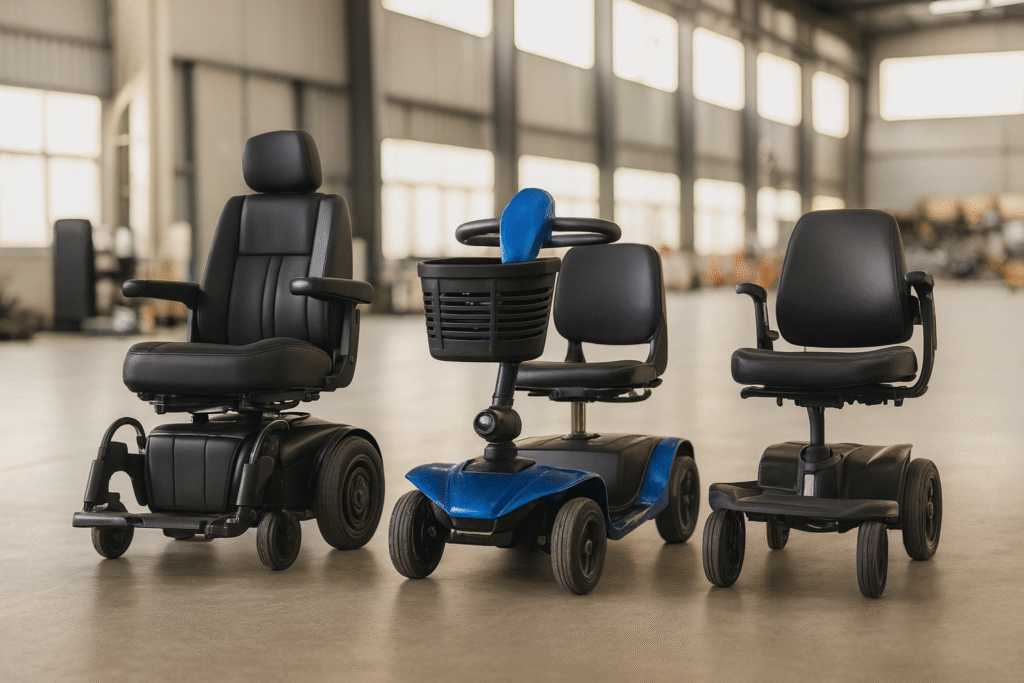
B2B Buying Guide: Electric Wheelchairs
Quick Answer: Electric wheelchairs are powered mobility devices using electric motors and battery systems for users with limited walking ability. B2B buyers should evaluate motor power (250–500W), battery capacity (20–60Ah), frame material (carbon fiber, aluminum, or steel), weight capacity (100–150kg), foldability, and certification requirements (CE MDR, FDA) when sourcing from manufacturers.
Last updated: July 2026
Electric wheelchairs are powered mobility devices that use electric motors and battery systems to provide independent mobility for users with limited walking ability. For B2B buyers — distributors, importers, and medical supply companies — selecting the right electric wheelchair supplier requires understanding product types, core specifications, material options, certification requirements, and manufacturing capabilities. This guide covers everything you need to make an informed purchasing decision.
What Types of Electric Wheelchairs Are Available?
Folding Electric Wheelchairs
Folding electric wheelchairs are designed for portability and transport. They feature a folding frame mechanism that allows the wheelchair to collapse compactly for storage in car trunks, airplanes, or tight spaces. Typical weight ranges from 18-30kg. Folding models are the most popular category for B2B distribution due to broad market appeal.
1000Mobility models: ALYA Air, ALYA Core, ALYA Flex, Striker GT
Carbon Fiber Electric Wheelchairs
Carbon fiber electric wheelchairs represent the premium segment, offering the highest strength-to-weight ratio of any wheelchair material. Carbon fiber frames are 40-50% lighter than aluminum while maintaining equal or greater structural strength. The carbon fiber wheelchair market is projected to grow at a CAGR of 12% through 2030, with market share increasing from 13.7% to 28.5% (Accio.ai).
1000Mobility models: Luma Carbon, Magna Carbon
Heavy-Duty Electric Wheelchairs
Heavy-duty models support higher weight capacities (150-200kg) with reinforced frames, larger motors (400W-500W), and bigger batteries. These are suited for bariatric users and outdoor terrain. Steel or reinforced aluminum frames are common.
1000Mobility models: ALYA Flex
Seat-Lifting Electric Wheelchairs
Seat-lifting models include a powered lift mechanism that raises the seat height, enabling users to reach higher objects or transfer more easily. These serve rehabilitation centers and users with specific mobility needs.
1000Mobility models: Striker GT
What Core Specifications Should B2B Buyers Evaluate?
| Specification | Why It Matters | Typical Range |
|---|---|---|
| Motor Power | Determines climbing ability and outdoor performance | 250W (indoor) — 500W (outdoor/heavy-duty) |
| Battery Capacity | Affects range per charge; larger = heavier | 12Ah (10-15km) — 60Ah (40-50km) |
| Battery Type | Lithium-ion: lighter, longer life; Lead-acid: cheaper, heavier | Li-ion (preferred for export) |
| Weight Capacity | Must match target user demographics | 100kg — 200kg |
| Total Weight | Affects shipping costs and user portability | 15kg (carbon) — 35kg (steel) |
| Folding Size | Important for transport and storage | Varies by model |
| Charging Time | User convenience factor | 4-8 hours typical |
| Controller Type | Affects user experience and customization | PG, VSI, or custom programming |
Material Comparison: Carbon Fiber vs Aluminum vs Steel
| Property | Carbon Fiber | Aviation Aluminum | Steel |
|---|---|---|---|
| Weight (typical wheelchair) | ~15kg | ~25kg | ~35kg |
| Strength-to-Weight Ratio | Highest | Good | Moderate |
| Corrosion Resistance | Excellent | Good | Poor (requires coating) |
| Durability | 10+ years | 8-10 years | 5-8 years |
| Price Range (ex-factory) | Premium | Mid-range | Budget |
| Market Position | High-end retail | Mainstream | Entry-level |
| Customization | Mold-based, higher MOQ | Welding-based, flexible | Welding-based, flexible |
Recommendation: For distributors targeting premium market segments, carbon fiber products offer the highest margins and differentiation. For volume-driven markets, aluminum models provide the best price-to-performance ratio.
What Certification Requirements Apply by Market?
| Market | Required Certification | Regulatory Body | Typical Timeline |
|---|---|---|---|
| European Union | CE-MDR (Medical Device Regulation) | Notified Body | 3-6 months |
| United States | FDA 510(k) or Registration | FDA | 2-6 months |
| United Kingdom | UKCA | Approved Body | 2-4 months |
| Australia | TGA Registration | TGA | 3-6 months |
| Canada | Health Canada Medical Device License | Health Canada | 3-6 months |
| India | CDSCO Registration | CDSCO | 4-8 months |
| Brazil | ANVISA Registration | ANVISA | 6-12 months |
1000Mobility products hold CE, FDA, ISO 13485, and ISO 9001 certifications. We provide technical documentation to support your market-specific registration process. View our certifications.
What Are the MOQ and Pricing Strategies?
| Order Type | MOQ | Lead Time | Payment Terms |
|---|---|---|---|
| Sample Order | 1 unit | 7-15 days | 100% in advance |
| Standard Order | 20 units | 30-45 days | 30% deposit + 70% before shipping |
| OEM/ODM Order | 20 units | 35-50 days | 30% deposit + 70% before shipping |
| Bulk Order | 100+ units | 45-60 days | 30% deposit + 70% before shipping |
Pricing tip: Request tiered pricing based on annual volume commitment. Typical distributor discounts range from 5% (50+ units) to 15% (500+ units). Learn about distributor pricing.
What Shipping and Logistics Should Buyers Consider?
- Sea Freight (FOB/CIF/DDP): 25-35 days, most cost-effective for bulk orders. Typical container: 80-120 wheelchairs per 20ft container depending on model and packaging.
- Air Freight: 5-10 days, suitable for urgent orders or samples. Higher cost but faster delivery.
- Express (DHL/FedEx): 3-7 days, best for sample orders under 30kg.
- Export Documentation: Commercial invoice, packing list, certificate of origin, bill of lading. We handle all documentation.
- Battery Shipping: Lithium-ion batteries require UN38.3 test report and IEC 62133 compliance for international transport.
Common Purchasing Pitfalls and How to Avoid Them
1. Choosing Price Over Quality
The cheapest supplier often cuts corners on materials, welding quality, or battery specifications. A 15% price difference can mean the difference between a 1% defect rate and a 10% defect rate — costing far more in returns and warranty claims.
2. Ignoring Certification Requirements
Importing uncertified medical devices can result in customs seizure, fines, or market bans. Always verify that your supplier holds valid certifications for your target market before placing an order.
3. Underestimating Lead Times
Factor in 30-45 days for production plus 25-35 days for sea freight. Plan orders 2-3 months ahead of your expected sales season. Rush orders incur premium charges and may compromise quality.
4. Not Testing Samples First
Always order a sample before committing to a bulk order. Test the product with actual users in your market. Sample costs are typically credited toward bulk orders.
5. Overlooking After-Sales Support
Confirm spare parts availability, warranty terms, and technical support before ordering. A reliable supplier provides 1% free spare parts with bulk orders and responds to quality issues within 24 hours.
Why Choose 1000Mobility as Your Electric Wheelchair Supplier?
- Carbon fiber expertise: Among the few Chinese manufacturers producing carbon fiber rollators and wheelchairs
- 15+ product models across electric wheelchairs, mobility scooters, and rollators
- Full certifications: CE, FDA, ISO 13485, ISO 9001
- OEM/ODM capabilities: Custom branding, specifications, and packaging — Learn more
- 50,000 sqm partner factory with 3,000 units/month capacity — View factory tour
- 5-language website and product manuals (EN/DE/FR/ES/IT)
- Global export experience to North America, Europe, Middle East, and beyond
Contact us for a product catalog and quotation.
Frequently Asked Questions
Q: What is the minimum order quantity for electric wheelchairs?
A: Sample orders start from 1 unit. Standard orders require a minimum of 20 units. OEM/ODM orders with custom branding also start at 20 units. Bulk orders of 100+ units qualify for tiered distributor pricing.
Q: How do I choose between carbon fiber and aluminum electric wheelchairs?
A: Choose carbon fiber for premium market segments where lightweight and differentiation justify higher prices. Choose aluminum for mainstream markets where price-to-performance ratio is the priority. Carbon fiber wheelchairs are 40-50% lighter than aluminum equivalents.
Q: What certifications do I need to import electric wheelchairs?
A: Requirements vary by market: EU requires CE-MDR, US requires FDA registration or 510(k), UK requires UKCA, Australia requires TGA registration. 1000Mobility holds CE, FDA, ISO 13485, and ISO 9001 certifications and provides documentation to support your registration process.
Q: How long does it take to receive my order?
A: Production takes 30-45 days for standard orders and 7-15 days for samples. Shipping adds 25-35 days by sea freight or 5-10 days by air freight. Total lead time from order to delivery is typically 2-3 months by sea or 6-8 weeks by air.
Q: Can I customize the electric wheelchairs with my own brand?
A: Yes, we offer OEM/ODM services including custom logo, frame color, packaging, user manual language, controller programming, and specification adjustments. MOQ for OEM orders is 20 units. Learn about OEM/ODM services.
Q: What warranty and after-sales support do you provide?
A: We provide 1% free spare parts with bulk orders, warranty on manufacturing defects, technical support via email or video call, and priority spare parts supply for distributors. Our team responds to quality complaints within 24 hours.
Q: Do you provide product training for distributors?
A: Yes, we offer online or on-site product training covering assembly, maintenance, troubleshooting, and user guidance. Training materials can be localized in your language for exclusive distributors.
 English
  Deutsch
  Français
  Español
  Italiano
  العربية
  Русский