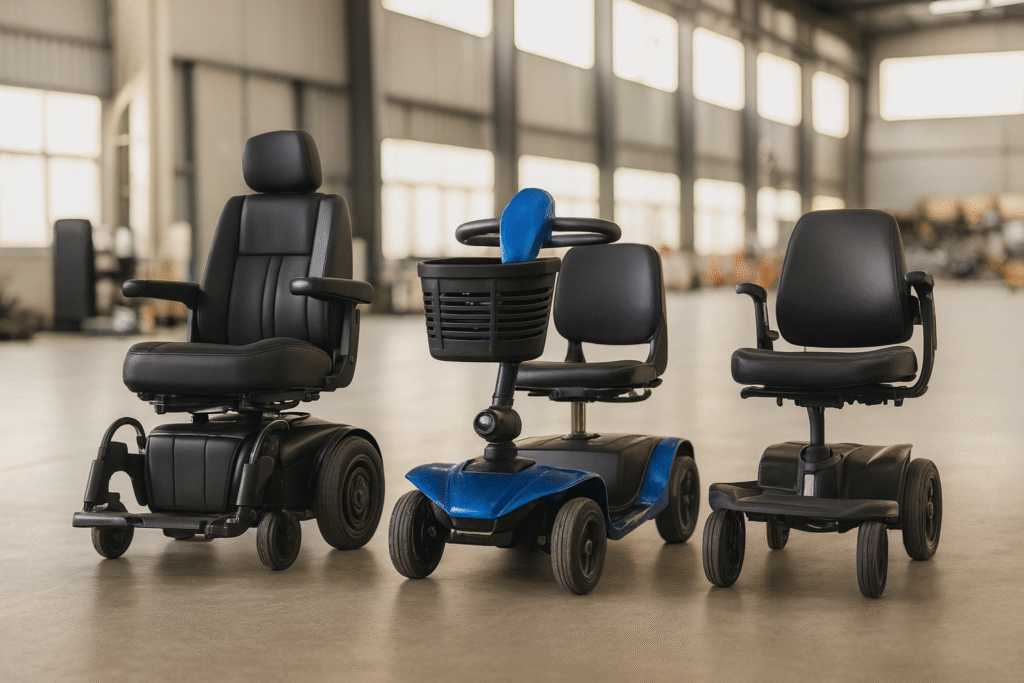
B2B Buying Guide: Mobility Scooters
Quick Answer: Mobility scooters are electric-powered vehicles with tiller steering designed for individuals with limited mobility. B2B buyers should evaluate wheel configuration (3-wheel vs 4-wheel), weight capacity (100–200kg), battery range, folding mechanism, and local speed classification regulations when sourcing from manufacturers.
Last updated: July 2026
Mobility scooters are electric-powered vehicles designed to assist individuals with limited mobility in navigating indoor and outdoor environments. Unlike electric wheelchairs, mobility scooters feature a tiller steering system, a seat mounted on a platform, and are primarily designed for users who can walk short distances but need assistance for longer trips. For B2B buyers — distributors, importers, and medical supply companies — understanding scooter types, specifications, and market regulations is essential for making informed purchasing decisions.
What Types of Mobility Scooters Are Available?
3-Wheel Mobility Scooters
3-wheel scooters feature two rear wheels and one front wheel with tiller steering. They offer a tighter turning radius, making them ideal for indoor use and narrow spaces. However, they provide less stability than 4-wheel models on uneven terrain.
Best for: Indoor use, shopping centers, smooth surfaces, users who prioritize maneuverability.
4-Wheel Mobility Scooters
4-wheel scooters provide superior stability with four points of ground contact. They are designed for outdoor use, uneven terrain, and higher speeds. The wider wheelbase offers better balance but requires more space for turning.
Best for: Outdoor use, parks, rough terrain, users who prioritize stability.
1000Mobility models: Cooper, Maxwell, Milo
Folding Mobility Scooters
Folding scooters collapse into a compact form for transport in car trunks, airplanes, or public transit. They typically use lightweight aluminum frames and smaller batteries to reduce weight. Folding models are growing in popularity for travel and urban mobility markets.
Best for: Travel, urban users, portability-focused customers.
1000Mobility models: Riley, Zippy
Heavy-Duty Mobility Scooters
Heavy-duty scooters support higher weight capacities (150-200kg) with reinforced frames, larger motors (500W+), and bigger batteries for extended range. They are built for outdoor use, inclines, and larger users. Wider tires and suspension systems are common features.
Best for: Outdoor terrain, bariatric users, commercial/institutional use.
1000Mobility models: Patinete XL
What Core Specifications Should B2B Buyers Evaluate?
| Specification | Why It Matters | Typical Range |
|---|---|---|
| Velocidad máxima | Affects user experience and regulatory classification | 6 km/h (Class 2) — 15 km/h (Class 3) |
| Campo de prácticas | Distance per battery charge; critical for user satisfaction | 15-50 km depending on battery and terrain |
| Capacidad de carga | Must match target user demographics | 100kg — 200kg |
| Potencia del motor | Determines climbing ability and acceleration | 250W (lightweight) — 800W (heavy-duty) |
| Capacidad de la batería | Affects range and charging time | 12Ah — 60Ah (lead-acid or lithium-ion) |
| Radio de giro | Important for indoor maneuverability | 0.8m (3-wheel) — 1.5m (4-wheel) |
| Total Weight | Affects shipping costs and portability | 25kg (folding) — 80kg (heavy-duty) |
| Distancia al suelo | Determines obstacle navigation ability | 5cm (indoor) — 15cm (outdoor) |
Electric Wheelchair vs Mobility Scooter: Which to Choose?
| Feature | Silla de ruedas eléctrica | Scooter de movilidad |
|---|---|---|
| Steering | Joystick control | Tiller handlebar |
| Primary Use | Indoor + daily mobility | Outdoor + longer distances |
| User Profile | Limited upper body mobility | Can walk short distances, needs assistance for longer trips |
| Radio de giro | Tighter (center-wheel drive) | Wider (especially 4-wheel) |
| Portabilidad | Folding models available | Folding models available, generally heavier |
| Velocidad | 4-8 km/h typical | 6-15 km/h typical |
| Price Range | Mid to premium | Entry to mid-range |
| Market Size (US) | 33,100 searches/month | 49,500 searches/month |
Distribution strategy tip: Offering both product lines allows you to serve a broader customer base. Mobility scooters have higher search volume and broader market appeal, while electric wheelchairs serve a more specialized segment with higher per-unit margins.
Target User Scenarios
Elderly Mobility
Aging populations represent the largest market segment for mobility scooters. Key features: easy-to-read displays, comfortable seating, simple controls, and safety features like automatic braking. The global aging population is driving sustained demand — by 2050, 1 in 6 people will be aged 65+ (UN).
Disability and Rehabilitation
Users with permanent or temporary disabilities require scooters that accommodate specific needs: adjustable armrests, swivel seats, and compatibility with prosthetics. Rehabilitation centers and hospitals are key B2B customers in this segment.
Outdoor and Recreational
Heavy-duty scooters for outdoor use in parks, shopping centers, and community spaces. Key features: suspension systems, all-terrain tires, longer range, and weather resistance. This segment is growing in North America and Europe.
Travel and Tourism
Folding mobility scooters for air travel, cruise ships, and tourism venues. Key requirements: airline-approved batteries (FAA-compliant lithium-ion), compact folding size, and lightweight construction. This is an emerging high-growth segment.
What Market Regulations Apply by Region?
| Market | Regulatory Classification | Key Requirements |
|---|---|---|
| European Union | Medical Device (Class I or IIa) | CE-MDR certification, EN 12184 compliance |
| United States | Class II Medical Device | FDA 510(k) clearance, ADA compliance |
| United Kingdom | Medical Device | UKCA marking, BS EN 12184 |
| Australia | Medical Device (Class I) | TGA registration, AS 3696 series compliance |
| Canada | Medical Device (Class II) | Health Canada MDEL/MDSAP |
Speed regulations: In the EU and UK, Class 2 scooters (max 6 km/h) can be used on pavements; Class 3 scooters (max 15 km/h) require road use capability and additional features (lights, indicators, mirrors). Ensure your product specifications match your target market’s regulatory class.
1000Mobility products hold CE, FDA, ISO 13485, and ISO 9001 certifications. View our certifications.
What Are the MOQ and Pricing Strategies?
| Order Type | MOQ | Lead Time | Payment Terms |
|---|---|---|---|
| Sample Order | 1 unit | 7-15 days | 100% in advance |
| Standard Order | 20 unidades | 30-45 days | 30% deposit + 70% before shipping |
| OEM/ODM Order | 20 unidades | 35-50 days | 30% deposit + 70% before shipping |
| Bulk Order | 100+ units | 45-60 days | 30% deposit + 70% before shipping |
Distributor pricing: 5% discount at 50+ units, 10% at 200+ units, 15% at 500+ units. Learn about distributor benefits.
What Shipping and Logistics Should Buyers Consider?
- Container loading: A 20ft container typically holds 40-60 mobility scooters depending on model size and packaging. A 40ft container holds 80-120 units.
- Battery shipping: Lead-acid batteries are classified as non-hazardous for sea freight. Lithium-ion batteries require UN38.3 test report and special packaging (Class 9 dangerous goods).
- Sea freight: 25-35 days to most ports worldwide. FOB, CIF, and DDP terms available.
- Air freight: 5-10 days. Cost-effective for samples and urgent orders.
- Documentation: Commercial invoice, packing list, certificate of origin, bill of lading, battery test reports (if applicable).
What Are Common Purchasing Pitfalls to Avoid?
1. Not Verifying Supplier Manufacturing Capabilities
Many trading companies pose as manufacturers. Always request a factory tour or third-party audit to verify manufacturing capabilities. Schedule a factory tour with 1000Mobility.
2. Choosing the Wrong Product Mix for Your Market
Analyze your local market before ordering: What speed regulations apply? What weight capacities are most needed? What terrain conditions exist? Ordering the wrong product mix ties up capital in slow-moving inventory.
3. Overlooking After-Sales Parts Availability
Mobility scooters require maintenance: tires, batteries, controllers, and brake pads. Confirm that your supplier provides spare parts at reasonable prices and with reliable shipping. 1000Mobility provides 1% free spare parts with bulk orders.
4. Ignoring Local Speed and Classification Regulations
Scooter speed classifications vary by country. A scooter that exceeds local speed limits may be classified as a road vehicle, requiring additional licensing, insurance, and registration. Always verify compliance before importing.
5. Not Planning for Seasonal Demand
Mobility scooter demand peaks in spring and summer (March-August in Northern Hemisphere). Order 2-3 months in advance to ensure stock availability during peak season. Production lead time is 30-45 days plus 25-35 days shipping.
Why Choose 1000Mobility as Your Mobility Scooter Supplier?
- 6 scooter models covering 3-wheel, 4-wheel, folding, and heavy-duty categories
- Full certifications: CE, FDA, ISO 13485, ISO 9001
- 50,000 sqm partner factory with 3,000 units/month capacity
- OEM/ODM capabilities: Custom branding, colors, and specifications — Learn more
- Flexible MOQ: Sample from 1 unit, standard from 20 units
- Global export experience: North America, Europe, Middle East, Southeast Asia, Latin America
- Distributor program: Exclusive territory protection and tiered pricing — Become a distributor
Ready to source mobility scooters? Contact us for a product catalog and quotation.
Frequently Asked Questions
Q: What is the difference between a mobility scooter and an electric wheelchair?
A: Mobility scooters use tiller steering (handlebar) and are designed primarily for outdoor use and users who can walk short distances. Electric wheelchairs use joystick control and are designed for users with more limited mobility, suitable for both indoor and outdoor use. Mobility scooters typically have higher top speeds and longer range.
Q: What is the minimum order quantity for mobility scooters?
A: Sample orders start from 1 unit. Standard and OEM/ODM orders require a minimum of 20 units. Bulk orders of 100+ units qualify for tiered distributor pricing (5-15% discount).
Q: What certifications do your mobility scooters have?
A: Our products hold CE Marking, FDA Registration, ISO 13485, and ISO 9001 certifications. We provide certification documentation and technical files to support your market-specific registration process.
Q: Can I customize mobility scooters with my own brand?
A: Yes, we offer OEM/ODM services including custom logo placement, frame color, packaging design, and specification adjustments (motor power, battery capacity, tire type). MOQ for OEM orders is 20 units.
Q: How many mobility scooters fit in a shipping container?
A: A 20ft container typically holds 40-60 scooters depending on model size and packaging. A 40ft container holds 80-120 units. We optimize packaging to maximize container utilization and reduce per-unit shipping costs.
Q: Do you provide spare parts and after-sales support?
A: Yes, we provide 1% free spare parts with bulk orders (100+ units). Additional spare parts are available at cost price for distributors. Our technical support team responds within 24 hours to quality inquiries.
Q: What is the lead time for mobility scooter orders?
A: Sample orders take 7-15 days. Standard production takes 30-45 days after deposit. OEM/ODM orders take 35-50 days. Sea freight adds 25-35 days; air freight adds 5-10 days. We recommend ordering 2-3 months before your peak sales season.
 English
  Deutsch
  Français
  Español
  Italiano
  العربية
  Русский