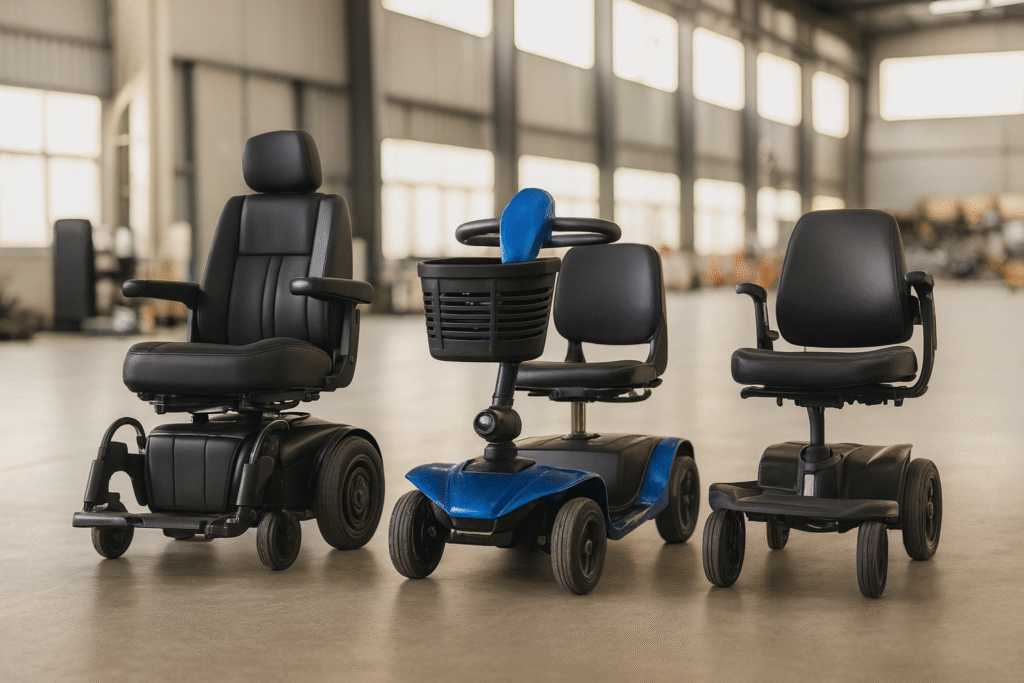
Carbon Fiber Technology in Mobility Equipment
Quick Answer: Carbon fiber is a high-strength, lightweight composite material used in premium electric wheelchairs and rollators, offering 5x the strength-to-weight ratio of steel at 70% less weight. 1000Mobility manufactures carbon fiber mobility products using aerospace-grade T700/T800 carbon fiber with custom OEM capabilities and MOQ from 1 unit.
Last updated: July 2026
Carbon fiber has fundamentally transformed the rehabilitation and mobility equipment industry over the past decade. Once limited to aerospace and Formula 1 applications, advances in manufacturing have made carbon fiber commercially viable for wheelchairs, rollators, and other mobility aids. For B2B buyers and distributors, understanding carbon fiber technology is essential for sourcing premium products that command higher margins and meet growing consumer demand for lightweight solutions.
How Does Carbon Fiber Compare to Aluminum and Steel?
The choice of frame material directly impacts product weight, strength, durability, and cost. The table below presents a technical comparison of the three primary materials used in mobility equipment manufacturing:
| Property | Carbon Fiber | Aluminum 6061-T6 | Steel (Carbon) |
|---|---|---|---|
| Density (g/cm³) | 1.5-1.6 | 2.7 | 7.85 |
| Tensile Strength (MPa) | 3,500-7,000 | 290-310 | 400-550 |
| Elastic Modulus (GPa) | 230-300 | 68.9 | 200 |
| Strength-to-Weight Ratio | Highest (2,187-4,375 kN·m/kg) | Moderate (107-115 kN·m/kg) | Low (51-70 kN·m/kg) |
| Fatigue Life | 5x aluminum (no fatigue limit) | Limited fatigue limit | Poor fatigue resistance |
| Corrosion Resistance | Excellent (chemically inert) | Good (oxide layer protection) | Poor (requires coating) |
| Vibration Damping | Excellent | Moderate | Poor |
| Cost (relative) | High (3-5x aluminum) | Medium | Low |
Carbon fiber’s density of 1.5-1.6 g/cm³ is approximately 44% lighter than aluminum (2.7 g/cm³) and 80% lighter than steel (7.85 g/cm³), while its tensile strength of 3,500-7,000 MPa is 10-23 times greater than aluminum 6061-T6 (290-310 MPa). This extraordinary strength-to-weight ratio is what makes carbon fiber the material of choice for premium mobility equipment.
How Is Carbon Fiber Manufactured for Mobility Equipment?
The production of carbon fiber mobility equipment involves a precise, multi-stage manufacturing process that ensures structural integrity and consistent quality:
1. Prepreg Preparation
Carbon fiber tow (typically 3K or 12K filaments) is pre-impregnated with epoxy resin at a controlled ratio (typically 60:40 fiber-to-resin by volume). The prepreg is stored at -18°C to prevent premature curing. The fiber orientation (0°, 45°, 90° layup angles) is engineered per product to optimize load distribution.
2. Layup and Molding
Prepreg sheets are cut and laid into CNC-machined steel or aluminum molds following a specific ply sequence. The layup schedule determines the final mechanical properties — more 0° plies increase longitudinal stiffness, while ±45° plies improve torsional strength. Vacuum bagging removes air pockets before curing.
3. Autoclave Curing
The mold is placed in an autoclave and cured under controlled conditions: temperature ramped to 120-135°C at 5-6 bar pressure for 2-3 hours. This ensures complete resin cross-linking, void content below 1%, and optimal fiber-volume fraction (55-65%). The autoclave process produces aerospace-grade structural integrity.
4. Demolding and Finishing
After curing, the part is demolded, flash-trimmed, and surface-finished. This includes sanding, primer application, and UV-resistant clear coat or paint. CNC trimming ensures dimensional accuracy within ±0.5mm tolerance.
5. Quality Control
Each carbon fiber component undergoes ultrasonic C-scan inspection to detect internal delamination, visual inspection for surface defects, and mechanical testing (tensile, flexural, and impact tests per ASTM D3039 and ASTM D7264 standards). Only components passing all QC criteria proceed to assembly.
How Is Carbon Fiber Used in Electric Wheelchairs?
Carbon fiber electric wheelchairs represent the pinnacle of lightweight powered mobility. The MAGNA Carbon by 1000Mobility weighs just 14.5 kg including battery — approximately 30-40% lighter than comparable aluminum folding electric wheelchairs. The LUMA Carbon is another flagship model featuring a full carbon fiber frame that delivers exceptional rigidity and vibration damping.
Carbon fiber frames in electric wheelchairs offer several advantages: reduced transport weight for caregivers, lower battery consumption due to decreased mass, and superior structural fatigue resistance for long-term durability. The MAGNA Carbon’s frame is rated for a 120 kg user weight capacity while maintaining airline-compatible folding dimensions.
How Is Carbon Fiber Used in Rollator Walkers?
Le NOVA Carbon rollator demonstrates carbon fiber’s potential in manual mobility aids. Weighing just 6.8 kg — approximately 30% lighter than aluminum rollators (8-10 kg) — the NOVA Carbon supports a 150 kg user weight capacity. The carbon fiber frame provides superior vibration absorption compared to metal frames, reducing user fatigue during extended use.
Carbon fiber rollators also feature a longer effective lifespan of 8-10+ years, compared to 5-7 years for aluminum and 3-5 years for steel. This extended durability reduces replacement frequency and improves the total cost of ownership for both distributors and end users.
Why Choose Carbon Fiber for Mobility Equipment?
- Weight Reduction of 30-50%: Carbon fiber components are typically 30-50% lighter than equivalent aluminum parts, and up to 80% lighter than steel. This weight savings is critical for elderly users and travel scenarios.
- Superior Fatigue Life: Carbon fiber’s fatigue life is approximately 5 times that of aluminum. Unlike metals, carbon fiber does not have a fatigue limit threshold, meaning it maintains structural integrity over millions of load cycles.
- X-Ray Transparency: Carbon fiber is radiolucent (transparent to X-rays), making it ideal for medical environments where patients may need imaging without removing mobility equipment. This property is particularly valuable in hospital and rehabilitation settings.
- Corrosion Immunity: Carbon fiber is chemically inert and does not rust, corrode, or degrade in humid or saline environments — a significant advantage over steel and even aluminum in coastal or tropical markets.
- Vibration Damping: Carbon fiber’s composite structure naturally dampens vibrations, providing a smoother user experience compared to metal frames that transmit road and surface vibrations directly.
What Carbon Fiber Capabilities Does 1000Mobility Have?
1000Mobility has invested significantly in carbon fiber manufacturing infrastructure, positioning itself as a leading OEM/ODM partner for carbon fiber mobility equipment. Our capabilities include:
- Custom Carbon Fiber Tube Forming: We produce carbon fiber tubes in various diameters (20mm-60mm), wall thicknesses (1.0mm-3.0mm), and layup configurations (3K twill, unidirectional, multi-directional) for rollator and wheelchair frames.
- Carbon Fiber Sheet Molding: Flat and curved carbon fiber panels for seat bases, backrests, and structural reinforcement components.
- OEM/ODM Customization: Full design-to-manufacturing service including CAD design, prototyping, mold development, and production. We can customize geometry, fiber layup, surface finish, and color. Explore our OEM/ODM Services for details.
- Quality Assurance: Every carbon fiber product is tested to EN 12183 (rollators) and ISO 7176 (wheelchairs) standards, with ultrasonic NDT inspection and mechanical load testing on every production batch.
Discover why leading distributors worldwide choose 1000Mobility as their carbon fiber mobility equipment manufacturing partner.
 English
  Deutsch
  Français
  Español
  Italiano
  العربية
  Русский