What Is a Mobility Scooter? Complete Guide 2026
A mobility scooter is a battery-powered personal vehicle designed to help individuals with limited walking ability move independently. It features a flat foot platform, a padded seat with armrests, and a tiller steering column. Unlike power wheelchairs, scooters are built for people who can walk short distances but need assistance covering longer ones.
Quick Answer
A mobility scooter is an electric-powered device with three or four wheels, a seat, and a tiller for steering, designed for people who can walk short distances but need help traveling longer ones. Most models reach 4–8 mph and cover 10–30 miles per charge using rechargeable sealed lead-acid or lithium-ion batteries.
Last updated: July 2026
How Mobility Scooters Work
Mobility scooters run on rechargeable batteries that power an electric motor. The rider controls direction and speed using a tiller—a vertical column similar to bicycle handlebars—equipped with thumb levers or finger controls for acceleration and braking. When you release the throttle, electromagnetic or automatic braking engages to bring the scooter to a controlled stop.
Most models offer a maximum speed between 4 and 8 mph, with a typical range of 10 to 30 miles per charge depending on battery type, terrain, rider weight, and weather conditions. Some premium models achieve up to 34 miles on a single charge.
Battery Types: SLA vs Lithium-Ion
Two main battery technologies dominate the mobility scooter market:
- Sealed Lead Acid (SLA): The standard, budget-friendly option. SLA batteries are heavier, take longer to charge (8–12 hours), and typically last 200–300 charge cycles before needing replacement. They cost $100–$300 per pack.
- Lithium-Ion: Lighter (roughly half the weight of SLA), faster charging, and longer-lasting with 2,000+ charge cycles. While the upfront cost is higher ($300–$800), the extended lifespan often makes lithium the more economical choice over time. Lithium batteries are also essential for air travel, as most airlines require batteries under 300 watt-hours (Wh).
For distributors evaluating product lines, understanding our mobility scooter buying guide can help you match the right battery technology to your target market.
Types of Mobility Scooters
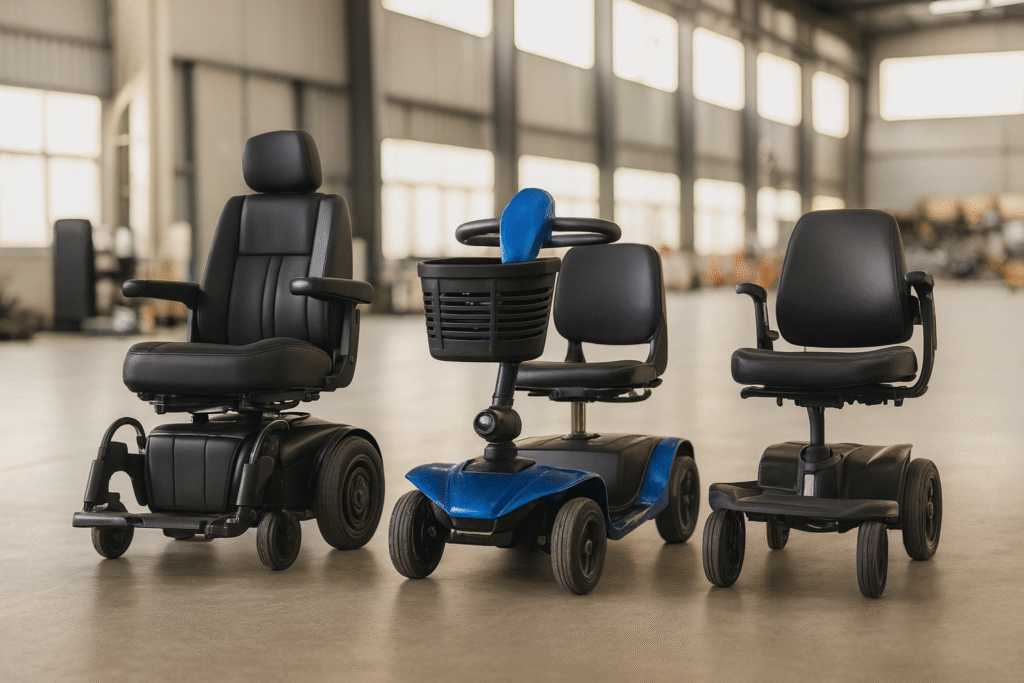
Mobility scooters fall into three primary categories based on size, portability, and intended use:
Travel (Portable) Scooters — Class 2
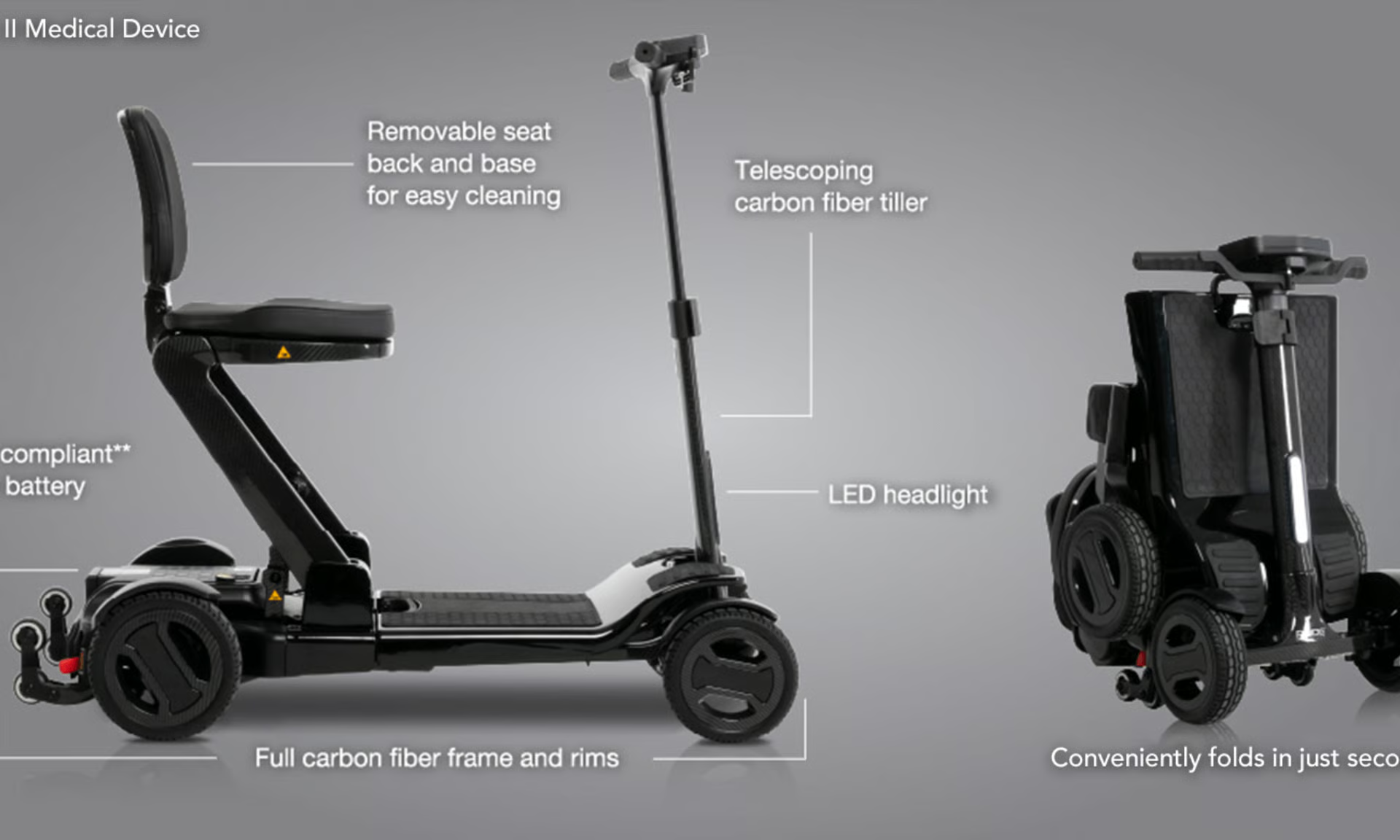
Lightweight and compact, travel scooters typically weigh around 50 lbs and break down into smaller pieces for car trunk transport. They offer a lower weight capacity (around 250 lbs) and shorter range per charge. Ideal for shopping trips, errands, and occasional outings. Most are classified as Class 2 devices with a maximum speed of 4 mph.
Mid-Size Scooters — Class 2
These models offer more comfort and range while still fitting through standard doorways. They feature larger seats, improved suspension, and longer battery life than travel models. Many users rely on mid-size scooters as their primary daily mobility aid for both indoor and outdoor use.
Heavy-Duty (Bariatric) Scooters — Class 3
Built for larger riders and rougher terrain, heavy-duty scooters can weigh 300+ lbs and support up to 500 lbs. They feature wider seats, reinforced frames, bigger wheels, and more powerful motors. Class 3 models can travel up to 8 mph on roads and are equipped with lights, indicators, mirrors, and horns for road use.
For B2B buyers interested in sourcing quality-manufactured scooters, explore our OEM/ODM services e quality certifications.
Class 2 vs Class 3: Legal Distinctions
In the UK and many European markets, mobility scooters are legally classified into categories that govern where they can be used:
| Feature | Class 2 | Class 3 |
|---|---|---|
| Max Speed | 4 mph | 4 mph (pavement) / 8 mph (road) |
| Road Use | No (except where no pavement) | Yes (not motorways/dual carriageways) |
| Registration | Not required | DVLA registration required |
| Min Age | None | 14 years |
| Weight Limit | 113.4 kg unladen | 150 kg unladen |
| Indoor Use | Yes | No |
Class 2 devices are designed for pavement use and indoor environments. Class 3 scooters are road-legal vehicles with additional safety equipment including front and rear lights, direction indicators, a rear-view mirror, an audible horn, and an amber flashing light for dual carriageway use.
Three-Wheel vs Four-Wheel Scooters
The number of wheels significantly affects a scooter’s performance characteristics:
Three-wheel scooters have a single front wheel providing a tighter turning radius, making them ideal for narrow hallways, store aisles, and tight corners. They typically offer more legroom for taller riders.
Four-wheel scooters offer superior stability, especially on uneven ground, slopes, and during curb climbing. They are the recommended choice for outdoor use and rough terrain. The trade-off is a wider turning circle.
Key Components and Features
Tiller and Controls
The tiller houses the throttle control (typically a thumb lever or finger control), speed dial, and display panel showing battery level and speed. Adjustable tiller angles accommodate different user heights and arm lengths.
Tires
- Pneumatic (air-filled): Absorb bumps for a smoother ride and provide better traction on wet surfaces. Require regular air pressure checks and can puncture.
- Solid (flat-free): Maintenance-free and longer-lasting, but transmit more vibration from road imperfections.
- Foam-filled: A middle-ground option offering better shock absorption than solid rubber without puncture risk.
Seating
Most scooters feature swivel seats with adjustable height, armrest width, and backrest angle. Premium models include suspension seat posts and captain’s-style seating for extended comfort.
Who Should Use a Mobility Scooter?
Mobility scooters are designed for individuals whose ability to walk is significantly limited by conditions such as arthritis, COPD, heart disease, neurological disorders, or post-surgical recovery. Unlike power wheelchairs—which are controlled by a joystick and designed for full-time seated use—scooters are intended for people who can walk short distances, transfer on and off the seat independently, and have sufficient upper body strength to operate a tiller.
For those weighing whether a scooter or a rollator is more appropriate, our rollator buying guide provides useful comparison points. You can also learn more about what a rollator is and how it differs from a scooter.
From the Field
At our factory, we produce six mobility scooter models spanning travel, mid-size, and heavy-duty categories. The most common question we hear from new distributors isn’t about motor power or battery range—it’s about Class 2 versus Class 3 distinctions. Many distributors initially assume that a higher top speed automatically means a better product, but in practice, Class 2 pavement scooters outsell Class 3 road models by a significant margin in most European markets. We’ve also noticed that distributors who understand the legal classification system tend to close deals faster, because they can immediately match the right scooter to a customer’s local regulations. Our factory tour showcases the full production line, including the testing procedures we use to verify each model meets its designated class specification before shipment.
FAQ
Can you use a mobility scooter on the road?
Only Class 3 mobility scooters are legally permitted on roads (excluding motorways and dual carriageways). Class 2 scooters are restricted to pavements and pedestrian areas, except when crossing the road or where no pavement exists. Class 3 scooters must be limited to 4 mph on pavements and can reach 8 mph on roads.
Do you need a license to drive a mobility scooter?
In the UK, no driving license is required for either Class 2 or Class 3 mobility scooters. However, Class 3 users must be at least 14 years old, and the scooter must be registered with the DVLA with a nil-value tax disc. In the US, no license is required, but state regulations vary regarding sidewalk versus road use.
How fast do mobility scooters go?
Class 2 mobility scooters have a maximum speed of 4 mph (6.4 km/h), which is the legal pavement speed limit. Class 3 scooters can reach 8 mph (12.9 km/h) on roads but must be restricted to 4 mph on pavements. Some heavy-duty models sold outside regulated markets can reach 15 mph.
How long do mobility scooter batteries last?
SLA batteries typically last 200–300 charge cycles (about 12–18 months of daily use), while lithium-ion batteries can last 2,000+ cycles (3–5+ years). Battery life is significantly reduced if batteries are left fully discharged, so regular charging after each use is essential.
Are mobility scooters covered by insurance?
In the US, Medicare Part B covers mobility scooters when deemed medically necessary, requiring a face-to-face examination and written prescription. In the UK, the Motability Scheme allows eligible individuals to lease scooters using government mobility allowances. Private insurance coverage varies by policy and provider.
Conclusione
Understanding what a mobility scooter is—its types, classifications, battery technologies, and legal requirements—is essential for both end users and B2B distributors making informed purchasing decisions. Whether you need a compact travel scooter for errands or a heavy-duty Class 3 model for road use, the right choice depends on terrain, distance, weight capacity, and local regulations. For businesses looking to source quality-manufactured mobility scooters, contact us about becoming a distributor or explore why manufacturers choose us.
1000Mobility Editorial Team
Product specialists with hands-on experience in mobility equipment manufacturing and B2B export. Learn more →
Interested in Wholesale Pricing?
Get OEM/ODM details, product specifications, and wholesale pricing within 24 hours.
Or send us a message directly:
 English
  Deutsch
  Français
  Español
  Italiano
  العربية
  Русский