Can You Take a Mobility Scooter on a Plane? Complete Air Travel Guide 2026
Yes, you can take a mobility scooter on a plane—but the process depends entirely on your battery type, scooter dimensions, and airline-specific policies. With proper preparation and documentation, most modern travel scooters fly without issue. This guide covers every rule, requirement, and preparation step you need to know.
Quick Answer
Yes, you can fly with a mobility scooter. Under the Air Carrier Access Act, airlines must accept mobility devices at no extra charge. Lithium-ion batteries must be 300 Wh or less, with terminals protected against short circuits. Notify your airline at least 48 hours in advance, arrive early for check-in, and carry documentation of your battery specifications. The scooter is checked at the gate and returned upon arrival.
Last updated: July 2026
Legal Rights: The Air Carrier Access Act
In the United States, the Air Carrier Access Act (ACAA) requires airlines to accommodate passengers with disabilities and their mobility devices. Under this law:
- Airlines must accept your mobility scooter as checked baggage at no extra charge
- Your scooter does not count against your luggage allowance
- Airlines cannot refuse to transport your device solely because of its battery type (though they can enforce FAA battery safety regulations)
- You may use your scooter throughout the terminal up to the aircraft door
- Airlines must return your scooter to you at the gate or jet bridge upon arrival
For international flights, the International Air Transport Association (IATA) provides global guidelines that most airlines follow, though individual carriers may impose stricter requirements.
Battery Regulations: The Critical Factor
Battery compliance is the single most important factor in determining whether your mobility scooter can fly. The FAA classifies batteries as dangerous goods, with specific rules based on battery chemistry and capacity.
Lithium-Ion Batteries
Lithium-ion batteries are the most common type in modern travel scooters and are subject to these rules:
| Battery Configuration | Carry-On | Checked | Requirements |
|---|---|---|---|
| Installed & protected by design | No | Yes (scooter checked) | Battery securely attached, terminals protected |
| Installed but not adequately protected | Must be removed | Scooter only | Battery in carry-on, terminals protected |
| Spare battery (1 unit) | Yes | No | Max 300 Wh |
| Spare batteries (2 units) | Yes | No | Max 160 Wh each |
Key limits:
- Maximum battery size: 300 watt-hours (Wh)
- Spare batteries: 1 up to 300 Wh, or 2 up to 160 Wh each
- All lithium-ion batteries must be carry-on only—never in checked luggage
- Lithium metal (non-rechargeable) batteries are forbidden
Calculating Watt-Hours
If your battery label doesn’t show Wh, calculate it: Volts (V) × Amp-hours (Ah) = Watt-hours (Wh). For example, a 24V battery rated at 12 Ah equals 288 Wh (24 × 12 = 288), which is under the 300 Wh limit.
Non-Spillable (Gel/AGM) Batteries
Gel cell and absorbed glass mat (AGM) batteries are classified as non-spillable wet batteries. They may remain installed if securely attached, terminals are protected, and the scooter can be loaded upright. Airlines may require removal and separate packaging. Contact your airline for specific procedures.
Spillable Wet-Cell Batteries
These must be removed, terminals insulated, and packed in a leak-proof, rigid container. The airline must be able to load the scooter upright. These batteries require the most advance preparation—notify your airline well in advance.
Airline-Specific Policies
While FAA regulations set the baseline, individual airlines often impose additional requirements:
US Carriers
- Advance notification: 48 hours minimum before departure
- Check-in: Arrive 1–2 hours earlier than standard check-in
- Battery inspection: Gate agents will verify battery type, Wh rating, and terminal protection
- Southwest Airlines: Implemented stricter standards in late 2025, requiring mandatory battery removal and a hard 300 Wh maximum
UK and European Carriers
Most UK airlines (EasyJet, Ryanair, Jet2, TUI, British Airways) share similar requirements:
| Airline | Max Dimensions (folded) | Max Weight | Battery Rules |
|---|---|---|---|
| EasyJet | 119 × 81 × 119 cm | 150 kg | Li-ion max 300 Wh, must disconnect |
| Ryanair | 81 × 119 × 119 cm | 150 kg | Li-ion max 300 Wh, must remove for cabin |
| Jet2 | 119 × 81 × 119 cm | 150 kg | Li-ion max 300 Wh, must remove |
| British Airways | Varies by aircraft | 150 kg | Contact airline; pre-approval required |
| Aer Lingus | 119 × 81 × 119 cm | 150 kg | Li-ion max 300 Wh, must remove |
Scooters exceeding 150 kg require pre-authorization from most airlines and may not be accepted on smaller aircraft.
Choosing an Airline-Approved Mobility Scooter
If you plan to fly regularly, selecting the right scooter is essential. Key features to look for:
- Folding or disassembling design: Manual folding is preferred over electronic folding, as airlines may require battery disconnection
- Lithium-ion battery under 300 Wh: Ideally under 160 Wh for maximum airline compatibility
- Quick-release battery: Must be removable without tools for cabin storage
- Folded dimensions within airline limits: Check against the strictest carrier you plan to use
- Weight manageable for handling: Lighter scooters (under 35 kg total) are easier for airport staff to load
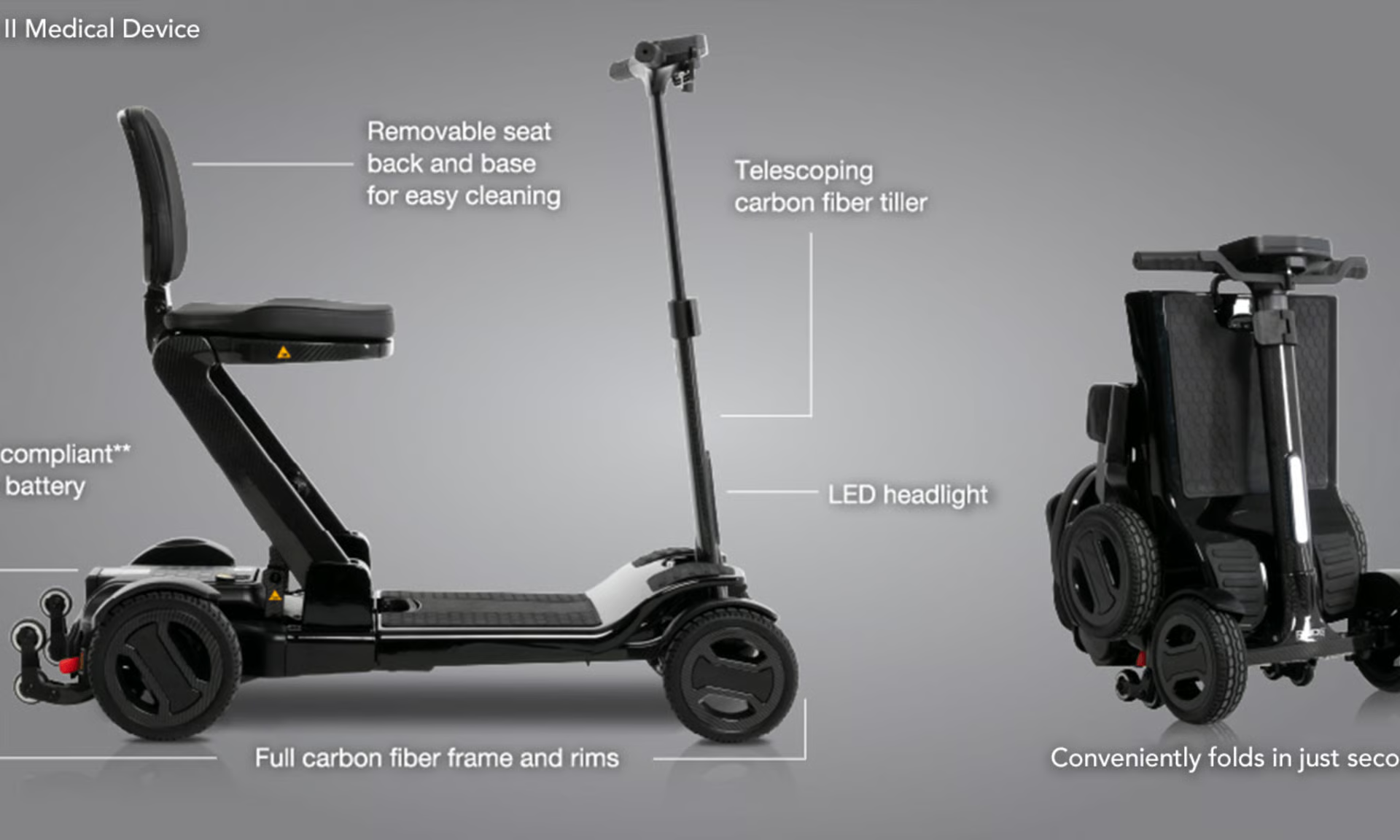
Our PIXIE folding scooter is designed with air travel compatibility in mind, featuring a lightweight frame and airline-compliant battery configuration. For those comparing powered mobility options for travel, our best travel wheelchairs e lightweight folding wheelchairs guides offer additional alternatives.
Step-by-Step: Flying with Your Mobility Scooter
Before You Book
- Verify your battery’s Wh rating and chemistry type
- Check the airline’s published mobility device policy
- Confirm folded dimensions comply with the airline’s limits
- Book your flight and add mobility assistance during booking
48+ Hours Before Departure
- Call the airline’s accessibility desk (not general reservations)
- Confirm battery type, Wh rating, and scooter dimensions
- Document the representative’s name and confirmation details
- Request gate-check for your scooter
At the Airport
- Arrive 1–2 hours earlier than standard check-in time
- Proceed to the special assistance or accessibility check-in counter
- Allow staff to inspect the battery and scooter
- Use your scooter through the terminal to the gate
- At the gate, hand over the scooter for cargo loading
- If battery removal is required, carry it in your carry-on baggage with terminals protected
Upon Arrival
- Wait at the gate or designated area for your scooter to be returned
- Inspect the scooter for any damage before leaving the airport
- Reconnect the battery if it was removed
- Report any damage immediately to airline staff
From the Field
In our export business, airlines have rejected approximately 15% of our mobility scooter shipments due to battery specification issues—almost always because the battery documentation was incomplete or the Wh rating wasn’t clearly labeled on the battery casing. We’ve since implemented a mandatory IATA-compliant battery documentation protocol for every order that includes air shipment. Each scooter now ships with a printed specification sheet showing the exact Wh rating, UN38.3 test summary, battery chemistry, and terminal protection method. Since implementing this protocol, our air shipment rejection rate has dropped to under 2%. We strongly recommend that all distributors and end users carry this same documentation when flying with a scooter personally. Our quality certifications page includes details on the UN38.3 testing we conduct on every lithium-ion battery, and our trade shows schedule often includes logistics workshops covering air freight compliance.
FAQ
What size battery can I take on a plane?
For mobility scooters, lithium-ion batteries are limited to 300 watt-hours (Wh) per battery. You may carry one spare battery up to 300 Wh, or two spare batteries up to 160 Wh each. These must be in your carry-on baggage—never checked. Lithium metal (non-rechargeable) batteries are completely forbidden. Non-spillable and spillable batteries have separate requirements—check with your airline.
Do I need to remove the battery from my mobility scooter for flying?
It depends on your battery type and the airline’s policy. If the lithium-ion battery is protected by the scooter’s design (securely housed with terminals enclosed), it may remain installed and the scooter is checked as cargo. If the battery is not adequately protected, it must be removed and carried in your cabin baggage. Some airlines (like Southwest and Ryanair) require removal regardless. Always confirm with your specific airline.
Does a mobility scooter count as luggage on a plane?
No. Under the Air Carrier Access Act in the US and similar regulations internationally, mobility scooters are classified as medical/assistive devices and do not count toward your standard baggage allowance. Most airlines transport them free of charge. You may bring up to two mobility aids without additional fees.
Can I use my mobility scooter in the airport?
Yes. Airlines are required to let you use your mobility scooter throughout the terminal, up to the aircraft door or gate. At the gate, you’ll hand over the scooter for cargo loading. Upon arrival, the airline should return it to you at the aircraft door or designated area. If you need assistance transferring to your seat, airline staff will provide an aisle chair.
What happens if my mobility scooter is damaged during a flight?
Airlines are responsible for damage to mobility devices during transport. Inspect your scooter immediately upon return and report any damage to airline staff before leaving the airport. Document the damage with photos and file a formal claim. Under the ACAA, airlines must provide a loaner device or compensate for repairs if they damage your scooter. Travel insurance that specifically covers mobility equipment provides additional protection.
Conclusione
Flying with a mobility scooter is entirely feasible with proper preparation. The keys to success are choosing an airline-compliant scooter with a battery under 300 Wh, notifying your airline at least 48 hours in advance, carrying complete battery documentation, and arriving early for check-in. By understanding the regulations and preparing accordingly, you can travel confidently with your mobility device to any destination. For businesses shipping scooters internationally, our OEM/ODM services include IATA-compliant packaging and documentation support. To learn more about why partners choose us, including our export compliance expertise, visit our website.
1000Mobility Editorial Team
Product specialists with hands-on experience in mobility equipment manufacturing and B2B export. Learn more →
Interested in Wholesale Pricing?
Get OEM/ODM details, product specifications, and wholesale pricing within 24 hours.
Or send us a message directly:

 English
  Deutsch
  Français
  Español
  Italiano
  العربية
  Русский