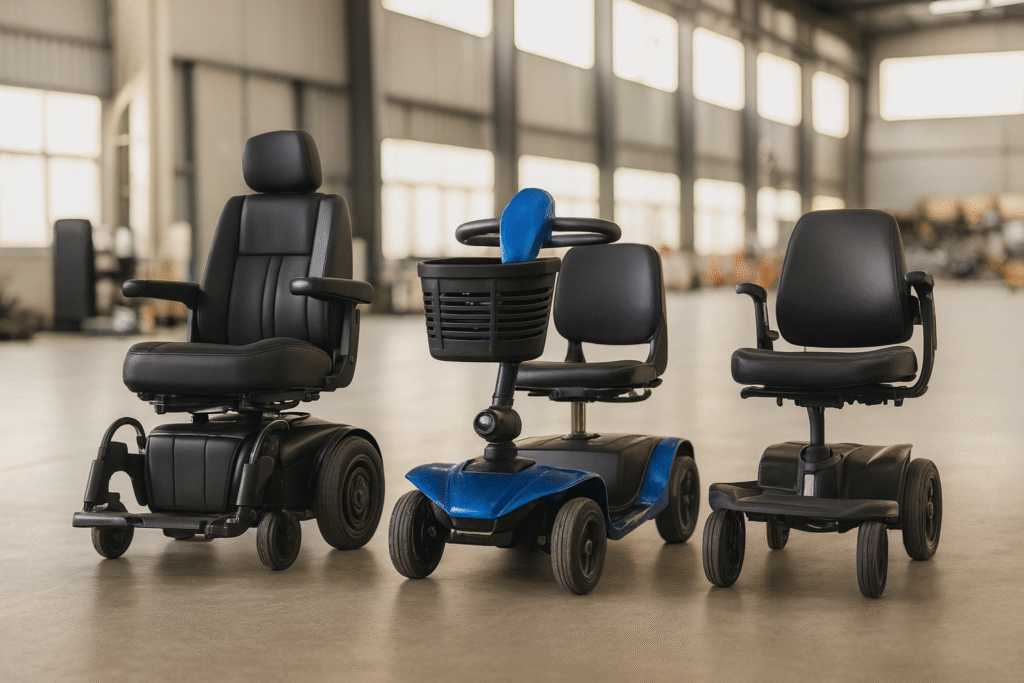
OEM vs ODM vs White Label: Choosing the Right Manufacturing Partnership for Mobility Brands
Quick Answer: OEM gives you full design control with the highest investment (USD 50K-250K+), ODM balances customization with speed at moderate cost (USD 15K-60K), and white label offers the fastest market entry with minimal investment (USD 5K-20K). For mobility brands, the right choice depends on your annual volume, technical differentiation needs, and how much IP control you require over your product line.
Last updated: September 2026
For mobility equipment distributors and brand owners, choosing the right manufacturing partnership model is one of the most consequential strategic decisions you will make. The choice between OEM, ODM, and white label determines your product development timeline, capital requirements, intellectual property ownership, quality control processes, and ultimately your competitive position in the market.
According to industry analysis, 64% of distributors underestimate their true manufacturing costs by 30-50% when they focus solely on per-unit pricing while ignoring total cost of ownership, including failure rates, warranty claims, and lost tender opportunities. The manufacturing model you choose directly impacts each of these cost factors.
Whether you are launching a new wheelchair brand or evaluating whether to upgrade your current sourcing strategy, this guide provides the framework to make an informed decision. For brands ready to explore manufacturing partnerships with Chinese factories, see our electric wheelchair manufacturer sourcing guide e OEM/ODM services overview.
The Three Manufacturing Models Defined
OEM (Original Equipment Manufacturer)
In an OEM arrangement, the brand owner provides complete product designs, specifications, and technical standards. The manufacturer is responsible for production and assembly according to these exact requirements. The finished product carries the brand owner’s trademark, and the brand owner controls all aspects of marketing, distribution, and after-sales support.
Key characteristics:
- The brand owner owns all designs, specifications, and intellectual property
- The manufacturer focuses on production efficiency, quality management, and delivery timelines
- Typical margin for manufacturers: 3-8% (processing fee model)
- Requires the highest upfront investment in design, engineering, and tooling
- Provides maximum control over product differentiation and quality
ODM (Original Design Manufacturer)
In an ODM arrangement, the manufacturer designs, engineers, tests, and validates the complete product. The brand owner selects from the manufacturer’s existing designs or requests modifications. The product is then branded with the buyer’s logo and packaging. ODM manufacturers often hold their own certifications (CE, FDA, ISO) and may offer co-development of proprietary features.
Key characteristics:
- The manufacturer retains ownership of the foundational design
- The brand owner can request deeper customizations: firmware, hardware mods, cosmetic changes
- Typical margin for manufacturers: 15-25% (design premium included)
- Shorter development timeline than OEM—manufacturer’s design is already validated
- Balances product differentiation with faster time-to-market
White Label (Private Label)
White label manufacturing means the buyer sources pre-engineered, fully assembled products from a factory and rebrands them with their logo, packaging, and documentation—without modifying the hardware design or internal specifications. The product is identical across multiple brands; only the branding changes.
Key characteristics:
- No design or engineering investment required
- Fastest time-to-market—weeks, not months
- Lowest MOQ and upfront capital requirement
- No hardware or software differentiation from competitors using the same factory
- Manufacturer controls product updates, firmware, and future iterations
Comprehensive Comparison Table
| Dimension | White Label | ODM | OEM |
|---|---|---|---|
| Design Ownership | Manufacturer | Shared (manufacturer owns base, buyer owns modifications) | Brand owner exclusively |
| Customization Level | Logo, packaging, documentation only | Cosmetic changes, minor hardware mods, color options, accessory selection | Complete—from frame geometry to component selection |
| Time to Market | 4-8 weeks | 12-16 weeks | 24-36 weeks |
| Upfront Investment | USD 5,000-20,000 | USD 15,000-60,000 | USD 50,000-250,000+ |
| Typical MOQ | 500-2,000 units | 3,000-5,000 units | 5,000-10,000+ units |
| Unit Cost (ex-works) | Lowest (shared R&D across many buyers) | Moderate (design premium amortized) | Highest (dedicated production) |
| Product Failure Rate | 5-8% | 2-3% | 0.5-1% |
| IP Control | None on product design | Limited to modifications | Complete |
| Quality Control Cost (% of order) | 2-3% | 3-5% | 5-8% |
| Firmware/Software Control | Manufacturer-controlled | Negotiable (sometimes shared) | Full brand owner control |
Cost and performance data based on 2026 industry benchmarks from manufacturing analysis reports (Alibaba Manufacturing Guide, 2026; RuiqiGO Manufacturing Analysis, 2026).
Which Model Fits Your Distributor Profile?
The right manufacturing model depends on your business stage, technical capabilities, and market positioning. Here is how to match each model to specific distributor profiles:
Profile 1: The Market Validator
Who you are: A new entrant testing market demand for mobility products. You have limited capital (under USD 25,000), no in-house engineering team, and need to validate your business model before committing to deeper investment.
Best model: White Label
White label allows you to launch a branded product line within 4-8 weeks at minimal cost. You can test pricing, distribution channels, and customer preferences without risking significant capital. The trade-off is that you have no product differentiation—competitors sourcing from the same factory will have identical products.
Key success factors:
- Choose a factory with proven, certified products (CE, FDA, ISO)
- Negotiate exclusive regional distribution rights if possible
- Build your differentiation through service, warranty, and brand experience rather than product features
- Plan to transition to ODM within 12 months once market demand is validated
Profile 2: The Regional Distributor
Who you are: An established distributor with 1,000-5,000 annual units, existing retail or B2B channels, and a desire to differentiate your product line from competitors. You have moderate capital (USD 30,000-100,000) and some technical staff.
Best model: ODM
ODM gives you the best balance of customization, speed, and investment. You can request specific color schemes, component upgrades, and cosmetic modifications that differentiate your brand without bearing the full cost of from-scratch engineering. A 12-16 week development timeline keeps your product fresh in a competitive market.
Key success factors:
- Work with an ODM partner that holds its own certifications—avoid factories that claim capabilities without documentation
- Negotiate exclusive design modifications (even if the base is shared, your modifications should be protected)
- Invest 3-5% of order value in quality control (in-production inspections + pre-shipment inspection)
- Request component traceability—know exactly which motors, controllers, and batteries are used
Profile 3: The Brand Builder
Who you are: An established brand or distributor with 5,000+ annual units, proven market demand, and a vision for a unique product line that differentiates on design, performance, or technology. You have significant capital (USD 100,000+) and engineering or product development capabilities.
Best model: OEM
OEM gives you complete control over every aspect of the product—from frame geometry to motor selection to firmware behavior. While the upfront investment is significant (USD 50,000-250,000+), the long-term payoff is substantial: product failure rates drop to 0.5-1% (vs 5-8% for white label), tender win rates increase to 58% (vs 12% for white label), and you build proprietary IP that becomes a competitive moat.
Key success factors:
- Invest in thorough prototyping and testing before mass production
- Establish a dedicated quality control program including bi-annual factory audits
- Ensure your contract explicitly transfers all IP ownership, including molds and tooling
- Plan for a 24-36 month product lifecycle to amortize upfront investment
- Budget for ongoing R&D and product improvement iterations
IP Protection and Mold Ownership
Intellectual property protection is the most critical legal consideration in any manufacturing partnership, particularly for OEM and ODM arrangements. Without explicit contractual protection, manufacturers may legally produce similar or identical products for competing brands.
Essential Contract Clauses
| Clause | What It Protects | Recommended Duration |
|---|---|---|
| Exclusivity Agreement | Prevents manufacturer from selling identical products to competitors in your territory | 2-5 years with renewal |
| Mold/Tooling Ownership | Establishes that custom molds and tools are your property, not the factory’s | Permanent (tools remain yours) |
| Design Non-Disclosure | Prevents the factory from sharing your designs with third parties | 5-10 years post-contract |
| Non-Compete (Design) | Prevents the factory from creating substantially similar designs for other brands | 3-5 years |
| Component Specification Lock | Requires the factory to maintain specified components (motor, battery, controller brands) without substitution | Duration of contract |
The Mold Ownership Trap
One of the most common disputes in OEM manufacturing is mold ownership. Custom injection molds for wheelchair components (armrests, footrests, side guards, fairings) can cost USD 5,000-50,000 per mold. If your contract does not explicitly state that molds are your property, the factory may claim ownership and refuse to release them if you switch manufacturers.
Best practice: Include a “Mold Transfer Clause” specifying that all custom molds, tools, and fixtures purchased with your funds are your exclusive property and must be released to you upon contract termination or at your written request.
Cost and ROI Analysis: 3-Year Total Cost of Ownership
The most common mistake B2B buyers make is focusing solely on unit cost while ignoring total cost of ownership. A comprehensive analysis reveals that the cheapest per-unit option often becomes the most expensive when failure rates, warranty claims, and lost opportunities are factored in.
3-Year Cost Comparison (1,000 Units/Year)
| Cost Component | White Label | ODM | OEM |
|---|---|---|---|
| Unit Cost (ex-works) | Lowest | Moderate | Highest |
| True Cost Per Unit (all-in) | Similar to ODM due to high failure rates | Competitive | Highest upfront, lowest lifetime |
| Product Failure Rate | 5-8% | 2-3% | 0.5-1% |
| Tender Win Rate | ~12% | ~34% | ~58% |
| 3-Year Net Profit/Loss | Often negative (high warranty costs) | Positive | Highest absolute profit |
Source: Gillson Lights ODM vs White-Label vs OEM True Cost Analysis, 2026 (Alibaba Manufacturing Analysis, 2026)
The counterintuitive finding: despite having the highest unit cost, OEM delivers the highest absolute profit over 3 years. This is because:
- Lower failure rates reduce warranty claims, returns, and reputation damage
- Higher tender win rates capture institutional procurement contracts that white-label products cannot compete for
- IP ownership creates a defensible market position that competitors cannot replicate
- Quality consistency builds customer trust and repeat business at premium pricing
The Upgrade Path Strategy
Many successful mobility brands follow a phased approach:
- Phase 1 (Year 1): Launch with white label or ODM to validate market demand. Target 500-2,000 units. Focus on distribution channel development.
- Phase 2 (Year 2): Transition to ODM with custom modifications once you understand customer preferences. Target 2,000-5,000 units. Begin building brand identity around specific product features.
- Phase 3 (Year 3+): Invest in OEM for flagship products while maintaining ODM/white label for entry-level SKUs. Target 5,000+ units for OEM products. Build proprietary IP portfolio.
This phased approach minimizes initial risk while building toward long-term competitive advantage. The key is to avoid committing to OEM investment before you have proven market demand.
1000Mobility OEM/ODM Capabilities
At 1000Mobility, we support all three manufacturing models for mobility equipment, with specific strengths in OEM and ODM partnerships:
OEM Capabilities
- Custom frame engineering: Carbon fiber, aluminum alloy, and steel frame designs to client specifications
- Component sourcing: Client-selected motors, controllers, batteries, and wheels from approved suppliers
- Custom firmware: Powered wheelchair control systems with client-specified features and parameters
- Full certification support: CE, FDA, ISO 7176, ISO 13485, and market-specific compliance documentation
- Dedicated production lines: Quality control with 100% batch inspection for OEM orders
ODM Capabilities
- Existing design library: 16+ validated product platforms (manual, powered, scooters, rollators)
- Customization options: Color schemes, seat configurations, accessory packages, packaging design
- Pre-certified platforms: Designs already holding CE, FDA, and ISO certifications
- Rapid prototyping: 3-4 week turnaround for modified prototypes
- Scalable MOQs: From 500 units for existing designs to 3,000+ for modified platforms
White Label Options
- Rebranded stock products: Minimum 100 units, 2-4 week turnaround
- Regional exclusivity: Negotiable exclusive distribution rights for qualified partners
- Full documentation: Branded manuals, warranty cards, and marketing materials
For distributors ready to explore a manufacturing partnership, our distributor program provides detailed capability assessments, sample product evaluation, and partnership terms tailored to your market and volume requirements.
Conclusione
Choosing between OEM, ODM, and white label is not a one-time decision—it is a strategic evolution. The most successful mobility brands start with lower-risk models to validate their market, then progressively invest in deeper customization and IP ownership as their volume and market position grow.
The key principles to remember:
- Total cost beats unit cost: The cheapest per-unit price often becomes the most expensive option when failure rates, warranty claims, and lost tenders are factored in.
- Match the model to your scale: Do not invest in OEM tooling for 500 units per year, but do not rely on white label if you are moving 10,000+ units and competing for institutional tenders.
- Protect your IP: Whether white label, ODM, or OEM, ensure your contract includes exclusivity clauses, mold ownership transfer, and non-compete provisions.
- Plan the upgrade path: Start simple, prove demand, then invest deeper. The phased approach minimizes risk while building toward competitive advantage.
1000Mobility supports mobility brands at every stage of this journey—from white label electric wheelchair sourcing to full OEM partnerships with proprietary design ownership. Our OEM/ODM services include everything from custom frame engineering to full certification support.
Ready to explore your manufacturing options? Contact 1000Mobility for a free partnership assessment, product samples, and a customized proposal matching the right manufacturing model to your business stage and volume requirements.
Author: 1000Mobility Editorial Team
Interested in Wholesale Pricing?
Get OEM/ODM details, product specifications, and wholesale pricing within 24 hours.
Or send us a message directly:
 English
  Deutsch
  Français
  Español
  Italiano
  العربية
  Русский