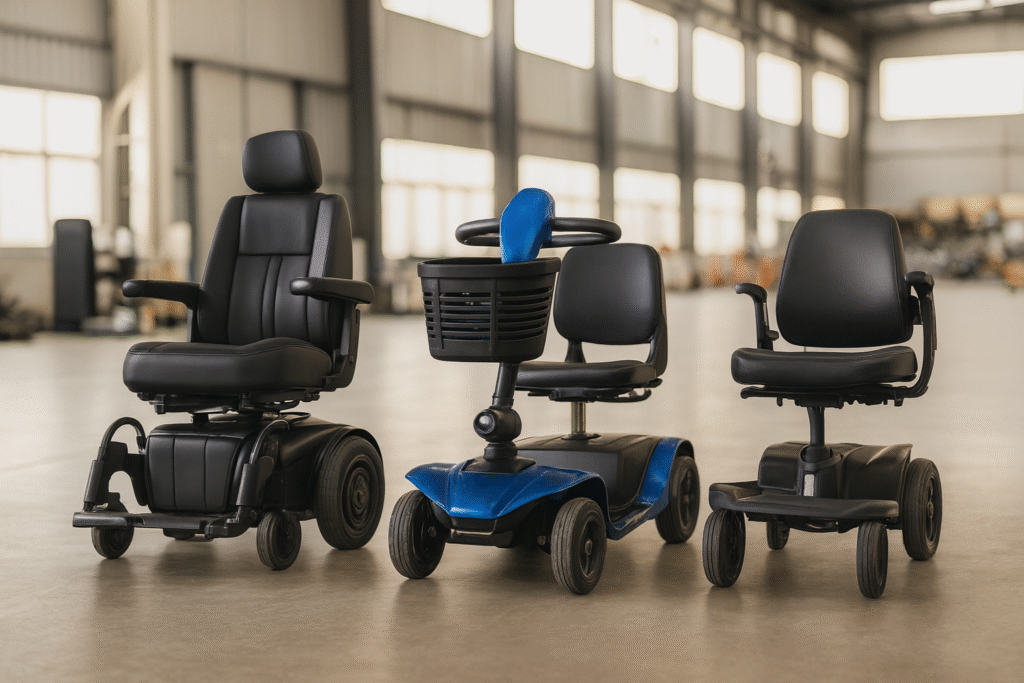
2026–2027 Wheelchair Industry Trends: B2B Buyer’s Market Outlook
Last updated: November 2026
Global Wheelchair Market: 2024–2030 Forecast
The global wheelchair market was valued at approximately $5.2 billion in 2024 and is projected to reach $7.8 billion by 2030, growing at a CAGR of 7.0% (Fortune Business Insights, 2025). Electric wheelchairs account for 58% of market value, manual wheelchairs 28%, and mobility scooters 14%.
| Segment | 2024 Value | 2030 Projected | CAGR | Key Growth Driver |
|---|---|---|---|---|
| Electric Wheelchairs | $3.0B | $4.8B | 8.1% | Aging population, insurance coverage expansion |
| Manual Wheelchairs | $1.5B | $1.9B | 4.0% | Developing market access, NGO procurement |
| Mobility Scooters | $0.7B | $1.1B | 7.8% | Elderly lifestyle demand, tourism accessibility |
| Carbon Fiber Wheelchairs | $0.3B | $0.8B | 17.7% | Premium lightweight demand, sports/recreation |
| Smart/Connected Wheelchairs | $0.1B | $0.5B | 30.5% | IoT health monitoring, autonomous navigation |
For manufacturers and distributors, the highest-growth segments — carbon fiber (17.7% CAGR) and smart wheelchairs (30.5% CAGR) — are also the highest-margin categories. Our carbon fiber vs aluminum comparison details the material science driving this trend.
Trend 1: Trade Policy and Tariff Shifts (2026–2027)
US Section 301 Tariffs
The US maintains Section 301 tariffs on Chinese-origin goods, including wheelchairs classified under HS 8713. The current landscape:
| Product Category | HS Code | Section 301 Rate (2026) | Expected 2027 Direction |
|---|---|---|---|
| Manual wheelchairs | 8713.10.0000 | 7.5% | Stable or slight reduction |
| Electric wheelchairs | 8713.90.1000 | 25% | Likely to persist |
| Mobility scooter parts | 8713.90.3000 | 25% | Likely to persist |
| Rollator walkers | 8713.10.0000 | 7.5% | Stable |
| Wheelchair batteries (lithium) | 8507.60.0000 | 7.5% | Stable |
Buyer action: Electric wheelchair distributors face a 25% tariff that adds $60–100/unit at current FOB prices. Strategies to mitigate: (1) source frame components from Vietnam/India for final assembly, (2) negotiate lower FOB prices to partially offset tariff, or (3) pass the cost to end users through premium positioning.
For landed cost calculations including Section 301 tariffs, see our FOB vs EXW vs DDP guide with worked examples.
EU Anti-Dumping and MDR Impact
The EU does not currently impose anti-dumping duties on Chinese wheelchairs, but the Medical Device Regulation (MDR 2017/745) transition has reshaped certification costs:
| Certification | Pre-MDR Cost | MDR Cost (2026) | Impact on B2B Buyers |
|---|---|---|---|
| CE marking (Class I) | $2,000–5,000 | $5,000–12,000 | Higher unit cost passed through |
| CE marking (Class IIa) | $8,000–15,000 | $15,000–35,000 | Significant barrier for new suppliers |
| Notified Body review timeline | 3–6 months | 12–18 months | Plan certification 18 months ahead |
| Post-market surveillance | Minimal | Mandatory annual report | Ongoing compliance cost |
Buyer action: EU distributors should verify that their Chinese suppliers have valid MDR certificates (not expired MDD certificates). The MDD-to-MDR transition deadline has passed, and suppliers without MDR certification cannot legally ship to the EU. See our factory audit checklist for verification steps.
Trend 2: Carbon Fiber Adoption Acceleration
Carbon fiber wheelchairs are transitioning from a niche premium product to a mainstream B2B category. The price gap between carbon fiber and aluminum is narrowing:
| Factor | 2023 | 2026 | 2027 Projection |
|---|---|---|---|
| Carbon fiber raw material ($/kg) | $18–22 | $14–17 | $12–15 |
| Carbon fiber wheelchair FOB (100+ units) | $1,200–2,500 | $800–1,800 | $650–1,400 |
| Aluminum wheelchair FOB (100+ units) | $320–520 | $280–450 | $270–430 |
| Price premium (carbon vs aluminum) | 275–380% | 185–300% | 150–230% |
| Carbon fiber market share | 5.8% | 8.2% | 10.5% |
Why the price is dropping:
- Chinese carbon fiber production capacity expanded 40% since 2023 (Gebrosky et al., 2024)
- Automated layup manufacturing reduces labor cost by 30% vs hand layup
- Volume purchasing by major wheelchair brands drives raw material discounts
- Competition among carbon fiber wheelchair manufacturers increases
Buyer action: If you’ve been waiting for carbon fiber wheelchairs to become affordable for your market, 2026–2027 is the window. The FOB-to-retail margin on carbon fiber wheelchairs remains 200–400%, significantly higher than aluminum (80–150%). Position carbon fiber as a premium tier in your product lineup.
Trend 3: Lithium Battery Regulation Tightening
IATA and IMO continue to tighten lithium battery transport regulations, affecting B2B wheelchair exporters:
| Regulation | Effective | Key Change | Impact |
|---|---|---|---|
| IATA DGR 67th Edition | Jan 2026 | State of charge limit: 30% max for air transport | Reduces available capacity on air shipments |
| IMDG Code Amendment 42-24 | Jan 2026 | Enhanced DG packing requirements for UN3480 | Stricter spare battery packing rules |
| UN38.3 Rev 9 (proposed) | 2027 | Additional thermal runaway test (T.9) | New test will add $3,000–5,000 per battery model |
| EU Battery Regulation 2023/1542 | Aug 2027 | Battery passport, carbon footprint declaration | Documentation burden for EU-bound shipments |
| US FAA lithium battery rules | Ongoing | Cargo Aircraft Only for >300 Wh | Limits air freight for standard wheelchair batteries |
Buyer action: Request UN38.3 test reports now for all battery models you plan to ship through 2027. If the proposed T.9 thermal runaway test is adopted, retesting costs will apply. Stock spare UN38.3-compliant batteries before the EU Battery Regulation takes effect. For current shipping rules, see our UN38.3 shipping guide.
Trend 4: Smart and Connected Wheelchairs
The smart wheelchair segment — defined as wheelchairs with IoT connectivity, health monitoring, or autonomous navigation — is the fastest-growing category at 30.5% CAGR. While still a small market ($100M in 2024), it signals where the industry is heading:
| Feature | Current Adoption | 2027 Projection | B2B Implication |
|---|---|---|---|
| Bluetooth smartphone connectivity | 8% of electric WCs | 20% | Companion app as differentiator |
| GPS location tracking | 3% | 12% | Fleet management for rental operators |
| Fall detection / SOS alert | 2% | 8% | Elderly care facility demand |
| Health vitals monitoring (heart rate, SpO2) | <1% | 5% | Insurance reimbursement opportunity |
| Autonomous navigation (obstacle avoidance) | <1% | 3% | Research/hospital market |
| Predictive maintenance alerts | 1% | 7% | Reduces warranty service cost |
Buyer action: Most B2B distributors don’t need to invest in smart wheelchairs yet, but should monitor which manufacturers offer Bluetooth connectivity as a standard feature. Companion apps that display battery status, trip logging, and maintenance alerts add perceived value at minimal hardware cost.
Trend 5: Supply Chain Diversification
The “China Plus One” strategy is gaining traction among wheelchair distributors seeking to reduce single-country supply risk:
| Strategy | Description | Pros | Cons |
|---|---|---|---|
| China-only (status quo) | All sourcing from Chinese manufacturers | Lowest cost, widest supplier base | Tariff risk, geopolitical exposure |
| China + Vietnam | Frame assembly in Vietnam, components from China | Avoids some Section 301 tariffs (if substantial transformation) | Limited wheelchair industry in Vietnam, higher cost |
| China + Taiwan | High-end components from Taiwan, assembly in China | Taiwan components exempt from Section 301 | Higher component cost, limited suppliers |
| China + Mexico (nearshoring) | Final assembly in Mexico for US market | USMCA duty-free access | No established wheelchair manufacturing base in Mexico |
| Multi-supplier within China | 2–3 suppliers in different provinces | Reduces single-factory risk, competitive pricing | Quality consistency challenges |
Buyer action: For most B2B wheelchair distributors, the China-only strategy remains the most cost-effective through 2027. Diversification strategies add 15–30% to unit cost and require significant supplier development investment. Instead, mitigate risk by maintaining relationships with 2–3 Chinese manufacturers and keeping 60–90 days of inventory buffer.
2026–2027 B2B Buyer’s Action Calendar
| Timeframe | Action | Why |
|---|---|---|
| Q4 2026 (now) | Audit suppliers’ MDR certificates (EU buyers) | MDD certificates are no longer valid |
| Q4 2026 | Request UN38.3 reports for all battery models | Prepare for IATA DGR 2026 changes |
| Q4 2026 | Evaluate carbon fiber wheelchair pricing | Price gap narrowing — prime entry window |
| Q1 2027 | Lock in annual pricing contracts before tariff changes | Section 301 review expected in Q2 2027 |
| Q1 2027 | Review EU Battery Regulation compliance plan | Regulation takes effect August 2027 |
| Q2 2027 | Test smart wheelchair prototypes (if entering segment) | Early adopters gain category leadership |
| Q2–Q3 2027 | Build 60–90 day inventory buffer | Tariff/policy uncertainty during review period |
| Q4 2027 | Full compliance with EU Battery Regulation | Battery passport and carbon footprint required |
FAQ
Conclusion
The wheelchair industry in 2026–2027 is shaped by three forces: regulatory tightening (EU MDR, IATA DGR, EU Battery Regulation), material innovation (carbon fiber price decline), and trade policy uncertainty (Section 301 tariffs). For B2B buyers, the strategic priorities are clear:
- Verify compliance now — EU MDR certificates, UN38.3 battery reports, and FDA registrations must be current
- Evaluate carbon fiber — the price gap is narrowing to a point where premium positioning is accessible
- Lock in supplier contracts — before 2027 tariff reviews and regulatory changes increase costs
- Build inventory buffer — 60–90 days of stock mitigates supply chain and policy disruption risk
The distributors who act on these trends in Q4 2026 will enter 2027 with a compliance-ready, cost-optimized supply chain — while competitors scramble to catch up.
Need a compliance-ready wheelchair supplier for 2027? Contact our B2B team for electric wheelchairs, carbon fiber models, mobility scooters, and rollator walkers — with CE MDR, FDA, ISO 13485, and UN38.3 documentation ready for your market.
Interested in Wholesale Pricing?
Get OEM/ODM details, product specifications, and wholesale pricing within 24 hours.
Or send us a message directly:
 English
 Deutsch
 Français
 Español
 Italiano
 العربية
 Русский