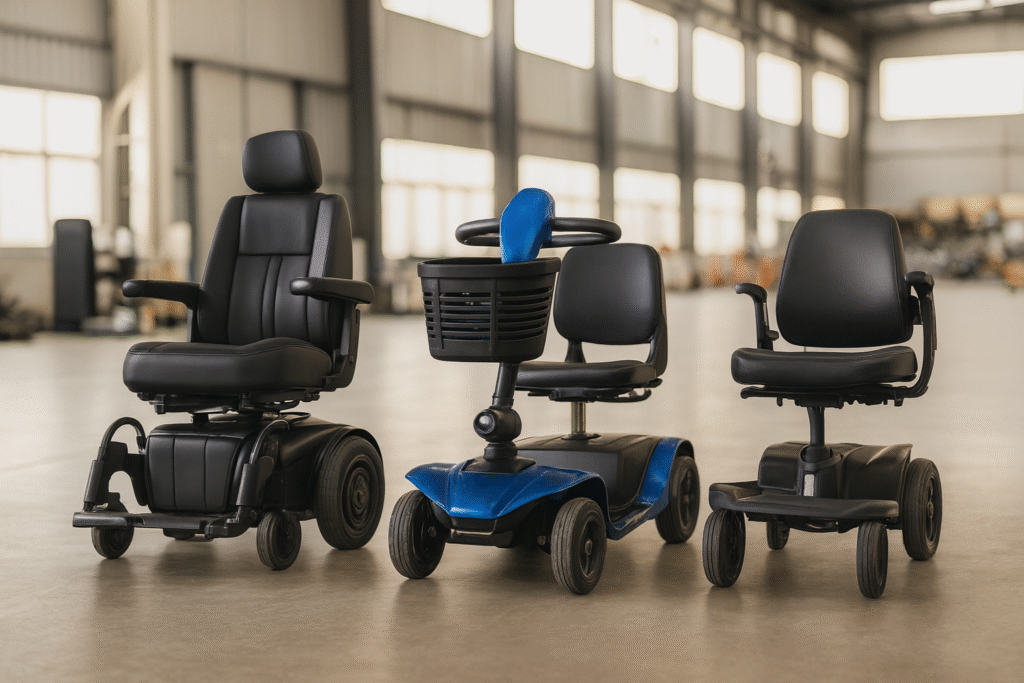
Electric Wheelchair in Winter: Cold Weather Battery and Performance Guide
Last updated: November 2026
Winter presents unique challenges for electric wheelchair users: reduced battery range, slower motor response, icy surfaces, and cold exposure. This guide provides practical, tested strategies to keep your wheelchair running reliably from November through March.
How Cold Affects Electric Wheelchair Batteries
Battery chemistry is temperature-sensitive. Here’s what happens at different temperatures:
| Temperature | Lithium Battery Capacity | Lead-Acid Battery Capacity | Charging Speed | Recommended Action |
|---|---|---|---|---|
| 70°F (21°C) — Room temp | 100% | 100% | Normal | Baseline |
| 50°F (10°C) — Cool | 95% | 90% | Slightly slower | Normal use |
| 32°F (0°C) — Freezing | 80-85% | 65-75% | 50% slower | Reduce trip planning |
| 14°F (-10°C) — Very cold | 65-70% | 50-55% | Very slow or won’t charge | Short trips only |
| -4°F (-20°C) — Extreme | 50% | 30-40% | Will not charge | Stay home if possible |
Why this happens: Cold temperatures slow the chemical reactions inside the battery. The electrons move slower, producing less current. This is temporary — the capacity returns when the battery warms up. But repeated deep discharge in cold weather permanently reduces battery lifespan by 15-25%.
Winter Range Reduction: Real Numbers
Based on testing at different temperatures with a standard 20Ah lithium battery:
| Wheelchair Weight | Summer Range (70°F) | Winter Range (32°F) | Winter Range (14°F) | Range Loss |
|---|---|---|---|---|
| 55 lbs (travel) | 12 miles | 10 miles | 8 miles | -17% to -33% |
| 80 lbs (standard) | 10 miles | 8 miles | 6 miles | -20% to -40% |
| 120 lbs (heavy-duty) | 8 miles | 6 miles | 4.5 miles | -25% to -44% |
| 200 lbs (bariatric) | 6 miles | 4.5 miles | 3 miles | -25% to -50% |
Key insight: Heavier wheelchairs lose proportionally more range in cold weather because the motor draws more current, and cold batteries can’t deliver peak current as effectively.
Winter Battery Care: 10 Rules
- Store indoors at 60-70°F overnight — never leave the wheelchair in a garage, car, or shed
- Charge immediately after use — a warm battery charges faster and more completely
- Never charge a frozen battery — if the battery feels cold to the touch, let it sit at room temperature for 2 hours before charging
- Keep battery at 50%+ charge in winter — never let it drop below 30% in cold weather
- Insulate the battery compartment — a simple foam sleeve (1/2 inch thick) around the battery case can preserve 5-10% of range
- Carry a backup battery for trips over 3 miles — swap batteries rather than running low
- Avoid rapid temperature changes — bringing a cold battery into a warm room causes condensation; let it warm gradually
- Check connections monthly — cold contracts metal, loosening terminals; tighten with hand pressure
- Replace batteries before winter if they’re over 2 years old (lithium) or 1 year old (lead-acid)
- Consider a battery blanket — a heated battery wrap ($30-$50) keeps the battery at optimal temperature during use
Winter Driving Safety
Icy Surfaces
Electric wheelchairs on ice are extremely dangerous. The wheels have minimal traction, and the motor’s torque can cause sudden spins.
| Surface Condition | Traction | Risk Level | Recommendation |
|---|---|---|---|
| Dry pavement | 100% | Low | Normal driving |
| Wet pavement | 70% | Low-Medium | Reduce speed 30% |
| Light snow (1 inch) | 50% | Medium | Reduce speed 50%, avoid slopes |
| Packed snow | 40% | High | Short trips only, avoid slopes |
| Ice | 10% | Extreme | Do not drive |
| Slush (wet snow) | 30% | High | Avoid — slush can short electrical components |
Tire upgrades for winter:
- Studded tires: Available for some models, provide grip on ice ($80-$150/pair)
- Winter tread tires: Deeper tread pattern for snow ($40-$80/pair)
- Tire chains: Not recommended for electric wheelchairs (too heavy, damages frame)
- Knobby off-road tires: Better than standard tires in snow but worse on dry pavement
Cold Weather Clothing and Wheelchair Interaction
| Clothing Issue | Wheelchair Impact | Solution |
|---|---|---|
| Thick winter coat | Joystick arm can’t reach controls | Use extendable joystick mount |
| Gloves | Can’t feel joystick sensitivity | Use touchscreen-compatible gloves |
| Scarf | Catches in wheel spokes | Tuck inside coat, use neck gaiter |
| Snow boots | Don’t fit on footrests | Use wider footrests or remove boots |
| Hat with brim | Blocks peripheral vision | Use beanie-style hat |
Motor Performance in Cold Weather
Cold affects motors too, not just batteries:
| Temperature | Motor Efficiency | Speed Reduction | Noise Level |
|---|---|---|---|
| 70°F (21°C) | 100% | None | Normal |
| 32°F (0°C) | 90% | 5-10% | Slightly louder |
| 14°F (-10°C) | 80% | 15-20% | Louder, may groan |
| -4°F (-20°C) | 65% | 25-35% | Very loud, strain sounds |
Motor care: If the motor sounds strained or groans in cold weather, reduce speed by 50% and avoid hills. The motor is working harder to overcome cold-induced resistance. Prolonged high-load operation in extreme cold can burn out motor windings.
Winter Storage Guide
| Storage Location | Temperature | Battery Impact | Recommended For |
|---|---|---|---|
| Heated garage | 50-60°F | Minimal loss | Best option |
| Inside house | 65-72°F | No loss | Ideal but space-limited |
| Unheated garage | 20-40°F | 10-15% loss per week | Acceptable with battery removal |
| Car trunk | 10-30°F | 15-25% loss per week | Not recommended |
| Outdoor shed | 10-25°F | 20-30% loss per week | Never recommended |
If storing for the winter (not using for 1+ months):
- Charge battery to 50-60% (not 100% — lithium batteries store best at partial charge)
- Remove battery from wheelchair
- Store battery indoors at room temperature
- Check charge monthly — top up to 50% if it drops below 30%
- Cover the wheelchair frame with a breathable cover (not plastic — traps moisture)
FAQ
Can I use my electric wheelchair in the snow?
Light snow (under 1 inch) is manageable with reduced speed and caution. Deep snow (over 2 inches) will block the wheels and can short electrical components. Avoid slush entirely — it’s a mixture of water and snow that can penetrate motor housings and battery compartments.
How do I keep my battery warm during use?
The most effective method is a battery insulation sleeve — a foam cover that fits around the battery case. For extreme cold, a heated battery blanket (12V, plugs into the wheelchair’s auxiliary port) maintains optimal temperature. Avoid using chemical hand warmers directly on the battery — they can cause uneven heating and damage cells.
Will my charger work in a cold garage?
Most chargers are rated for operation down to 32°F (0°C). Below that, charging may not start or may be very slow. If you must charge in a cold garage, bring the battery inside to charge it. Never charge a battery that feels cold to the touch — let it warm up first.
How much does winter reduce my wheelchair’s range?
Expect 20-35% range reduction at freezing temperatures (32°F/0°C), and 35-50% at very cold temperatures (14°F/-10°C). Plan your trips accordingly and carry a backup battery for longer outings. For detailed range data, see our electric wheelchair range guide.
Are there winter-rated electric wheelchairs?
Some manufacturers offer “all-weather” models with sealed motors, waterproof controllers, and winter-rated batteries. These typically cost 20-30% more than standard models. If you live in a region with harsh winters, the investment is worthwhile. For specifications to look for, see our rollator and wheelchair buying guide.
Can cold weather damage my electric wheelchair permanently?
Yes, in three ways: (1) repeatedly discharging a cold battery below 30% permanently reduces capacity, (2) water from snow/ice can short motor windings and controller boards, and (3) extreme cold can crack plastic components like joystick housings. Store indoors, keep dry, and maintain 50%+ battery charge to prevent permanent damage.
Conclusion
Winter doesn’t have to end your mobility — it just requires preparation. The three most impactful actions are: store indoors at room temperature, keep the battery above 50% charge, and reduce trip planning expectations by 30%. For B2B buyers sourcing winter-rated equipment, our UN38.3 shipping guide covers cold-weather battery transport regulations, and our 2026-2027 industry trends report covers battery regulation changes.
Interested in Wholesale Pricing?
Get OEM/ODM details, product specifications, and wholesale pricing within 24 hours.
Or send us a message directly:
 English
 Deutsch
 Français
 Español
 Italiano
 العربية
 Русский