Carbon Fiber vs Aluminum Electric Wheelchair: A Data-Backed Comparison for Wholesale Buyers
Quick Answer: Carbon fiber electric wheelchairs are 40-50% lighter than aluminum equivalents, with tensile strength 5-10 times higher per unit weight. However, aluminum frames cost 40-60% less at wholesale and are easier to repair. For B2B buyers, the optimal choice depends on target market price point, logistics costs, and end-user demographics—premium markets favor carbon fiber, while high-volume markets benefit from aluminum’s lower unit cost.
Last updated: August 2026
Material Properties at a Glance: Carbon Fiber vs Aluminum
Understanding the fundamental material science behind carbon fiber and aluminum is essential for making informed wholesale purchasing decisions. Both materials dominate the electric wheelchair frame market, but they serve different segments with distinct performance and cost profiles.
The two primary materials used in modern electric wheelchair frames are T700-grade carbon fiber composite (unidirectional layup) and 6061-T6 aluminum alloy. Carbon fiber reinforced polymer (CFRP) is an anisotropic material—meaning its strength varies by fiber orientation—while aluminum is isotropic, with uniform properties in all directions. This fundamental difference affects everything from frame design to failure modes.
| Property | Carbon Fiber (T700 CFRP) | Aluminum (6061-T6) | Difference |
|---|---|---|---|
| Density | 1.6 g/cm³ | 2.70 g/cm³ | CF is 41% lighter |
| Tensile Strength | 3,500 MPa | 310 MPa | CF is 11.3× stronger |
| Specific Strength | 2,187 kN·m/kg | 115 kN·m/kg | CF is 19× higher |
| Young’s Modulus | 230-295 GPa | 68.9 GPa | CF is 3-4× stiffer |
| Fatigue Strength | 1.2M cycles @ 80% load | 96.5 MPa (500M cycles) | CF superior at high loads |
| Elongation at Break | 1.5-2.6% | 12-17% | Aluminum more ductile |
Sources: MatWeb Material Database for 6061-T6 aluminum; Frontiers in Materials (2024) for carbon fiber composite properties; RICHALL Medical in-house testing data for wheelchair-specific applications.
These numbers tell a clear story: carbon fiber offers dramatically superior strength-to-weight ratio, while aluminum provides better ductility and impact tolerance. The practical implications for wheelchair design and B2B purchasing are significant. For a deeper dive into carbon fiber technology, visit our carbon fiber technology page.
Weight Comparison: How Much Lighter Is Carbon Fiber?
Weight is the single most visible differentiator between carbon fiber and aluminum electric wheelchairs. For end users—particularly elderly and disabled passengers—every kilogram matters when lifting a wheelchair into a car trunk or carrying it up stairs.
Typical frame weights for electric wheelchairs:
| Component | Carbon Fiber Frame | Aluminum Frame | Weight Savings |
|---|---|---|---|
| Frame only | 4.2 kg | 7.8 kg | 3.6 kg (46%) |
| Total chair (with battery) | 16-19 kg | 21-24 kg | 3-5 kg (15-21%) |
| Folded dimensions | Comparable | Comparable | Similar |
Source: Industry testing data from RICHALL Medical and 1000Mobility production records.
The total weight difference of 3-5 kg may seem modest, but it has outsized commercial implications. A wheelchair under 20 kg qualifies as “ultra-lightweight” and commands a 20-30% retail premium. More importantly, lighter chairs expand the addressable market: elderly users who cannot manage a 24 kg aluminum chair can often handle a 17 kg carbon fiber model independently.
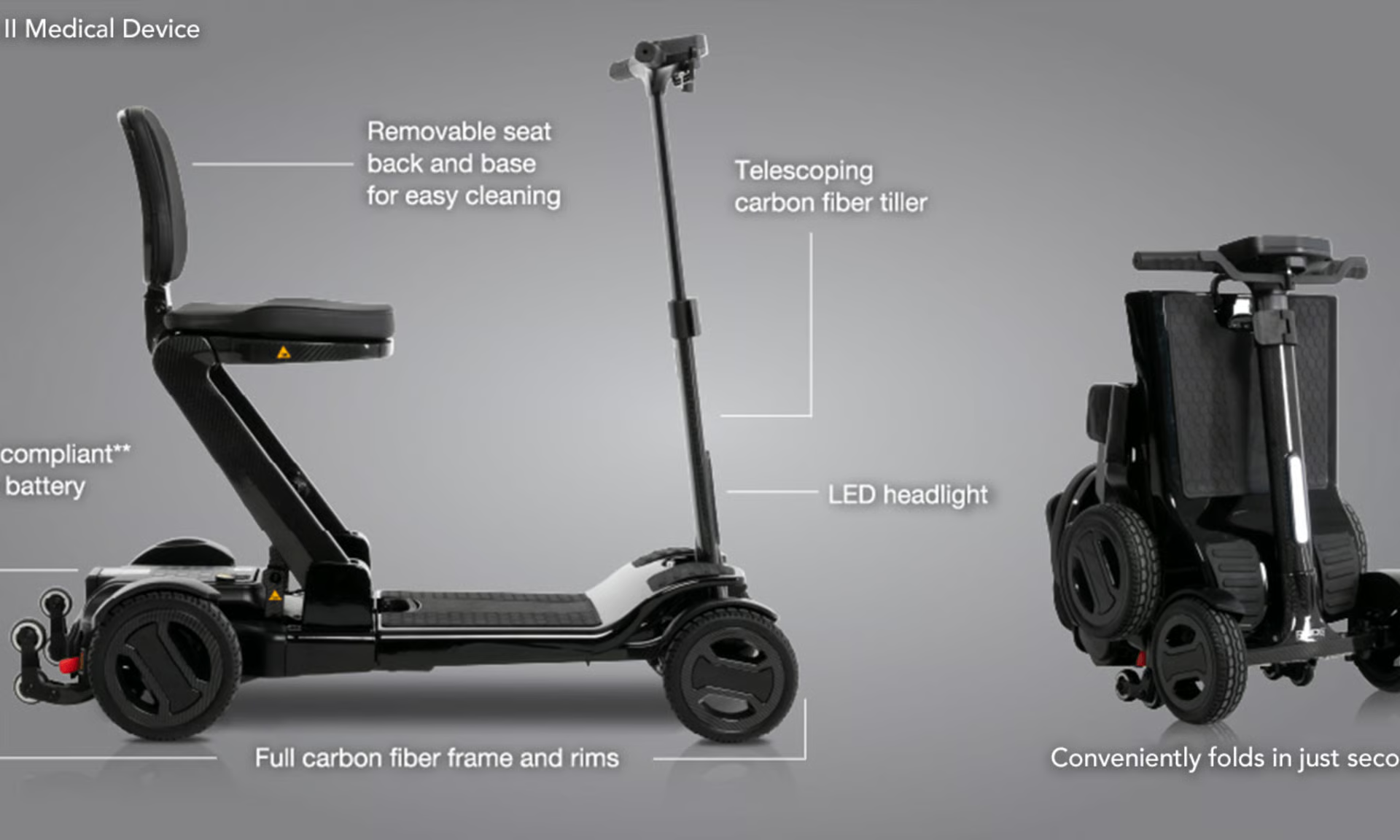
For B2B buyers, the weight advantage translates into higher customer satisfaction, lower return rates, and the ability to target premium market segments. The lightweight segment is projected to hold 58.5% of the wheelchair market share in 2025, according to Grand View Research’s Mobility Aids Market report. Explore our MAGNA Carbon ultralight wheelchair to see carbon fiber construction in practice.
Strength & Durability: Tensile Strength, Fatigue Life, and Impact Resistance
Strength and durability determine product lifespan, warranty costs, and customer safety. Both materials excel in different ways, and understanding their failure modes is critical for B2B buyers.
Tensile Strength and Frame Integrity
Carbon fiber’s tensile strength of 3,500 MPa for T700-grade composite is approximately 11 times that of 6061-T6 aluminum (310 MPa). This means a carbon fiber frame can be designed with thinner walls and smaller tube diameters while maintaining equal or greater structural integrity. The specific strength (strength per unit weight) of carbon fiber is 19 times that of aluminum, according to material science research published in Frontiers in Materials.
However, raw tensile strength does not tell the complete story. Carbon fiber is anisotropic—strong along the fiber direction but weaker across it. A well-designed carbon fiber wheelchair frame uses unidirectional layup patterns that orient fibers along primary stress paths, maximizing strength where it matters most. Poor layup design can create weak points that fail under unexpected loading conditions.
Aluminum, being isotropic, provides more predictable strength in all directions. This makes it more forgiving of design simplifications and manufacturing variations—important when sourcing from factories with varying quality control standards.
Fatigue Life and Long-Term Durability
Fatigue life determines how many load cycles a frame can withstand before crack initiation. This is particularly important for wheelchairs, which experience repeated loading from user weight transfers, curb drops, and vibrations.
- Carbon fiber: Withstands 1.2 million cycles at 80% of maximum load without crack propagation, per ASTM F2617-22 testing. Carbon fiber’s fatigue behavior is characterized by sudden failure rather than gradual crack growth, meaning regular inspection is critical.
- Aluminum 6061-T6: Fatigue strength of 96.5 MPa at 500 million cycles. Aluminum exhibits gradual crack propagation, making failures more predictable and detectable through visual inspection.
ANSI/RESNA testing standards require wheelchairs to withstand 200,000+ cycles of durability testing. Both materials can meet this threshold when properly designed, but carbon fiber’s higher fatigue threshold provides additional safety margin for heavy-duty applications.
Impact Resistance
This is where aluminum has a clear advantage. Carbon fiber, despite its extraordinary tensile strength, is brittle under impact. A sharp impact—such as dropping the wheelchair on a concrete corner—can cause delamination or catastrophic failure that is not immediately visible. Aluminum, with its 12-17% elongation at break, deforms plastically under impact, absorbing energy and providing visible warning of damage.
For markets where wheelchairs face rough handling (public transport, shared use, outdoor terrain), aluminum’s impact tolerance is a significant advantage. For premium markets where users handle their equipment carefully, carbon fiber’s weight advantage outweighs the impact risk. Our LUMA Carbon wheelchair demonstrates how carbon fiber can be engineered for daily-use durability.
Cost Analysis: Unit Price, Freight, and Total Cost of Ownership
Cost is the decisive factor for most B2B purchasing decisions. Carbon fiber commands a significant premium, but the total cost picture is more nuanced than unit price alone.
Unit Price Comparison
Carbon fiber electric wheelchairs typically cost 40-60% more than aluminum equivalents at wholesale FOB pricing. The price difference stems from:
- Raw material cost: T700 carbon fiber costs $15-25/kg versus $3-5/kg for 6061-T6 aluminum
- Manufacturing process: Carbon fiber frames require labor-intensive hand layup (800+ sheets per frame), while aluminum frames use automated welding and CNC bending
- Tooling: Carbon fiber molds cost tens of thousands of dollars per design, while aluminum tooling is reusable across more variations
- Scrap rate: Carbon fiber has a higher rejection rate during production due to void detection and layup defects
Freight Cost Savings
The weight advantage of carbon fiber creates freight savings that partially offset the higher unit cost. A 20-foot container can hold approximately 72 carbon fiber units versus 54 aluminum units, due to lower per-unit volume and weight. This reduces per-unit ocean freight by approximately $28 per unit.
Total Cost of Ownership
| Cost Factor | Carbon Fiber | Aluminum |
|---|---|---|
| Unit Price (FOB) | $800-1,500 | $400-700 |
| Freight (per unit) | ~$45 | ~$73 |
| Landed Cost | $845-1,545 | $473-773 |
| Warranty Reserve | 1-2% of revenue | 2-4% of revenue |
| Retail Price Range | $1,500-3,500 | $700-1,500 |
| Gross Margin | 40-55% | 25-40% |
Source: Industry pricing data from B2B marketplace analysis and manufacturer interviews, 2025-2026.
The higher gross margin on carbon fiber products (40-55% vs 25-40% for aluminum) means that despite the higher unit cost, carbon fiber can deliver better absolute profit per unit. Distributors who have switched 40% of their inventory to carbon fiber models have reported increased average order values within six months.
Maintenance & Repair: Long-Term Serviceability
Maintenance requirements and repairability affect your long-term operating costs and customer satisfaction. The two materials present very different service profiles.
Carbon Fiber Maintenance
- Inspection: Requires regular visual inspection for surface cracks, delamination, and impact damage. Internal damage may not be visible without ultrasonic testing.
- Repair: Damaged carbon fiber frames generally cannot be field-repaired. A cracked carbon fiber tube requires professional composite repair or frame replacement. This creates higher long-term service costs and longer downtime.
- UV sensitivity: Carbon fiber composites can degrade under prolonged UV exposure. Quality manufacturers apply UV-resistant clear coats, but budget suppliers may skip this step.
- Thermal expansion: Carbon fiber has very low thermal expansion, maintaining dimensional stability across temperature ranges—beneficial for precision components like motor mounts.
Aluminum Maintenance
- Inspection: Dents, bends, and weld cracks are visible to the naked eye. Regular visual inspection is straightforward and requires no special equipment.
- Repair: Aluminum frames can often be straightened, re-welded, or reinforced in the field. Most welding shops can handle 6061-T6 repairs, making local service feasible.
- Corrosion resistance: 6061-T6 aluminum forms a natural oxide layer that provides good corrosion resistance. Powder coating or anodizing further extends lifespan to 5-7 years in normal conditions, and 2-3 times longer than steel in salt spray environments.
- Temperature sensitivity: Aluminum conducts heat efficiently, which can cause frame surfaces to become uncomfortably hot or cold. Insulating coatings or ergonomic grips mitigate this issue.
For distributors serving markets with limited service infrastructure, aluminum’s repairability is a decisive advantage. For premium markets with access to manufacturer-authorized service centers, carbon fiber’s superior performance justifies the service complexity. Visit our why choose us page to learn about our after-sales support programs for both material types.
Shipping & Logistics: Container Optimization
Logistics costs represent 8-15% of total landed cost for wheelchair imports. The material choice significantly impacts shipping efficiency and customs processing.
Container Loading Efficiency
| Factor | Carbon Fiber | Aluminum |
|---|---|---|
| Units per 20ft container | ~72 | ~54 |
| Average unit weight | 17 kg | 23 kg |
| Carton volume | 0.08 m³ | 0.11 m³ |
| Container weight utilization | ~1,224 kg | ~1,242 kg |
| Per-unit ocean freight | ~$45 | ~$73 |
The 33% higher loading density for carbon fiber means lower per-unit freight costs and faster inventory turnover. For a 500-unit annual order, the freight savings alone can amount to $14,000—partially offsetting the higher unit cost.
Battery Shipping Compliance
Both carbon fiber and aluminum electric wheelchairs use lithium batteries, requiring Class 9 dangerous goods handling. The factory must provide:
- UN38.3 test summary for battery packs
- IATA-compliant packaging for air freight (PI965-970)
- IMDG Code compliance for sea freight (Special Provision 188)
- Battery labels with Wh rating and manufacturer information
Lighter carbon fiber wheelchairs with smaller batteries (under 160 Wh) are more likely to qualify for airline-approved travel, expanding the addressable market for travel-focused distributors. Check our ALYA Core model for an example of airline-compliant battery design.
B2B Purchasing Strategy: Which Material Suits Your Market?
The decision between carbon fiber and aluminum is not binary—smart distributors carry both to serve different market segments. Here is a strategic framework for allocating your purchasing budget.
When Carbon Fiber Makes Sense
- Premium retail markets (US, Western Europe, Japan): Customers willing to pay $1,500-3,500 for ultra-lightweight design
- Travel and tourism segment: Airlines increasingly demand wheelchairs under 20 kg with removable batteries under 300 Wh
- Active user demographic: Users who frequently transport their wheelchair independently
- High-margin specialty markets: Bariatric, pediatric, or sports wheelchairs where weight savings are critical
- Brand positioning: Differentiating from budget competitors with a premium product line
When Aluminum Makes Sense
- Volume markets (Southeast Asia, Latin America, Eastern Europe): Price-sensitive customers where $700-1,500 retail price point is optimal
- Institutional buyers (hospitals, care homes, rental fleets): Durability and repairability more important than weight
- Rough-use environments: Public transport, shared use, outdoor terrain where impact resistance matters
- New market entry: Lower investment risk when testing a new territory
- Government tenders: Often specify aluminum for standardization and lower lifecycle costs
Recommended Portfolio Mix
For most distributors, a 60/40 aluminum-to-carbon fiber mix provides optimal market coverage. Start with aluminum for volume and brand awareness, then introduce carbon fiber models as your premium offering grows. Our OEM/ODM services support both material types with custom branding, color options, and specification adjustments.
FAQ
Is carbon fiber worth the extra cost for wholesale buyers?
Yes, for premium market segments. Carbon fiber wheelchairs command 40-60% higher wholesale prices but deliver 40-55% gross margins versus 25-40% for aluminum. The freight savings ($28 per unit) and lower warranty rates (1-2% vs 2-4%) further improve the ROI. However, for price-sensitive markets, aluminum remains the more profitable choice due to higher volume potential.
Can carbon fiber wheelchair frames be repaired?
Unlike aluminum, which can be re-welded or straightened by most metal shops, carbon fiber frames require specialized composite repair. Small surface damage can sometimes be patched, but structural cracks typically require frame replacement. Distributors should stock replacement frames and factor this into their warranty reserve calculations.
Which material is better for airline travel?
Carbon fiber is generally better for air travel due to its lighter weight (under 20 kg total) and smaller battery requirements. Airlines require batteries under 300 Wh for carry-on and under 160 Wh for checked baggage. Carbon fiber wheelchairs typically use smaller, lighter batteries that meet these thresholds more easily than aluminum models with heavier frames and larger battery packs.
How do I verify the quality of carbon fiber used in wheelchair frames?
Request third-party test reports from TÜV, SGS, or Intertek verifying the carbon fiber grade (T700 or higher), tensile strength (should exceed 3,000 MPa), and fatigue life (should exceed 1 million cycles at 80% load). Also verify the layup pattern—unidirectional layup oriented along primary stress paths indicates engineering-quality construction. Visit our factory tour page to see our carbon fiber production process.
What testing standards apply to both materials?
Both carbon fiber and aluminum wheelchair frames must meet ISO 7176 series standards for fatigue, stability, and impact resistance. Additionally, carbon fiber frames should be tested per ASTM F2617-22 for composite-specific properties. Electrical components must meet IEC 60601-1 regardless of frame material. Our quality certifications page lists all applicable standards we test against.
Conclusión
The carbon fiber vs aluminum debate is not about which material is “better”—it is about which material is better for your specific market, customer base, and business model. Carbon fiber delivers unmatched strength-to-weight ratio, premium positioning, and higher margins, but requires higher upfront investment and specialized service capability. Aluminum offers proven durability, lower unit costs, broader repairability, and higher volume potential.
For B2B buyers, the winning strategy is to carry both: aluminum for volume and market penetration, carbon fiber for premium positioning and margin growth. At 1000Mobility, we manufacture both material types under the same ISO 13485 quality system, giving you a single supplier for your entire product portfolio.
Ready to source both carbon fiber and aluminum electric wheelchairs? Get Wholesale Pricing on our full product range, or request a factory tour to see our carbon fiber layup and aluminum welding processes firsthand. Our engineering team is ready to help you configure the optimal product mix for your market.
By 1000Mobility Editorial Team
Interested in Wholesale Pricing?
Get OEM/ODM details, product specifications, and wholesale pricing within 24 hours.
Or send us a message directly:
 English
  Deutsch
  Français
  Español
  Italiano
  العربية
  Русский