Introducción
The global wheelchair market is undergoing a material revolution. For decades, steel and aluminum dominated frame construction, offering durability at the cost of significant weight. Today, carbon fiber composite technology—originally developed for aerospace and motorsport—has emerged as the defining material for next-generation mobility devices. For distributors, healthcare procurement specialists, and OEM/ODM partners, understanding the carbon fiber wheelchair manufacturing landscape is no longer optional; it is a strategic necessity.
This comprehensive guide examines the carbon fiber wheelchair industry from every angle: the science behind the material, the manufacturing process, a detailed comparison of leading global manufacturers, material trade-offs, and actionable guidance for selecting the right manufacturing partner. Whether you are a B2B buyer sourcing products for a distribution network or a brand exploring OEM/ODM collaborations, this resource provides the technical and commercial intelligence you need.
The global advanced materials segment for mobility devices is projected to grow at a CAGR of 8.5% from 2024 to 2030, with carbon fiber serving as a primary growth driver. As user expectations shift toward lighter, more portable, and higher-performance wheelchairs, manufacturers who master carbon fiber composites will define the industry’s future.
Why Carbon Fiber: The Material Science Behind Modern Mobility
Carbon fiber is a polymer reinforced with extremely thin filaments of carbon atoms—each thinner than a human hair—woven into a fabric and set within a resin matrix, typically epoxy. The result is a composite material where the fibers provide exceptional tensile strength and the resin distributes load while maintaining structural shape. This combination yields a material that is up to five times stronger than steel and twice as stiff, yet weighs a fraction of either steel or aluminum.
Key Advantages for Wheelchair Applications
- Exceptional Strength-to-Weight Ratio: Carbon fiber composites can reduce wheelchair frame weight by 30–40% compared to aluminum equivalents. For electric wheelchairs, this translates to frame weights as low as 13–15 kg, making transport and handling dramatically easier for users and caregivers.
- Vibration Damping: Unlike rigid metals, carbon fiber’s composite structure naturally absorbs and dissipates vibration. This provides a smoother ride over uneven surfaces, reducing fatigue during extended use—a benefit particularly valued by active users and those with pain sensitivity.
- Fatigue Resistance: Carbon fiber demonstrates superior resistance to cyclic loading. Where aluminum frames may develop fatigue cracks over years of daily use, properly engineered carbon fiber frames maintain structural integrity far longer, often exceeding 7–10 years of service life.
- Corrosion Immunity: Carbon fiber does not rust, oxidize, or degrade in humid or wet environments. This makes it ideal for users in coastal climates or regions with high humidity, and reduces long-term maintenance costs.
- Design Freedom: The molding process allows engineers to create complex, organic shapes optimized through Finite Element Analysis (FEA). Material can be placed precisely where stress demands it and removed where it is unnecessary, achieving topological efficiency impossible with tubular metal construction.
- Anisotropic Engineering: Because carbon fiber’s strength is directionally dependent, engineers can “tune” the frame by orienting fiber plies to resist specific forces—bending during propulsion, torsion during turns, and impact from curb drops—creating a frame that performs as a purpose-built system rather than a generic tube.
The Carbon Fiber Wheelchair Manufacturing Process
Manufacturing a carbon fiber wheelchair is fundamentally different from traditional metalworking. It is an additive, layered process—closer to bespoke tailoring than welding. Quality is dictated by process discipline at every stage.
1. Design & Computational Engineering
Engineers use advanced CAD software to craft the initial geometry, then subject the digital model to Finite Element Analysis (FEA). The software simulates static loads, dynamic impact forces, torsional flexing, and millions of fatigue cycles. Engineers iteratively sculpt the form—adding material where stress concentrates and removing it where it is superfluous—resulting in optimized, organic shapes where material exists only where force demands it.
2. Ply Schedule & Layup Planning
The “layup” is the structural blueprint: it defines which fiber angles carry propulsion bending, which resist torsion during turns, and where local patches protect cutouts and mounts. Designers combine lengthwise fibers for primary bending stiffness with angled plies for torsional stability, then add local reinforcement around high-stress zones like axle mounts and seat rail connections.
3. Precision Cutting & Hand Layup
Automated cutting machines ensure dimensional accuracy. Layers are then hand-laid into molds by skilled technicians—a step where experience is critical. Proper layup prevents voids, wrinkles, and fiber misalignment, all of which can compromise structural integrity. Two primary construction methods are used:
- Monocoque Construction: Large sections or the entire frame are molded as a single, hollow piece. This eliminates welds and mechanical joints, creating a seamless, ultra-light, and incredibly strong structure borrowed directly from motorsport engineering.
- Tube-to-Tube Construction: Individual carbon fiber tubes are mitered and bonded together with an overwrap of additional carbon at the joints. This allows greater customization in frame geometry, making it preferred for bespoke, custom-fit manual wheelchairs.
4. Vacuum Bagging & Autoclave Curing
The laid-up assembly is vacuum-bagged to remove trapped air, then cured in an industrial autoclave—a high-pressure, high-temperature oven. This process ensures the resin fully impregnates the fibers, achieves the highest fiber-to-resin ratio, and eliminates porosity. Skipping autoclave curing for cheaper methods can result in a 15–20% reduction in ultimate strength.
5. Trimming, Machining & Assembly
The cured part is trimmed to exact dimensions, and precision holes are drilled for component mounting. Composite-to-hardware interfaces are engineered to spread load into the laminate gradually, preventing local crushing or delamination around fasteners.
6. Quality Assurance & Non-Destructive Testing
Every frame undergoes ultrasonic non-destructive testing (NDT) to detect internal flaws, alongside load testing to 1.5 times the ISO 7176 standard requirement. Leading manufacturers also perform fatigue cycle testing that simulates years of daily use.
Top Carbon Fiber Wheelchair Manufacturers (Global)
The carbon fiber wheelchair market spans specialized boutique builders, global rehabilitation giants, and vertically integrated Chinese manufacturers. Below is a detailed profile of the most significant players.
1. 1000Mobility — Integrated Carbon Fiber Solutions & OEM/ODM Excellence
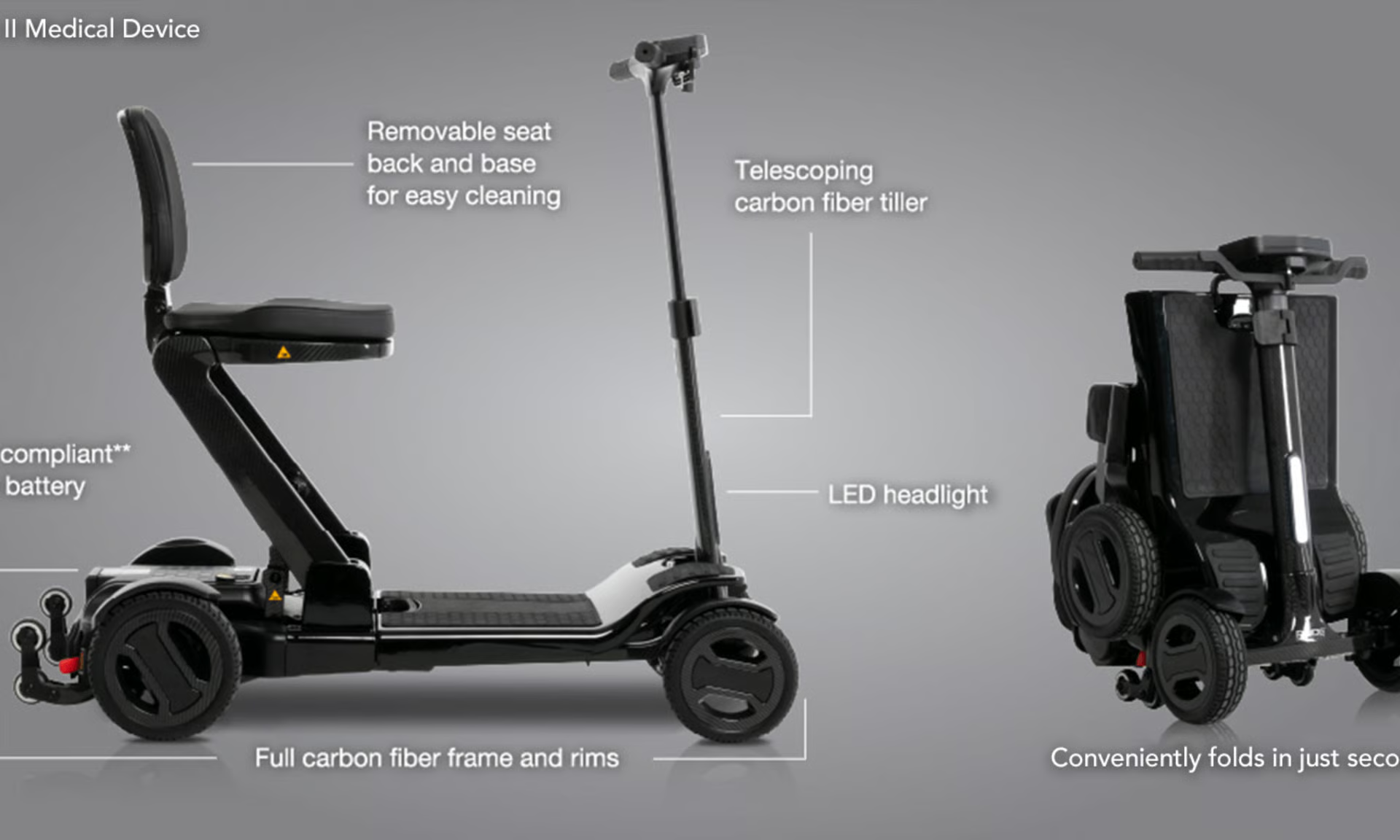
1000Mobility has established itself as a forward-thinking carbon fiber wheelchair manufacturer with a strong focus on integrated product development and OEM/ODM customization. The company’s flagship carbon fiber product line is anchored by the ALYA Air Ultra, an electric wheelchair featuring a full carbon fiber frame that exemplifies the intersection of lightweight engineering and functional design.
Key Product: ALYA Air Ultra
- Cuadro de fibra de carbono: The ALYA Air Ultra utilizes a rigid carbon fiber composite frame that achieves significant weight reduction—up to 40% lighter than comparable aluminum-frame power chairs—while maintaining exceptional structural rigidity.
- Ultra-Lightweight Design: The carbon fiber construction brings the total weight to a class-leading figure, making it effortless to lift into vehicles, carry up stairs, and transport for travel.
- Foldable Architecture: The chair folds in seconds without removing the battery, compacting to dimensions suitable for car trunks, overhead storage, and tight living spaces.
- OEM/ODM Customization: 1000Mobility offers comprehensive OEM and ODM services, allowing partners to specify frame colors, controller configurations, seating materials, battery options, and branded packaging. This flexibility makes them an ideal partner for distributors seeking to launch proprietary product lines without investing in ground-up R&D.
- Travel-Ready: Airline-compliant lithium batteries and a compact folded footprint make the ALYA Air Ultra a true travel companion.
1000Mobility’s vertically integrated approach—combining carbon fiber layup expertise, electronic system integration, and customizable manufacturing—positions it as a versatile partner for B2B clients ranging from regional distributors to global healthcare brands.
2. Motion Composites (Canada)
Based in Quebec, Canada, Motion Composites is a pioneer in carbon fiber manual wheelchair technology. Their HELIO C2 is one of the lightest folding wheelchairs in its category, featuring T700 high-tensile strength carbon fiber renowned for its vibration damping properties. The HELIO C2 employs a Rigid Unibody Frame and a Symmetrical Molded Crossbrace 3D for reduced torsion and better energy distribution. Transport weight starts at just 9.5 lb (4.3 kg). Their VELOCE model, a Red Dot 2019 Design Award winner, offers unrivaled agility for active lifestyles. Motion Composites focuses exclusively on manual wheelchairs and is a benchmark for carbon fiber folding frame engineering.
3. RICHALL Medical (China)
Zhejiang RICHALL Medical Technology operates a 28,000-square-meter facility with a dedicated R&D building and over two decades of engineering experience. The company holds ISO 9001, ISO 13485, CE (MDR), UKCA, and FDA certifications. Their vertically integrated process covers everything from tube cutting and welding to frame assembly and testing. RICHALL offers extensive OEM/ODM services, allowing international partners to customize frame color, wheel design, controller programming, and packaging. Their flagship carbon fiber power wheelchair models achieve net weights as low as 16.2 kg without batteries. RICHALL has a well-established presence in Europe, the USA, the UK, and Japan.
4. Sunrise Medical
Sunrise Medical, a global rehabilitation equipment leader, offers the QUICKIE Q50 R Carbon—one of the world’s lightest carbon folding power wheelchairs at just 14.5 kg (32 lbs) without batteries. The Q50 R Carbon features 250W high-efficiency brushless motors, a 24 km range with an optional second battery, and airline-approved lithium-ion batteries. The carbon frame naturally flexes over uneven surfaces, providing built-in shock absorption. The recently launched Q50 R Carbon Comfort adds enhanced cushioning and an attendant control option. Sunrise Medical’s global distribution network and decades of clinical expertise make them a trusted name in the rehabilitation sector.
5. Pride Mobility
Pride Mobility’s Jazzy® Carbon is a flagship folding power wheelchair built with ultralight carbon fiber technology. Weighing just 39 lbs without the battery, it supports a user weight capacity of 300 lbs and reaches top speeds of 3.7 mph. The Jazzy Carbon features front-end suspension, airline-compliant lithium batteries, and a one-hand fold mechanism. Pride also offers the Jazzy Carbon HD with a 181 kg (400 lb) weight capacity—among the highest in the foldable carbon fiber category—and full front and rear suspension. As an FDA Class II Medical Device, the Jazzy Carbon line meets rigorous safety standards.
6. RGK Wheelchairs (UK)
RGK Wheelchairs, based in Staffordshire, UK, represents the pinnacle of bespoke carbon fiber wheelchair craftsmanship. Their Veypr Sub4 is the world’s first truly made-to-measure carbon fiber wheelchair, featuring a 100% carbon fiber frame with four layers of handcrafted carbon fiber—including three structural layers offset by 45 degrees for omnidirectional strength, finished with a hand-laid herringbone weave pattern. Transport weight starts from an extraordinary 3.3 kg. RGK takes over 30 individual measurements precise to the millimeter for each chair. Their Sprint X racing wheelchair, developed with Loughborough University, cuts aerodynamic drag by 3%, and the Elite CX basketball wheelchair features carbon fiber seating technology for maximum energy transfer. RGK is now part of the Sunrise Medical group.
7. Karman Healthcare
Karman Healthcare, a US-based manufacturer, brings carbon fiber and advanced lightweight materials to a broader consumer audience. While not positioned as ultra-premium performance chairs, their products balance affordability with meaningful weight reduction. Karman’s product philosophy centers on accessibility—offering ergonomic seating systems (including the patented S-ERGO S-Shape Seating), foldable designs, and competitive pricing. Their diverse catalog spans over 100 wheelchair models, including ultra-lightweight options that make advanced materials accessible to cost-sensitive markets.
8. Baichen Medical (China)
Ningbo Baichen Medical Devices Co., Ltd., founded in 1998, specializes in electric wheelchair research, development, production, and sales. Their BC-EC8003 series features full carbon fiber construction with aerospace-grade materials, offering a lightweight yet rigid design. The BC-EC8003-X model includes electromagnetic brakes, a smart anti-rollover system, optional LED lighting, and a driving range of 22–27 km. Baichen emphasizes the corrosion resistance, battery efficiency, and aesthetic appeal of carbon fiber construction. Their manufacturing capabilities support OEM customization for international partners.
Material Comparison: Steel vs. Aluminum vs. Carbon Fiber
Choosing the right frame material is ultimately a question of trade-offs. No single material is universally best—the right choice depends on what the user and the procurement organization value most.
| Property | Steel | Aluminum | Carbon Fiber |
|---|---|---|---|
| Peso | Heavy (15–25 kg typical) | Light (10–18 kg typical) | Ultra-light (8–15 kg typical) |
| Strength-to-Weight Ratio | Low | Moderate | Excellent (5× stronger than steel by weight) |
| Durability & Fatigue Life | High—excellent long-term durability | Moderate—fatigue-limited under heavy cyclic use | Excellent—superior fatigue resistance when properly engineered |
| Cost | Lowest | Moderate | Highest (offset by longer lifespan and lower TCO) |
| Corrosion Resistance | Poor—rusts without coating | Good—naturally corrosion-resistant | Excellent—immune to rust and oxidation |
| Vibration Damping / Comfort | Moderate—damps better than aluminum | Low—stiff, transmits vibration to user | High—composite structure absorbs vibration naturally |
| Repairability | Easy—weldable | Moderate—weldable with skill | Difficult—requires specialist composite repair |
Summary: Steel remains the most economical choice for institutional and attendant-propelled chairs. Aluminum offers the best balance of cost, weight, and accessibility for the majority of users. Carbon fiber is the premium choice for users who prioritize maximum portability, long-term durability, vibration damping, and performance—and for B2B buyers evaluating total cost of ownership over a 5–10 year lifespan, the premium is often justified.
How to Choose a Carbon Fiber Wheelchair Manufacturer
Selecting the right carbon fiber wheelchair manufacturer requires evaluating technical capabilities, quality systems, and commercial flexibility. Here are the critical factors to assess:
1. Material Engineering Expertise
Not all carbon fiber is equal. Evaluate whether the manufacturer uses high-tensile grades (such as T700 or T800), employs autoclave curing (versus cheaper oven-only or bladder molding), and conducts FEA during design. Ask for ply schedule documentation and material traceability records.
2. Quality Management & Certifications
Look for ISO 9001 (quality management), ISO 13485 (medical device manufacturing), and relevant market certifications: CE/MDR for Europe, UKCA for the UK, and FDA registration for the United States. These certifications demonstrate a commitment to meeting the highest global standards for safety and quality.
3. In-House Manufacturing Capabilities
Vertically integrated manufacturers—those who control layup, curing, machining, assembly, and testing in-house—offer better quality control, faster iteration cycles, and more competitive pricing than those who outsource critical processes.
4. Testing & Validation
Ask whether the manufacturer performs ultrasonic NDT on every frame, fatigue cycle testing to ISO 7176 standards, and load testing beyond minimum requirements. Request test reports and batch records.
5. Customization & OEM/ODM Support
For B2B partners, the ability to customize frame geometry, colors, controller configurations, seating systems, and packaging is essential. Evaluate the manufacturer’s minimum order quantities (MOQs), lead times for custom configurations, and willingness to support co-branded or white-label products.
6. Global Distribution & After-Sales Support
Consider the manufacturer’s existing market presence, warranty terms, spare parts availability, and technical support infrastructure. A manufacturer with established distribution in your target markets can provide faster service and localized support.
7. Cost & Total Cost of Ownership
While carbon fiber wheelchairs command a premium over aluminum or steel models, evaluate the total cost of ownership over a 5–10 year period. Carbon fiber’s superior fatigue resistance, corrosion immunity, and lower maintenance requirements often result in a lower TCO despite the higher initial investment.
OEM/ODM Considerations for Carbon Fiber Wheelchairs
For brands and distributors seeking to launch their own carbon fiber wheelchair product lines, OEM (Original Equipment Manufacturer) and ODM (Original Design Manufacturer) partnerships offer a strategic path to market without the capital investment required for in-house composite manufacturing.
OEM vs. ODM: Understanding the Difference
- OEM: The manufacturer produces wheelchairs to your exact specifications—your design, your brand, your quality standards. You provide detailed engineering requirements; the manufacturer executes production.
- ODM: The manufacturer offers existing product designs that can be customized with your branding, color schemes, and selected feature modifications. This is faster to market and requires less engineering investment.
Key Considerations for OEM/ODM Partnerships
Intellectual Property: Clearly define ownership of tooling, molds, and design modifications. In OEM arrangements, ensure that custom molds and designs remain your property. In ODM arrangements, understand which design elements are proprietary to the manufacturer.
Quality Consistency: Carbon fiber manufacturing is highly process-dependent. Insist on documented quality control procedures, batch traceability, and consistent autoclave curing parameters. Request periodic audit reports and on-site inspection rights.
Customization Scope: Determine the extent of customization available—frame geometry, carbon fiber layup patterns, surface finishes, component selection (motors, controllers, batteries, seating), and packaging design. Manufacturers like 1000Mobility and RICHALL Medical offer extensive customization across these dimensions.
Regulatory Compliance: Ensure the manufacturer can support certification requirements for your target markets. This includes providing technical files, risk assessments, clinical evaluation data, and post-market surveillance support required for MDR, FDA, and UKCA compliance.
Lead Times & Scalability: Carbon fiber manufacturing has inherent lead time constraints due to layup and curing cycles. Understand the manufacturer’s production capacity, typical lead times for standard vs. custom configurations, and ability to scale during demand peaks.
Communication & Project Management: Effective OEM/ODM partnerships require clear communication channels, dedicated project managers, and transparent milestone tracking. Evaluate the manufacturer’s English-language communication capabilities, response times, and willingness to participate in regular video conferences.
Frequently Asked Questions
1. How much lighter is a carbon fiber wheelchair compared to aluminum?
Carbon fiber wheelchairs typically weigh 30–40% less than comparable aluminum models. For electric wheelchairs, this can mean the difference between a 20 kg aluminum-frame chair and a 13–15 kg carbon fiber-frame chair—a reduction that significantly impacts portability, transport, and caregiver burden.
2. Is carbon fiber safe for daily wheelchair use?
Yes. Carbon fiber composites are used in aerospace, motorsport, and medical applications precisely because of their exceptional strength and fatigue resistance. When manufactured to ISO 7176 standards with autoclave curing and proper NDT, carbon fiber wheelchair frames are extremely safe for daily use, with service lives often exceeding 7–10 years.
3. What certifications should I look for in a carbon fiber wheelchair manufacturer?
At minimum, look for ISO 9001 (quality management) and ISO 13485 (medical device manufacturing). For specific markets: CE/MDR for Europe, UKCA for the UK, and FDA registration for the United States. These certifications ensure the manufacturer meets internationally recognized standards for safety, quality, and regulatory compliance.
4. Can carbon fiber wheelchair frames be repaired if damaged?
Carbon fiber repair is possible but requires specialist composite repair expertise—typically available through the manufacturer or authorized service centers. Minor surface damage can often be repaired, but structural damage to load-bearing areas may require frame replacement. This is why choosing a manufacturer with robust warranty terms and after-sales support is critical.
5. What is the typical lead time for OEM/ODM carbon fiber wheelchair orders?
Lead times vary by manufacturer and customization level. Standard ODM configurations typically ship in 30–45 days. Custom OEM projects involving new mold development and layup design can take 3–6 months from initial specification to first production batch. Discuss lead times and production scheduling during the partnership evaluation phase.
6. Are carbon fiber electric wheelchairs airline-approved?
Many carbon fiber electric wheelchairs are designed for air travel, featuring airline-compliant lithium-ion batteries (typically under 300Wh per IATA regulations). Models like the Sunrise Medical Q50 R Carbon and Pride Mobility Jazzy Carbon explicitly meet FAA requirements. However, always confirm with your specific airline before traveling, as policies vary by carrier.
7. How does the cost of a carbon fiber wheelchair compare over its lifetime?
While carbon fiber wheelchairs have a higher initial purchase price—typically 2–3× that of aluminum equivalents—their superior fatigue resistance, corrosion immunity, and lower maintenance requirements often result in a lower total cost of ownership over a 5–10 year period. For B2B buyers evaluating procurement across fleets or distribution networks, this TCO advantage can be substantial.
Conclusión
Carbon fiber has fundamentally transformed the wheelchair industry, offering a material that resolves the historic trade-off between weight, strength, and durability. For B2B buyers, distributors, and OEM/ODM partners, the decision to invest in carbon fiber wheelchair products is not merely about adopting a lighter material—it is about partnering with manufacturers who understand the science, engineering, and quality discipline that carbon fiber composites demand.
The manufacturers profiled in this guide represent the global spectrum of carbon fiber wheelchair expertise: from RGK’s bespoke craftsmanship and Motion Composites’ engineering precision, to the scalable OEM/ODM capabilities of 1000Mobility and RICHALL Medical, and the global brand strength of Sunrise Medical and Pride Mobility. Each brings distinct strengths to the market.
For organizations seeking a manufacturing partner that combines carbon fiber engineering capability, product customization flexibility, and a commitment to global quality standards, 1000Mobility offers a compelling proposition. The ALYA Air Ultra demonstrates that carbon fiber technology can be successfully integrated into production-ready electric wheelchairs that meet the real-world needs of users and the commercial requirements of distribution partners.
As the mobility industry continues its trajectory toward lighter, smarter, and more sustainable products, carbon fiber will remain at the forefront of material innovation. The question for B2B decision-makers is not whether to embrace carbon fiber, but which manufacturing partner will best help them capitalize on this transformation.
Authored by the 1000Mobility Editorial Team. For OEM/ODM inquiries and partnership opportunities, visit 1000mobility.com.
Interested in Wholesale Pricing?
Get OEM/ODM details, product specifications, and wholesale pricing within 24 hours.
Or send us a message directly:
 English
  Deutsch
  Français
  Español
  Italiano
  العربية
  Русский