Mobility Scooter vs Electric Wheelchair: A B2B Distributor’s Guide to Market Positioning
Quick Answer: Mobility scooters and electric wheelchairs serve fundamentally different user groups and command distinct B2B market segments. Scooters target outdoor-oriented users with adequate upper-body strength, while power wheelchairs serve users needing full-time postural support and indoor maneuverability. Distributors carrying both categories capture wider market coverage and higher revenue per account.
Last updated: September 2026
For B2B distributors in the mobility equipment industry, understanding the distinction between mobility scooters and electric wheelchairs is not just a product knowledge exercise—it is a strategic positioning decision that determines which market segments you serve, which clients you attract, and ultimately, your profit margins. The global wheelchairs and mobility scooters market was valued at USD 18.74 billion in 2025 and is projected to reach USD 30.34 billion by 2032, growing at a CAGR of 7.12% (PMarketResearch, 2026). Within this market, electric wheelchairs accounted for USD 7.0 billion (37.4% share) while mobility scooters represented USD 3.78 billion (20.2% share), signaling distinct demand drivers for each category.
This guide provides B2B distributors with a comprehensive comparison framework—covering use cases, technical specifications, target customer profiles, profit margins, and inventory strategies—to help you make informed decisions about which product categories to stock and how to position them in your market.
Use Case Comparison: Where Each Device Excels
The fundamental difference between mobility scooters and electric wheelchairs lies in their intended use environments and the physical capabilities required from users. These differences directly impact which B2B channels and end-user segments each product serves best.
Indoor Use
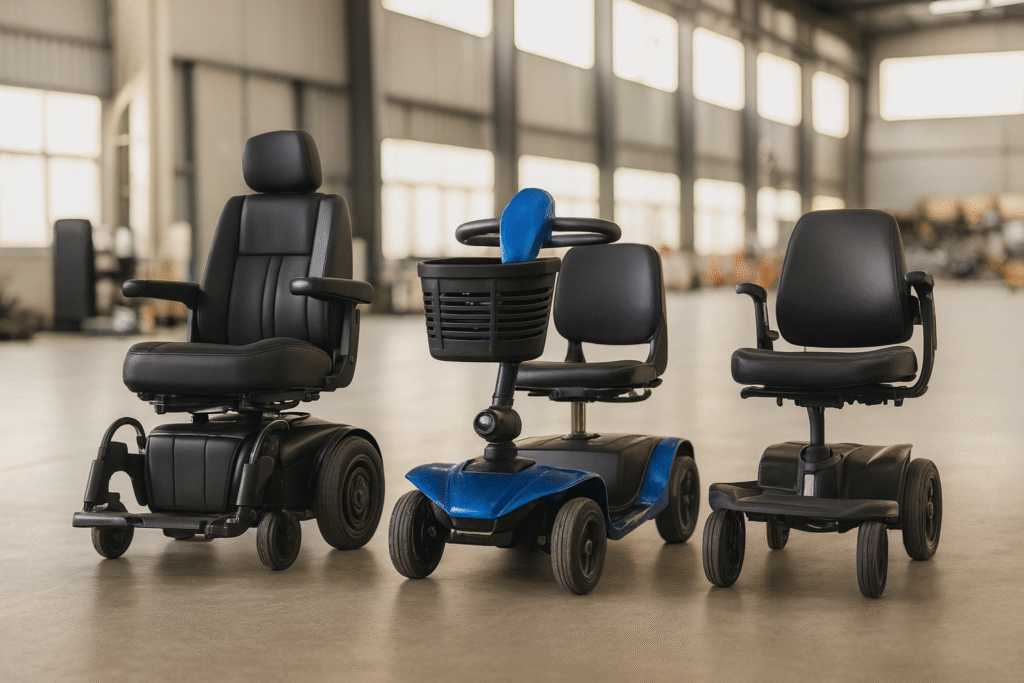
Electric wheelchairs dominate indoor environments. Their compact footprint, mid-wheel drive configurations, and tight turning radius—often as low as 20 inches—allow navigation through doorways, narrow hallways, and around furniture. Most power wheelchairs offer 360-degree rotation in place, making them ideal for home use, care facilities, and clinical settings where space is constrained.
Mobility scooters, by contrast, require significantly more room to maneuver. Their longer wheelbase and handlebar-style steering create a larger turning radius, making them impractical for tight indoor spaces. A distributor supplying scooters to a chain of grocery stores, for instance, found that the scooters could not navigate narrow aisle ends without difficult multi-point turns—an issue that ultimately limited the project’s success (AGL-Trike, 2025).
Outdoor Use
Mobility scooters are purpose-built for outdoor environments. With larger pneumatic tires, higher ground clearance, and more powerful motors, they handle uneven terrain, grass, gravel paths, and slopes with ease. Their longer battery range—typically 8 to 30+ miles per charge for heavy-duty models—makes them suitable for neighborhood travel, park visits, and outdoor shopping centers.
Electric wheelchairs can handle gentle outdoor slopes and smooth surfaces but are generally limited to shorter outdoor trips. Their smaller wheels and lower ground clearance make them less suitable for rough terrain, though some models feature anti-slip drive systems for moderate outdoor use.
Travel and Transport
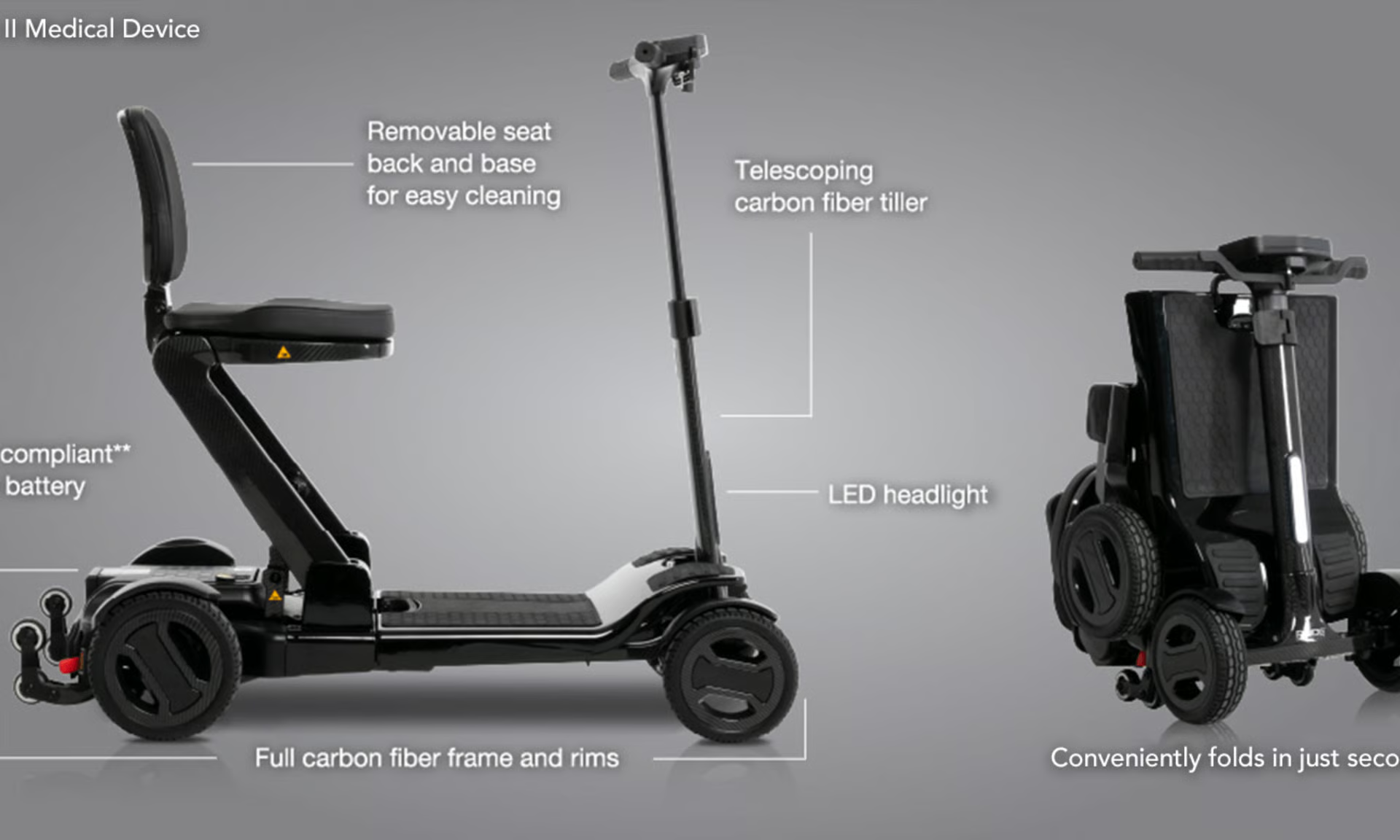
For travel applications, mobility scooters offer a mixed picture. While some compact models can be disassembled into manageable components fitting into car trunks, the individual pieces remain heavy and bulky—often requiring a vehicle lift. Foldable electric wheelchairs, on the other hand, have evolved significantly, with some models folding to dimensions as compact as 63×37×75 cm and weighing under 30 kg, making them more practical for airline travel and public transport.
Medical and Clinical Settings
Electric wheelchairs are classified as medical devices in most jurisdictions, requiring prescriptions and clinical documentation. They provide postural support, pressure relief features, and can accommodate specialized seating systems for users with severe mobility impairments. Mobility scooters are generally classified as personal mobility vehicles rather than medical devices, with fewer regulatory requirements for prescription and dispensing.
Technical Parameters: Head-to-Head Comparison
For B2B distributors, technical specifications directly influence which market segments you can serve and at what price points. The following comparison table highlights the key differentiators:
| Parameter | Scooter de mobilité | Fauteuil roulant électrique |
|---|---|---|
| Vitesse maximale | 4–8 mph (6.4–12.9 km/h) | 3–5 mph (4.8–8 km/h) |
| Autonomie par charge | 8–30+ miles (13–48+ km) | 7–25 miles (11–40 km) |
| Capacité de charge | 250–500+ lbs (113–227+ kg) | 250–450 lbs (113–204 kg) |
| Folding Capability | Disassembly required | Foldable or rigid frame |
| Rayon de braquage | 50–80 inches (127–203 cm) | 20–35 inches (51–89 cm) |
| Control Method | Handlebar/tiller steering | Joystick control |
| Typical Weight (unit) | 80–200+ lbs (36–91+ kg) | 50–150 lbs (23–68 kg) |
| Type de batterie | Lead-acid or Lithium-ion | Primarily Lithium-ion |
| Seat Design | Basic, swivel seat | Ergonomic, posture-supportive |
| Regulatory Class | Personal mobility vehicle | Medical device (Class II in US) |
Distributors should note that lithium-ion battery adoption is accelerating across both categories. Battery costs are declining at 10–12% annually, reducing total cost of ownership by 25–35% over five years and driving market share increases from 54.3% to a projected 72.5% by 2034 (DataIntelo, 2026).
Target Customer Profile Differences
Understanding who buys each product type helps distributors segment their sales channels and marketing investments effectively.
Mobility Scooter Customers
- Retail pharmacies and DME stores serving elderly customers who can walk short distances but fatigue easily
- Resort and tourism operators needing fleet mobility for guests with limited stamina
- Large facility managers (airports, theme parks, shopping malls) requiring fleet mobility solutions
- Home healthcare providers supplying clients who primarily need outdoor neighborhood mobility
- Government and municipal buyers procuring for community accessibility programs
Electric Wheelchair Customers
- Rehabilitation centers and hospitals requiring clinical-grade mobility devices for patients with severe mobility impairments
- Nursing homes and long-term care facilities needing devices for full-time resident mobility
- Specialized DME dealers serving clients with prescriptions from healthcare providers
- Home healthcare agencies providing equipment for homebound patients
- VA hospitals and government health programs procuring for veterans and eligible beneficiaries
The electric wheelchair market is projected to grow from USD 2.74 billion in 2025 to USD 6.56 billion by 2034 at a CAGR of 10.18%, significantly faster than the overall mobility devices market, driven by aging populations and increasing prevalence of mobility disorders (Fortune Business Insights, 2026). North America dominates this segment with a 50.22% market share.
Profit Margins and Inventory Strategy Comparison
Profit economics differ substantially between the two categories, influencing inventory decisions for B2B distributors.
Mobility Scooter Economics
Mobility scooters typically offer lower per-unit margins but higher volume turnover. Entry-level models sourced from Chinese manufacturers range from USD 200–500 per unit at wholesale, with retail pricing of USD 600–1,500, providing gross margins of 30–45%. Heavy-duty and premium scooters command higher absolute margins. Inventory turnover tends to be faster due to broader consumer appeal and less complex sales cycles.
Electric Wheelchair Economics
Electric wheelchairs require larger upfront inventory investment but deliver significantly higher per-unit margins. Standard powered wheelchairs sourced at USD 400–800 wholesale can retail for USD 1,500–4,000, yielding gross margins of 40–60%. Complex Rehab Technology (CRT) power wheelchairs, which are projected to account for 50.64% of the market in 2026, command even higher margins—often USD 5,000–15,000+ at retail (Fortune Business Insights, 2026). However, sales cycles are longer due to prescription requirements, insurance approvals, and clinical assessments.
| Metric | Scooter de mobilité | Fauteuil roulant électrique |
|---|---|---|
| Typical Wholesale Cost | USD 200–500 | USD 400–800 (standard), USD 1,000+ (CRT) |
| Retail Price Range | USD 600–1,500 | USD 1,500–15,000+ |
| Gross Margin | 30–45% | 40–60% |
| Sales Cycle Length | 1–4 weeks | 4–12 weeks (insurance-dependent) |
| Inventory Turnover | Higher (faster) | Lower (slower, higher value) |
| After-Sales Service Revenue | Moderate | High (maintenance, parts, seating) |
Dual-Category Distribution Strategy
For distributors evaluating whether to carry one or both product categories, the data strongly supports a dual-category approach. The key advantages include:
- Market coverage: Scooters capture the consumer-oriented, outdoor mobility segment while power wheelchairs address the clinical, medical-grade segment. Together, they cover the full spectrum of mobility needs.
- Cross-selling opportunities: Facilities such as nursing homes often need both—scooters for ambulatory residents and power wheelchairs for those with severe mobility limitations. Offering both categories strengthens account relationships.
- Revenue diversification: Scooters provide steady cash flow through faster turnover, while power wheelchairs deliver higher-margin transactions that offset slower inventory cycles.
- Competitive differentiation: Distributors offering comprehensive mobility solutions are better positioned to win institutional contracts and government tenders that require multi-category supply capabilities.
If you are considering sourcing electric wheelchairs for your distribution portfolio, explore our electric wheelchair manufacturing capabilities for competitive OEM pricing. For scooter distribution, our 4-wheel mobility scooter wholesale program offers volume pricing designed for B2B buyers.
Choosing the Right Product Mix for Your Market
Your optimal product mix depends on your primary sales channels and target regions. For distributors focused on the North American market—where electric wheelchair demand is strongest—allocating 60–70% of inventory budget to power wheelchairs and 30–40% to scooters may be appropriate. In European markets, where both categories have strong institutional demand, a more balanced 50/50 split often works well.
For comprehensive guidance on evaluating suppliers and products, refer to our electric wheelchair buying guide et mobility scooter buying guide, which cover certification requirements, quality benchmarks, and negotiation strategies specific to each product category.
FAQ
Which is more profitable for distributors: mobility scooters or electric wheelchairs?
Electric wheelchairs generally offer higher per-unit profit margins (40–60% vs. 30–45% for scooters) due to their medical device classification, higher retail prices, and more complex sales process. However, mobility scooters provide faster inventory turnover and simpler sales cycles, making them valuable for consistent cash flow.
Can a distributor successfully sell both categories?
Yes. Many successful B2B distributors carry both categories to serve diverse customer segments. Scooters address outdoor mobility and consumer markets, while power wheelchairs serve clinical and institutional buyers. A dual-category approach maximizes market coverage and cross-selling opportunities.
What certifications should I look for when sourcing these products?
For both categories, look for CE marking (Europe), FDA 510(k) clearance (US market for electric wheelchairs classified as medical devices), ISO 13485 (quality management for medical devices), and RoHS compliance. Mobility scooters may have fewer medical device regulatory requirements but still need safety certifications.
How does the aging population affect demand for each category?
The aging population drives demand for both categories but in different ways. Users who can walk short distances but tire easily are prime scooter candidates. Those with severe mobility limitations requiring full-time support need electric wheelchairs. The electric wheelchair market is growing at 10.18% CAGR, faster than the overall mobility market’s 7.12%.
What is the typical lead time for bulk orders from Chinese manufacturers?
Lead times vary by product complexity and order volume. Standard mobility scooters typically ship within 15–30 days during off-peak periods and up to 45 days during peak season. Electric wheelchairs may require 30–60 days due to more complex assembly and quality testing requirements. OEM/ODM customization adds 2–4 weeks for design finalization.
Conclusion
For B2B distributors, the choice between mobility scooters and electric wheelchairs is not an either/or decision—it is a strategic portfolio question. Scooters deliver volume-driven revenue with faster turnover, while electric wheelchairs provide higher margins and tap into the rapidly growing medical mobility market. The most successful distributors carry both, segmenting their sales channels and marketing to match each product’s natural customer base.
As the global mobility devices market accelerates toward USD 30 billion by 2032, distributors who understand the technical, clinical, and economic differences between these two categories will be best positioned to capture market share. Partner with 1000Mobility to access both product lines with competitive OEM pricing, comprehensive certification support, and dedicated B2B account management. Contact our distributor team to discuss your market positioning strategy.
By 1000Mobility Editorial Team
Interested in Wholesale Pricing?
Get OEM/ODM details, product specifications, and wholesale pricing within 24 hours.
Or send us a message directly:
 English
  Deutsch
  Français
  Español
  Italiano
  العربية
  Русский