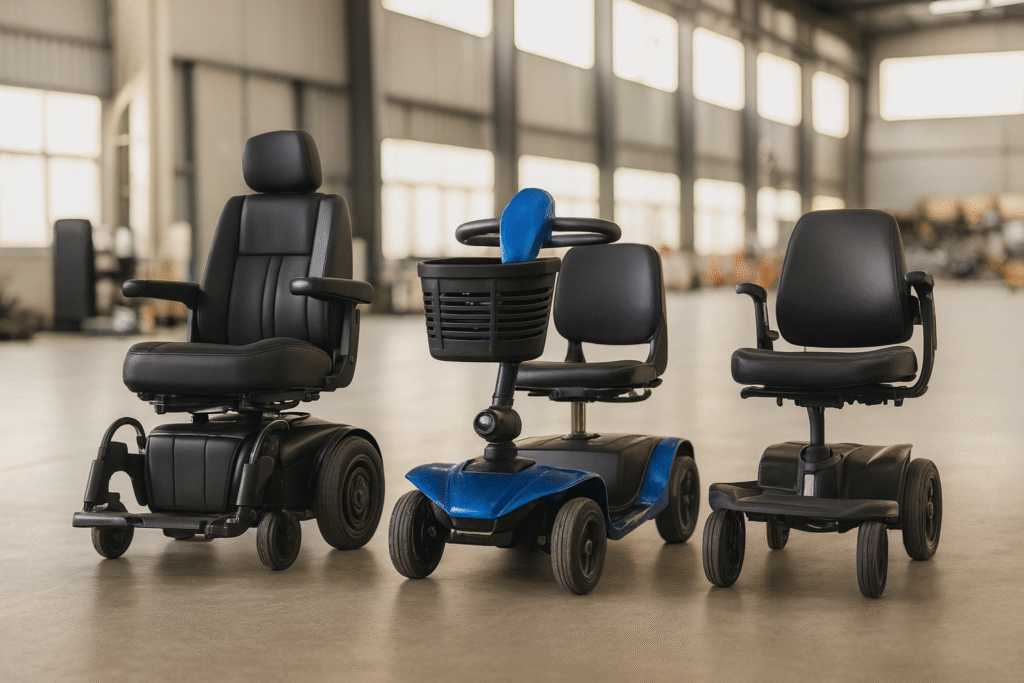
Russia & CIS Mobility Equipment Market 2026: Sourcing Guide for Wheelchair Importers
Quick Answer: Russia’s electric wheelchair market reached USD 1.6 billion in 2025 with a 9.8% CAGR, driven by conflict-related injuries and aging demographics. Importers need EAC certification, ruble currency risk management, and a choice between Baltic sea freight and China-Europe rail routes for logistics.
Last updated: September 2026
Russia & CIS Mobility Equipment Market Size and Growth
The Russia and CIS (Commonwealth of Independent States) region represents one of Europe’s fastest-growing mobility equipment markets. According to industry research, the Russian electric wheelchair market alone reached USD 1.6 billion in 2025 and is projected to grow at over 9.8% CAGR through 2030, potentially exceeding USD 2.5 billion.
The Russia smart wheelchair market, a subset of the broader mobility equipment sector, was valued at USD 56.28 million in 2025 and is forecasted to reach USD 103.44 million by 2034, growing at a CAGR of 7.06%, according to Deep Market Insights.
Key Market Drivers
- Geopolitical impact: The Russia-Ukraine conflict has created a surge in demand for rehabilitation equipment, with casualty-related mobility needs driving significant supply shortages
- Aging population: Russia’s population aged 55+ reached 30% in 2024 (up from 27.3% in 2015), driving steady demand growth for mobility aids
- Hospital reconstruction: Multiple regions are rebuilding healthcare facilities, creating bulk procurement opportunities for wheelchair and scooter suppliers
- Limited domestic production: Only a few companies like Caterwil have规模化 production capacity, making imports essential
CIS Country-Level Market Overview
Beyond Russia, the five Central Asian CIS countries represent emerging markets with growing demand:
| Country | Import Profile | Key Opportunities |
|---|---|---|
| Kazakhstan | Largest CIS importer after Russia (10.1% of EAEU orthopedic imports, ~USD 95.2M) | Government healthcare modernization programs |
| Uzbekistan | 43 electric wheelchair import shipments (top 5 globally) | Large population, growing middle class |
| Belarus | 5.4% of EAEU orthopedic imports (~USD 50.9M) | Manufacturing hub potential, Customs Union member |
| Kyrgyzstan | 0.4% of EAEU orthopedic imports | Emerging market, EAEU member |
| Armenia | 1.97% of EAEU orthopedic imports | Small but growing healthcare sector |
According to the Eurasian Intergovernmental Council, Russia accounted for 86.9% of EAEU medical device imports, Kazakhstan 9.4%, and Belarus 5.7% in 2021 — a ratio that has remained relatively stable.
EAC Certification: The Gateway to the Eurasian Market
The Eurasian Economic Union (EAEU) — comprising Russia, Kazakhstan, Belarus, Armenia, and Kyrgyzstan — requires EAC certification for all medical devices, including wheelchairs and mobility scooters. This unified registration system allows products certified in one member state to be sold across all five countries.
Risk Classification System
Under EAEU Commission Decision No. 173, medical devices are classified into four risk categories:
| Class | Risk Level | Examples | Registration Complexity |
|---|---|---|---|
| Class 1 | Low | Manual wheelchairs, basic mobility aids | Simplified pathway |
| Class 2a | Medium | Standard electric wheelchairs | Standard review |
| Class 2b | Increased | Advanced power wheelchairs with smart features | Extended review |
| Class 3 | High | Implantable devices, complex rehab systems | Full clinical evaluation |
EAC Registration Process
The registration process involves two phases:
Phase A — Preparation:
- Classify the medical device according to risk categories
- Prepare technical documentation (drawings, IFU, technical brief)
- Conduct testing (toxicological, biological, technical, electromagnetic compatibility)
- Select a reference state (main reviewing authority) and recognition states
Phase B — Review and Registration:
- Submit application with all required documents to the reference state authority
- Pay state registration fees
- Undergo expert review (up to 60 working days for safety, quality, and efficacy assessment)
- Production inspection may be conducted (up to 90 additional working days)
- Recognition states review and confirm the assessment
- Registration certificate issued in the unified EAEU register
- EAC marking applied to product and packaging
The entire process can take 6-10 months depending on risk class and documentation completeness. For electric wheelchair manufacturers in China targeting the Russian market, preparing EAC-compliant documentation early is critical.
Ruble Settlement and Currency Risk Management
Trading with Russian buyers presents unique currency challenges. The ruble has experienced significant volatility, creating pricing risk for both suppliers and importers. Effective currency risk management strategies include:
Practical Currency Management Approaches
- Forward contracts: Lock in exchange rates for future payments, typically available through Russian and international banks for 3-6 month terms
- Multi-currency invoicing: Offer quotes in USD, EUR, and RUB to give buyers flexibility in payment timing
- Partial prepayments: Structure deals with 30-50% advance payment to reduce exposure on large orders
- Currency clauses: Include price adjustment mechanisms in contracts that trigger when exchange rates move beyond agreed thresholds
- CNY settlement: Growing acceptance of Chinese yuan (RMB) settlements under the Cross-Border Interbank Payment System (CIPS) reduces USD dependency
Understanding why experienced suppliers matter becomes critical when navigating these payment complexities. Manufacturers with prior Russia export experience can guide distributors through acceptable payment terms and banking channels.
Logistics: Baltic Sea Freight vs. China-Europe Railway
Importers sourcing mobility equipment from China must choose between two primary logistics routes to Russia:
Route Comparison
| Factor | Baltic Sea Freight | China-Europe Railway Express |
|---|---|---|
| Transit time | 40-50 days (port to port) | 15-20 days (door to door) |
| Cost per container | USD 2,500-4,000 | USD 5,000-8,000 |
| Entry port | St. Petersburg / Baltic ports | Multiple rail terminals (Moscow, etc.) |
| Best for | Bulk orders, cost-sensitive shipments | Time-sensitive, high-value equipment |
| Risk factors | Port congestion, weather delays | Capacity constraints, gauge changes |
| Insurance | Standard marine cargo | Rail cargo insurance required |
Strategic Recommendations
- For high-volume orders: Use sea freight via Baltic ports for standard manual wheelchairs and accessories, reserving rail for urgent or high-value shipments
- For new product launches: Air freight initial samples, then rail for first production batches to reduce time-to-market
- For mixed orders: Consider consolidated rail shipments that combine multiple product types to optimize container utilization
- For CIS distribution: Use Russia as a transshipment hub, with subsequent road transport to Kazakhstan, Belarus, and other CIS markets
Russian B2B Platforms and Sourcing Channels
The Russian mobility equipment market has shifted significantly toward B2B e-commerce platforms and direct supplier relationships. Key sourcing channels include:
Major B2B Platforms
| Platform | Type | Relevance for Wheelchair Importers |
|---|---|---|
| Volza.com | Import-export intelligence | Identify verified buyers (29 electric wheelchair buyers in Russia) and suppliers |
| Medica-expo.ru | Medical equipment trade show | Annual exhibition for connecting with Russian distributors |
| B2B-Center.ru | Government procurement portal | Tender opportunities for hospital fleet purchases |
| ETP GPB (EETP) | Electronic trading platform | State and municipal medical equipment tenders |
| Allegro.ru / Ozon B2B | E-commerce B2B channels | Growing online distribution for smaller orders |
Key Russian Wheelchair Importers
According to Volza import trade data, the top electric wheelchair buyers in Russia include:
- OOO GBS Broker — 58% of Russia’s total electric wheelchair imports (26 shipments)
- OOO MEDGRAD — 11% share (5 shipments), imports from 5 countries
- OOO MEYRA RU — 11% share (5 shipments), German brand distributor
- LLC REAMED — 26 import shipments, sourcing from 2 countries
- LLC VED LOGISTIC DV — 10 shipments, Far East logistics specialist
China dominates wheelchair exports to Russia, accounting for 82% of personal wheelchair export shipments (4,556 shipments), followed by Germany (293 shipments) and Thailand (144 shipments), according to Volza data.
Quality and Compliance: What Russian Buyers Expect
Russian distributors and healthcare institutions have specific quality expectations that differ from Western markets:
- GOST-R compliance: While EAC certification is now the primary requirement, some Russian buyers still request GOST-R certificates for specific product attributes
- Russian-language documentation: Complete IFU, technical manuals, and labeling in Russian are mandatory under EAC rules
- Cold-climate performance: Products must withstand temperatures from -30°C to +40°C, particularly affecting battery performance for electric wheelchairs
- After-sales support: Russian buyers expect 2-year warranties minimum, with spare parts availability commitments
- SPOT code matching: Products must have correct HS/SPOT classification codes for customs declaration
Working with a manufacturer that maintains comprehensive quality certifications including ISO 13485, CE MDR, and FDA registration provides a strong foundation for EAC certification applications.
Seasonal Considerations for Russian Market Entry
Russian wheelchair demand follows seasonal patterns that differ from other markets. Winter months (December-February) see increased demand for indoor-use wheelchairs and mobility scooters as outdoor navigation becomes challenging in snowy conditions. Conversely, spring and summer months drive demand for outdoor-capable models with all-terrain wheels and extended battery range.
Distributors should align their product mix with these seasonal patterns. Stocking heavier-duty models with larger wheels before winter and lighter, portable models before spring ensures product availability matches demand cycles. Additionally, winter shipping requires attention to container insulation — battery-powered wheelchairs shipped during January-February may need cold-weather packaging to prevent lithium-ion battery damage during transit through temperatures that can drop below -30°C in Siberian routes.
Factory production scheduling should account for these seasonal variations. Placing winter-season orders by August ensures production completion before November shipping cutoffs, when Baltic Sea routes begin experiencing ice-related delays. Distributors serving Russia’s Far East should consider Vladivostok port entries for winter shipments, as the Northern Sea Route becomes increasingly viable.
Government Procurement and Tender System in Russia
Russia’s government healthcare procurement operates through a centralized electronic tender system. Federal Law 44-FZ governs state procurement, while Federal Law 223-FZ covers procurement by state-owned enterprises. Understanding these systems is critical for wheelchair importers targeting institutional sales.
Key Procurement Platforms
- EIS (Unified Information System): The primary government procurement portal where all federal and regional tenders are published
- Sberbank-Ast: A major electronic trading platform for medical equipment tenders
- RTS-tender: Another significant platform hosting healthcare equipment procurement opportunities
- ZakazRF: Regional procurement portal for municipal-level medical facility purchases
Tender participation requires registration as a supplier, bank guarantee submission, and compliance with strict documentation requirements. International suppliers typically participate through local distributor partners who handle the registration and bidding process.
After-Sales Service Requirements in the Russian Market
Russian buyers have high expectations for after-sales support, which significantly influences purchasing decisions. Distributors who invest in service infrastructure gain a sustainable competitive advantage:
Service Infrastructure Requirements
- Local repair capability: Russian healthcare regulations may require local repair and maintenance services for medical devices. Distributors should establish partnerships with regional service centers
- Spare parts availability: Minimum 2-year spare parts commitment is expected. Maintaining a spare parts inventory in Russia reduces downtime and builds trust
- Technical documentation in Russian: Complete service manuals, parts lists, and repair guides must be available in Russian for local technicians
- Warranty processing: Clear warranty claim procedures with defined response times (typically 48-72 hours for institutional clients)
- Training programs: Providing product training to distributor technical staff ensures proper assembly, adjustment, and maintenance
For electric wheelchairs specifically, battery replacement services and charging system diagnostics are recurring service needs. Distributors who offer comprehensive battery programs (including recycling of spent lithium-ion batteries in compliance with Russian environmental regulations) differentiate themselves from competitors.
Central Asian Market Deep Dive: Beyond Russia
While Russia dominates the EAEU medical device market, the five Central Asian countries represent emerging opportunities that smart distributors should not overlook.
Kazakhstan: The Gateway Market
As the second-largest EAEU medical device importer (approximately USD 284.4 million in 2021), Kazakhstan offers a well-regulated market with growing healthcare spending. The government’s “Densaulyk” (Health of the Nation) healthcare modernization program has allocated significant funding for medical equipment procurement through 2027.
Key advantages of the Kazakhstan market include EAEU single registration acceptance, growing middle-class healthcare spending, and proximity to both Russian and Chinese supply routes via the Khorgos dry port.
Uzbekistan: High-Growth Opportunity
With 43 electric wheelchair import shipments recorded (ranking 4th globally in import volume), Uzbekistan represents one of the most active emerging markets for mobility equipment. The country’s large population (35 million) and growing healthcare infrastructure investment create substantial demand.
Unlike EAEU members, Uzbekistan maintains its own medical device registration system. However, the government has expressed interest in harmonizing with EAEU standards, which could simplify future market entry.
Belarus: Manufacturing Hub Potential
Belarus maintains a relatively developed domestic medical device manufacturing sector. For wheelchair distributors, Belarus represents both a market and a potential manufacturing base within the EAEU customs union. Products assembled in Belarus can circulate within the EAEU without additional customs duties.
Common EAC Certification Pitfalls and How to Avoid Them
Based on industry experience, several common mistakes delay EAC certification for wheelchair importers:
| Common Pitfall | Impact | Prevention Strategy |
|---|---|---|
| Incorrect risk classification | Wrong documentation package, extended review | Consult EAEU Classification Rules (Decision No. 173) early; engage experienced EAC consultants |
| Missing Russian-language labeling | Customs rejection, registration delay | Prepare bilingual labels during production, not after |
| Incomplete technical file | Expert review rejection, 60+ day delay | Use checklist from reference state authority; include all required annexes |
| No local authorized representative | Cannot submit application | Engage EAEU-based representative before starting certification |
| Clinical data gaps for higher-risk devices | Extended clinical evaluation, 90+ day delay | Prepare clinical evaluation report aligned with EAEU requirements |
Working with a manufacturer who has prior EAC certification experience can reduce the timeline from 10 months to 4-6 months by avoiding these common mistakes. The manufacturer’s quality management system documentation, technical file completeness, and understanding of EAEU-specific requirements are the most critical factors in certification speed.
Building a Russian Distribution Network
Successful wheelchair distribution in Russia requires building relationships with the right partners. The distribution landscape includes several tiers:
Distribution Tiers
- Tier 1 – National distributors: Companies like OOO GBS Broker and OOO MEDGRAD handle large-volume imports with national coverage. They typically require exclusive distribution agreements and minimum annual volume commitments
- Tier 2 – Regional distributors: Focus on specific federal districts (e.g., Siberia, Urals, Far East). Offer regional market knowledge and established hospital relationships
- Tier 3 – Specialized medical equipment dealers: Focus on rehabilitation equipment, often serving both institutional and retail customers
- Tier 4 – Online retailers: Growing segment serving individual consumers and small clinics through platforms like Allegro.ru and Ozon
New entrants should consider starting with Tier 2 or Tier 3 partners who offer regional expertise without demanding exclusive national rights. As market presence grows, relationships can be expanded to national-level distributors.
FAQ
What is EAC certification for medical devices in Russia?
EAC certification is the mandatory conformity assessment for medical devices entering the Eurasian Economic Union (EAEU) market, covering Russia, Kazakhstan, Belarus, Armenia, and Kyrgyzstan. It involves state registration through a reference member state, with risk classification from Class 1 (low) to Class 3 (high). The process can take up to 10 months for higher-risk devices.
How large is the Russian wheelchair market in 2026?
The Russian electric wheelchair market reached USD 1.6 billion in 2025 and is projected to grow at over 9.8% CAGR through 2030, potentially exceeding USD 2.5 billion. The smart wheelchair segment alone was valued at USD 56.28 million in 2025 with a 7.06% CAGR through 2034.
What are the main logistics routes for importing wheelchairs into Russia?
Two primary routes dominate: sea freight via Baltic ports (St. Petersburg) offering lower cost but 40-50 day transit, and the China-Europe Railway Express offering 15-20 day transit at higher cost. The railway route has gained significant traction for time-sensitive medical equipment shipments.
Which countries are the main suppliers of wheelchairs to Russia?
China dominates wheelchair exports to Russia with 82% of personal wheelchair export shipments, followed by Germany, Thailand, and the United States. Top buyers include OOO GBS Broker (58% of imports), OOO MEDGRAD, and OOO MEYRA RU.
What currency risks should wheelchair importers in Russia consider?
Ruble volatility creates significant pricing risk. Importers should use forward contracts, maintain USD/EUR reserves, negotiate flexible payment terms with suppliers, and consider partial prepayments to lock exchange rates on large orders.
Conclusion
The Russia and CIS mobility equipment market offers substantial growth opportunities for wheelchair importers, driven by conflict-related demand, aging demographics, and limited domestic production capacity. Success requires navigating EAC certification, managing ruble currency risks, and selecting the optimal logistics route between Baltic sea freight and China-Europe rail.
1000Mobility offers a complete range of electric wheelchairs manufactured in China with EAC-ready documentation, Russian-language labeling support, and proven export experience to the Eurasian market. Contact us to discuss your Russia and CIS distribution requirements.
By the 1000Mobility Editorial Team
Interested in Wholesale Pricing?
Get OEM/ODM details, product specifications, and wholesale pricing within 24 hours.
Or send us a message directly:
 English
  Deutsch
  Français
  Español
  Italiano
  العربية
  Русский